
Your Parent Is in Pain. You Are Running Out of Answers.
You have watched your parent wince getting out of a chair, heard them say "I'm fine" when they clearly are not, and spent hours reading conflicting medical advice that leaves you more confused than when you started. You have called the doctor's office only to be told the next available appointment is three weeks away. You have argued with a sibling who thinks you are overreacting — or not doing enough.
Meanwhile, the pain is getting worse. Your parent is moving less, sleeping less, and withdrawing from the people and activities that used to give them joy. And every day that passes without a clear plan increases the risk of a fall, a hospitalization, or an emergency that forces decisions nobody is prepared to make.
The Coordinated Care System
This toolkit does what no single website, doctor visit, or family conversation can do on its own: it connects the clinical, legal, and family coordination pieces of chronic pain management into one structured action plan.
Free articles explain what chronic pain is. Your parent's doctor manages prescriptions in a ten-minute visit. An elder law attorney handles the legal documents for $200–$500 an hour. A geriatric care manager runs an assessment for $800–$2,000. None of them talk to each other — and none of them hand you a system for managing everything at home, day after day, between appointments.
That is what the Coordinated Care System does. It gives you the exact assessment tools, medication checklists, communication scripts, and coordination templates that connect every piece — so you stop reacting to crises and start managing your parent's care proactively.
What's Inside the Toolkit
- Pain Assessment Scoring Guides — because "Mom says her back hurts" is not enough for a doctor to act on. The PEG 3-Item Scale captures functional impact in under two minutes. The PAINAD scale lets you score pain in a parent with dementia who cannot speak. The MOBID-2 observational method catches pain during routine morning care. Each tool includes step-by-step instructions with scoring thresholds that tell you exactly when to call the doctor.
- Medication Safety Audit Workbook — because your parent's prescriber may not know about the three supplements, the sleep aid from Costco, and the cream prescribed by a different specialist. Walk through every bottle in the house, screen against the 2023 AGS Beers Criteria for high-risk medications in older adults, and generate a clean medication summary to bring to the next appointment. Catches polypharmacy issues that cause cognitive fog, dizziness, and falls.
- Non-Drug Pain Relief Protocols — because medication is not the only tool and sometimes not the safest one. Detailed application guides for heat therapy (morning stiffness), cold therapy (acute joint swelling), TENS units, gentle movement routines, and positioning techniques. Each protocol includes safety limits specific to aging skin and circulation to prevent burns and tissue damage.
- SBAR Doctor Communication Scripts — because rushed appointments reward whoever walks in prepared. The SBAR framework (Situation, Background, Assessment, Recommendation) turns your observations into the exact format physicians use internally. Fill in the template before the visit, hand it to the doctor, and watch the conversation change from "How are we doing?" to "Let's adjust the plan based on what you've tracked."
- Daily Pain Tracking System — because two weeks of data is worth more than two years of guessing. Morning, midday, and evening check-ins that take under four minutes each. The tracker generates 7-, 14-, and 30-day summaries showing pain patterns, medication timing, sleep quality, and flare triggers — visual evidence that gives your parent's care team something concrete to respond to.
- Sibling Care Coordination Kit — because 45% of caregiving families experience serious conflict, usually because one sibling carries the entire load by default. Includes a task division agreement, a care meeting agenda template, boundary-setting conversation scripts, and an FMLA guide so remote siblings can take job-protected leave to help without risking their income.
- Legal Authority Checklist — because without a Durable Power of Attorney and Healthcare Proxy in place before a cognitive crisis, your family may need a court-supervised guardianship costing $5,000–$12,000. Plain-English explanations of what each document does, when it activates, and the deadline after which it is too late to execute. Includes a HIPAA Release template so you can actually speak to your parent's doctors.
- Emergency Red-Flag Decision Guide — because a sudden change in pain can mean a fracture, a silent heart attack, or a urinary tract infection presenting as confusion instead of classic symptoms. A quick-reference flowchart that separates manageable flare-ups from true emergencies, so you do not second-guess yourself at 2 a.m.
- Long-Term Financial Planning Chapter — because private nursing home care averages over $9,500 per month, and an unplanned care transition can deplete a substantial estate in under five years. Covers Medicare coverage for pain management services (with HCPCS billing codes), Medicaid asset protection strategies including the five-year look-back period, and a family care agreement template designed to survive state Medicaid audits.
Who This Toolkit Is For
You are an adult child or family caregiver helping an aging parent manage chronic pain at home — arthritis, neuropathy, post-surgical pain, or pain they cannot fully describe because of cognitive decline. You may be the only one in the family doing this, or you may be trying to coordinate with siblings who live far away, disagree about the right approach, or have not yet stepped up.
You do not need a medical background. Every tool in this kit uses plain language, step-by-step instructions, and fill-in-the-blank templates. If you can follow a recipe, you can run a PAINAD assessment, screen a medication list, and prepare an SBAR report for your parent's doctor.
Why Free Online Information Is Not Solving This
The National Institute on Aging publishes accurate pain management information. AgingCare has helpful articles. Your parent's doctor answers questions during appointments. None of these are the problem.
The problem is that none of them are connected. The NIH does not give you a medication audit template. AgingCare does not include a sibling task division agreement. Your parent's doctor does not know that a different specialist prescribed a drug that interacts with the one they just wrote. And the elder law attorney who charges $400 an hour to draft a Power of Attorney has no idea whether your parent's pain is being managed safely at home.
This toolkit sits in the center. It connects the clinical tracking to the doctor communication to the legal preparation to the family coordination — because in eldercare, the gaps between these systems are where the real damage happens.
Your Investment Is Protected
If the toolkit does not help you feel more organized and confident in managing your parent's care, reach out to us for a full refund. No complicated process, no questions designed to change your mind.
Start With the Free Checklist — or Get the Full Toolkit Now
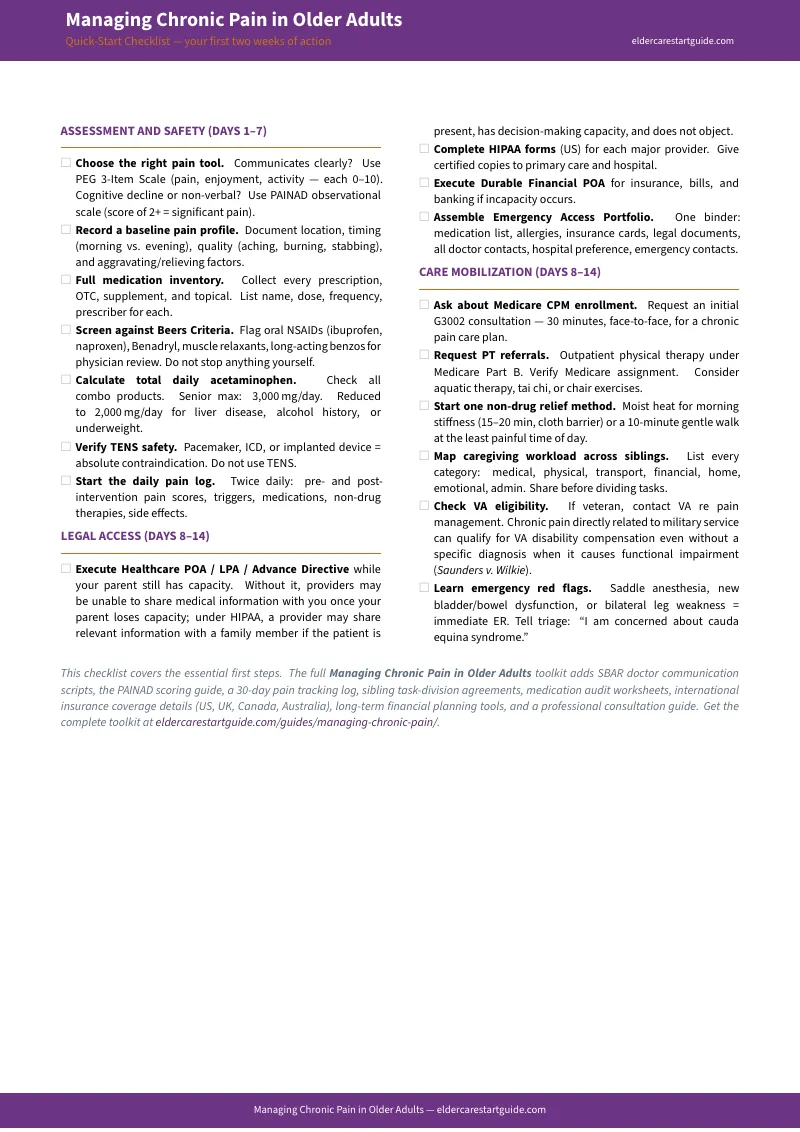
The free Quick-Start Checklist gives you the most important actions for the first two weeks — a triage-level overview of what to do right now. It is a solid starting point.
The full toolkit goes further: complete scoring guides, medication audit templates, multi-week pain tracking logs, doctor communication scripts, sibling coordination agreements, legal authority checklists, and a long-term financial planning chapter. Everything you need to manage your parent's chronic pain care — not just this week, but for the months and years ahead.