You're coordinating your parent's care from another city. Nobody trained you for this.
The call comes at work, or late at night, or during your kid's soccer game. Your mother fell. Your father's electricity was shut off. The pharmacy can't refill the prescription because they need authorization from someone — and that someone isn't you, because you never signed the paperwork that gives you authority.
You open forty tabs. You call the Area Agency on Aging. You leave a voicemail with an elder-law attorney who charges $400 an hour. You try to figure out the difference between a Durable Power of Attorney and a Healthcare Proxy. You argue with your sibling about whether Dad can still live alone. You spend $1,200 on an emergency flight and use up three vacation days, and when you get there, your parent says they're fine.
This is long-distance caregiving: an unpaid, untrained second job that runs on guilt, adrenaline, and midnight Googling. And the information you need does exist — in government fact sheets, legal blogs, caregiver forums, and your state's Medicaid handbook. It's just never in one place, never in the right order, and never written for someone managing everything by phone from 800 miles away.
The Remote Care Coordination System — everything in the order you actually need it
The Long-Distance Caregiving Playbook is a complete remote care coordination system built for adult children managing a parent's care from another city, state, or country. It puts every decision, document, and action step in the sequence a long-distance caregiver encounters them — legal authority first (because that window closes permanently), then local help, then monitoring, then the family conversation everyone has been avoiding.
This isn't a collection of tips. It's the operating manual for the hardest job no one applies for — with fill-in worksheets, assessment tools, vetting checklists, and coordination templates that turn scattered crisis management into a repeatable system.
What's inside
Legal Authority — The Window That Closes Without Warning
If your parent hasn't signed a Durable Power of Attorney and Healthcare Proxy while mentally competent, no family member automatically has authority over their bank accounts, medical records, or care decisions. The only alternative is court-supervised guardianship — thousands of dollars, months of delays, and a public proceeding your family doesn't want. The Playbook walks you through what to sign, in what order, and the specific requirements in the US (state-level POA rules), UK (Lasting Power of Attorney), Canada (provincial Representation Agreements), and Australia (Enduring Power of Attorney). Plus the cross-border acceptance problem: how to verify that a document signed in one jurisdiction will actually be honored in another.
Functional Assessment Tools — Not "How Are You, Mom?" but Objective Data
Your parent says they're fine. They're probably hiding things. The Playbook includes the Lawton-Brody IADL scale and the CDC's STEADI fall-risk screening — structured assessment tools that turn vague worry into a documented baseline. Designed to be completed during a visit or by a local proxy using the fill-in worksheets, so decisions are based on evidence, not competing family opinions about whether things are "really that bad."
Building Your Local Care Network from Scratch
The people who will be your eyes, ears, and hands on the ground when you can't be there. How to identify and vet local helpers (paid and unpaid), connect with the Area Agency on Aging for free or subsidized services, screen home care agencies without getting steered into expensive placements by commission-based referral platforms, and evaluate whether a Geriatric Care Manager is worth the cost. Includes interview questions, background check protocols, and a local helper audit template.
Healthcare Coordination from 800 Miles Away
How to manage your parent's medical care when you can't attend appointments. HIPAA authorization guidance so providers will actually talk to you, a doctor summary log for tracking diagnoses and medication changes across visits, three-way call strategies, and the steps to request medical records remotely. Covers the equivalent privacy frameworks in the UK (GDPR), Canada (PIPEDA), and Australia (the Privacy Act 1988).
Remote Monitoring That Respects Dignity
Ambient motion sensors, cellular fall-detection wearables, smart medication dispensers, and video doorbells — evaluated by privacy impact, false-alarm rate, and ease of use for a non-technical parent. Not a product recommendation list: a structured evaluation framework so you can match the technology to your parent's specific situation, mobility, and comfort level. Includes the fail-safe protocol for when a sensor goes offline and you can't reach anyone by phone.
Public Benefits You're Probably Not Claiming
Most families don't discover these programs until they've already spent down savings. US Medicare home health criteria, Medicaid home and community-based waiver programs (state-specific), FMLA leave protections, and veterans' Aid and Attendance benefits. UK local authority care packages and Attendance Allowance. Canadian Community Home Care and the Involuntary Separation pension adjustment (Form ISP3040). Australian Support at Home and My Aged Care assessments. Each section: eligibility checklist, the exact calls to make, and what to say.
Sibling Coordination — Dividing Work Without Dividing the Family
The sibling who lives closest carries the physical burden: grocery runs, doctor's appointments, medication compliance. The one who lives farthest carries the financial burden and the guilt. The Playbook's labor-division framework assigns tasks by location, skill, and availability — not by who cares the most. Includes a family meeting agenda template, a sibling task allocation worksheet (a written agreement on roles and time commitments), and structured talking points for handling the "you're overreacting / you're not doing enough" cycle.
The Visit Framework — Making Every Trip Count
When you fly in twice a year, every visit has to do double duty. The Playbook's visit protocol: room-by-room home safety audit, "showtiming" detection guidance (the signs a parent is masking decline for your benefit), pantry and medication spot-check, local helper and neighbor check-in routine, and a post-visit documentation procedure using the Agency Communication Log. Structured so you're not scrambling to remember what to look for while also trying to be present with your parent.
Emergency Planning — Before the 2 a.m. Phone Call
A refrigerator-door emergency sheet designed so first responders or a neighbor can act without calling you first: contacts, medications, allergies, care preferences, hospital preference, and insurance information. Emergency contact chain-of-command, out-of-state medical transport logistics, and the financial pre-authorizations that prevent billing disasters during a hospitalization far from where you live.
Transition Indicators — When Distance Isn't Working Anymore
The objective signals that home-based care is no longer safe: ADL decline thresholds, wandering risk, falls requiring hospitalization, caregiver injury, and the financial tipping point where private home care costs exceed residential care. A structured decision framework — not guilt-driven guesswork — for evaluating assisted living, memory care, and skilled nursing from a distance.
Fill-In Worksheets and Templates
Care coordination directory, Lawton-Brody IADL assessment worksheet, room-by-room home safety checklist, visit observation log, POA submission tracker, monthly expense tracker, emergency contact and medical summary sheet, sibling task allocation worksheet, family meeting agenda template, and agency communication log — all printable standalone PDFs, designed to be filled in by hand and kept in a caregiving binder you share with family, providers, and attorneys.
Who this is for
- Adult children managing a parent's care from another city, state, or country — you need a system, not more advice articles
- The primary long-distance coordinator doing this alone — while siblings check in occasionally and assume everything is handled
- Families who haven't had the hard conversation yet — about driving, finances, legal authority, or whether Mom can still live alone
- Caregivers about to hire professional help for the first time — a home care aide, a Geriatric Care Manager, or an elder-law attorney — and don't want to pay someone to sort through information you could have organized yourself
- Anyone coordinating care across borders — the Playbook covers four jurisdictions (US, UK, Canada, Australia) so you're not reverse-engineering a foreign system from government PDFs
Why free resources aren't enough
The National Institute on Aging, AARP, and your state's Area Agency on Aging all publish good information. The problem is structure: the NIA has thousands of pages organized by medical topic, not by what a long-distance caregiver needs to do on Tuesday. AARP's articles are excellent overviews, but they don't give you the fill-in worksheets, vetting checklists, or step-by-step coordination protocols that turn reading into action.
Then there are the lead-generation platforms — the "free advisors" who will happily match you with an assisted living facility. What they don't mention: their referral commissions can run 50–100% of the first month's rent (often $3,000–$12,000 per placement), which means their incentive is to move your parent into a facility, not to help you explore aging-in-place alternatives. The Playbook is commercially neutral — it has no referral partnerships, no sponsored recommendations, and no financial incentive to steer you toward any particular care arrangement.
Full refund, no time limit
If the Playbook doesn't help, email [email protected] for a full refund. No forms, no time limit, no questions. You keep the PDFs either way.
Start with the free checklist — or get the full Playbook now
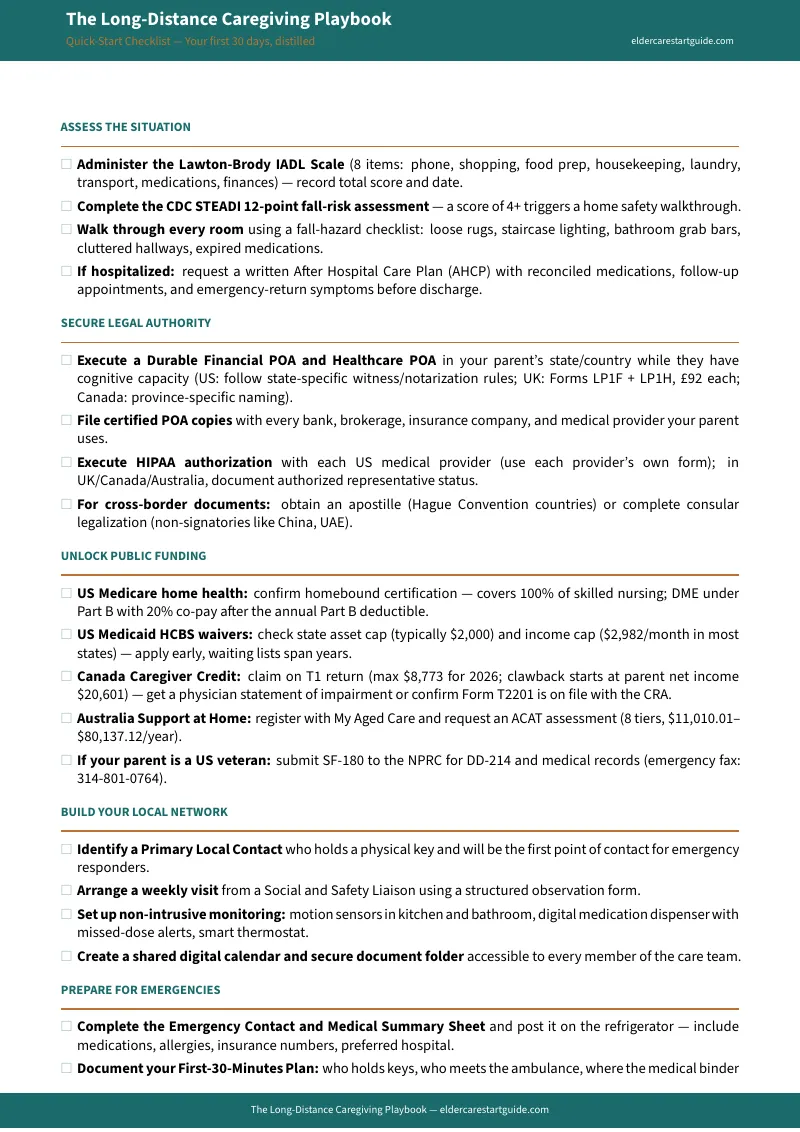
The free Quick-Start Checklist gives you the first five steps every long-distance caregiver should take immediately. The full Long-Distance Caregiving Playbook is the complete 14-chapter system — legal authority, functional assessment, local care networks, healthcare coordination, remote monitoring, public benefits, sibling coordination, visit protocols, emergency planning, transition decision tools, and every fill-in worksheet.
You're already doing this job. The Playbook gives you the system to do it without the midnight panic.