You dread the bathroom more than your parent does.
Every attempt ends the same way. The excuses ("I showered yesterday"), the anger, the pushing away. Sometimes the screaming. You leave the bathroom feeling guilty, exhausted, and completely alone in this — because nobody in your family understands how hard it is to help someone who doesn't want to be helped.
Meanwhile, the medical risks are climbing. Skin is breaking down in places you can barely bring yourself to check. You noticed a smell that wasn't there six months ago. You're terrified of the UTI that sends your parent to the ER — or the Adult Protective Services call from a well-meaning neighbor.
You've Googled it. Every article says the same thing: "be patient" and "try a sponge bath." That's not a system. That's a platitude.
The Dignity Hygiene System — clinical protocols made practical for families
This toolkit gives you what the articles don't: a structured, evidence-based system to manage hygiene resistance at home — without arguments, without force, and without destroying your relationship with your parent.
It's built on two clinical frameworks that professional geriatric care managers use with their own clients: the DICE method (Describe, Investigate, Create, Evaluate) for diagnosing and solving resistance, and the Bathing Without a Battle program for replacing stressful showers with calm, effective alternatives.
The difference between this and free advice? Free advice tells you to be patient. This toolkit gives you the exact scripts to say, the exact steps to follow, and the exact documentation to keep — so you can prove you're doing everything right, even on the days it doesn't feel like it.
What's inside the full toolkit
- The DICE Clinical Worksheet — a structured four-phase process to diagnose why your parent resists (pain? fear? cognitive decline? depression?) and design a targeted intervention instead of guessing
- Word-for-word de-escalation scripts — for body odor conversations, the "I already showered" loop, soiled clothing, and incontinence accidents — because knowing what to say is half the battle
- Step-by-step towel bath protocol — the single most effective bathing alternative, with supply list, water temperature guidance, and techniques to keep your parent warm, covered, and calm throughout
- Bathroom safety audit checklist — grab bar placement, non-slip surfaces, shower chair selection, lighting modifications, and the Medicare DME rules so you know what's covered and what you'll pay out of pocket
- Incontinence and skin protocols (in the 14-chapter guide) — perineal care, moisture barrier application, atypical UTI warning signs, and Stage 1 through Stage 4 pressure injury staging with the point where you need a wound care specialist
- Daily Care Tracker (DICE-Aligned) — a landscape log of every hygiene attempt, your parent's response, and the room conditions, so one week's data feeds the next DICE cycle
- Hygiene Effort Log — a legal-grade documentation system to record every care attempt, partial cleaning, and refusal — your protection against neglect allegations
- Katz ADL Self-Assessment — score your parent's independence across six domains (bathing, dressing, toileting, transferring, continence, feeding) to objectively track decline and know when home care is no longer safe
- Benefits Application Tracker — VA Aid and Attendance, Medicaid HCBS waivers, UK Attendance Allowance, and Ontario home care, with filing dates and document checkboxes
- Weekly Hygiene Schedule — plan full towel-bath days, partial washes, hair, and laundry so nothing is decided in the moment
- Caregiver Self-Check — a monthly screen of your own sleep, stress, and capacity, with a next-step line when the score says you need respite
Who this toolkit is for
- Adult children helping a parent who refuses to bathe, change clothes, or cooperate with personal hygiene
- Caregivers managing resistance alongside dementia, depression, chronic pain, or mobility limitations
- Primary caregivers who need documentation in case of medical appointments or Adult Protective Services contact
- Families dealing with sibling conflict over a parent's declining self-care — the assessment tools give everyone objective data instead of accusations
Why free articles aren't solving this
Government websites like the National Institute on Aging and the Alzheimer's Association offer medically sound advice. But they stop at "be patient" and "try a sponge bath." They don't give you the printable scripts for the conversation you're dreading tonight. They don't give you the tracking sheets to bring to your parent's doctor next week. And they don't give you the legal documentation framework that protects you when a sibling or a social worker questions your care.
Professional geriatric care managers use the same clinical frameworks in this toolkit — the DICE method, the Bathing Without a Battle protocols, the Katz ADL assessments. But an initial assessment alone runs $300–$2,000, with ongoing consulting at $100–$250 per hour, and none of it is covered by Medicare. This toolkit puts those professional-grade tools in your hands for a fraction of a single consulting session.
Full refund, no time limit
If the toolkit doesn't help your situation, email [email protected] for a full refund. No deadline, no questions, no fine print.
Your parent's dignity and your sanity are not competing goals
Hygiene resistance feels like a fight you can't win. But it's usually a communication problem with a clinical solution — your parent is trying to tell you something they can't articulate, and you need the right framework to hear it.
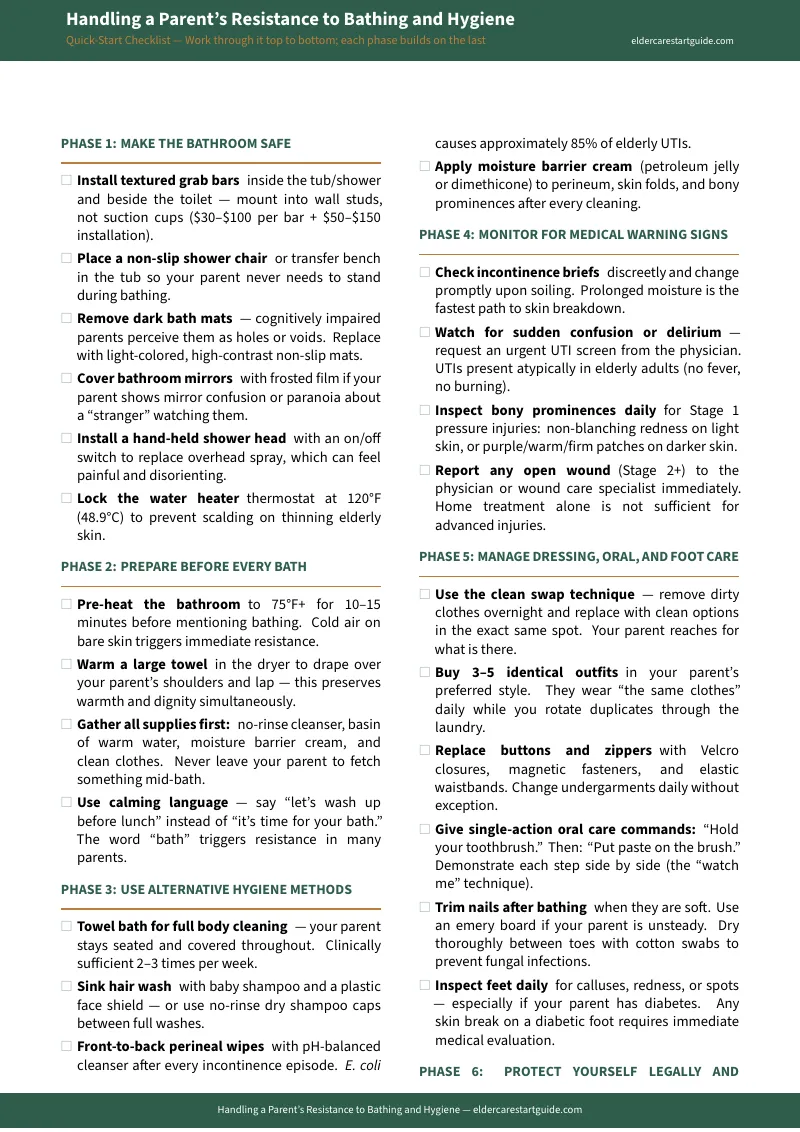
The free checklist gives you tonight's first steps. The full toolkit gives you the system to make this manageable for the long term.