
Your Family Needs a Care System — Not More Advice
Your grandparent's care has become a full-time operation running on goodwill and group texts. Someone manages medications. Someone else drives to appointments. A teenager watches the house after school. And nobody — not the parent burning out, not the grandchild losing sleep, not the college student canceling plans — has a written system that says who does what, when it's too much, and where the emergency contacts live.
The free resources exist. AARP has articles. Government agencies have fact sheets. But families don't fail because information is unavailable — they fail because that information is scattered across dozens of websites and none of it is assembled into a working daily system they can actually print, fill in, and hand to a teenager at the kitchen table.
The Family Care Command System
The Grandchild's Guide to Helping With Grandparents is a complete operational toolkit — 14 chapters, printable worksheets, daily trackers, and legal templates — organized around the same clinical 4Ms framework (What Matters, Medication, Mentation, Mobility) that age-friendly hospitals use to coordinate patient care. Except this version is designed for a family, not a nursing unit.
Every tool in this kit follows one rule: supplement the primary caregiver, never supplant them. Grandchildren contribute meaningful, age-appropriate support. Parents get structured breathing room. And the grandparent receives consistent, safe engagement that clinical research links to improved cognitive function and slower decline.
What's Inside the Complete Toolkit
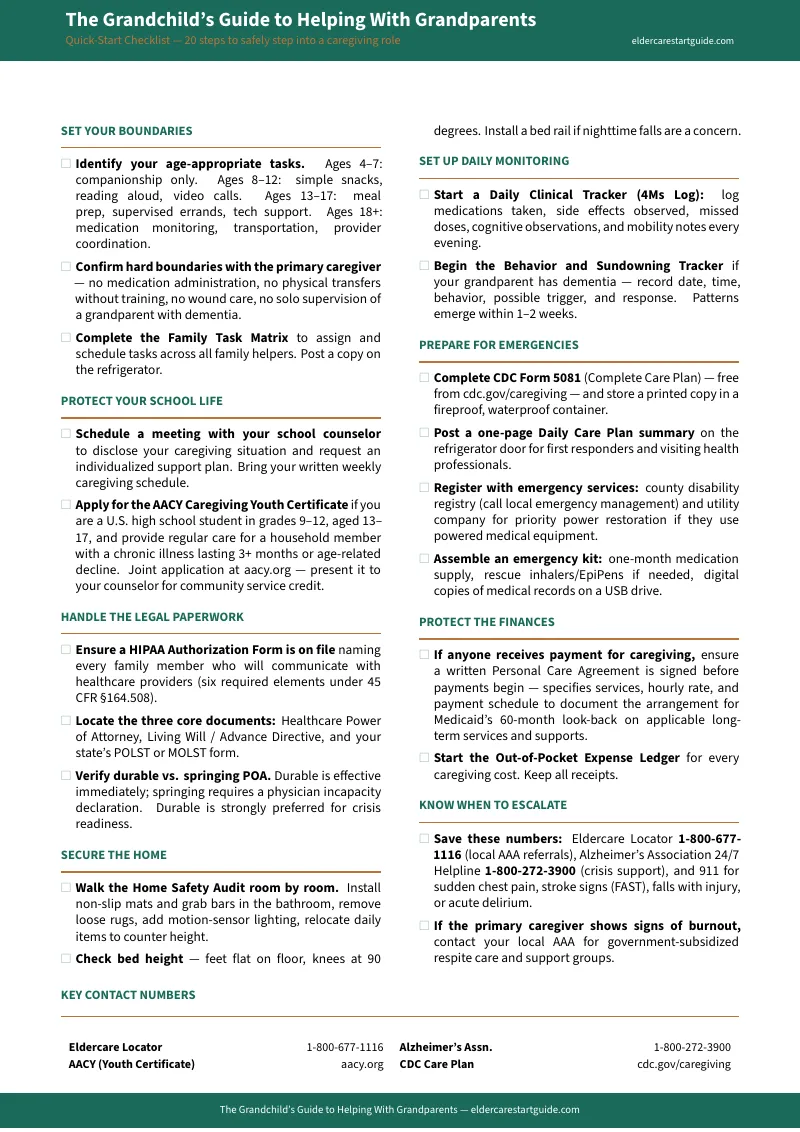
- Age-mapped task assignments for 4 developmental stages — because a willing twelve-year-old managing afternoon medications isn't being helpful, they're being placed in a position where a dosing error could cause real harm. Each age band (4–7, 8–12, 13–17, 18+) has explicit safe activities and absolute clinical boundaries.
- Academic advocacy scripts and accommodation templates — youth caregivers have a 22% high school dropout rate, not from lack of ability, but because no one contacted the school counselor. The toolkit includes step-by-step instructions for requesting accommodations, a script for the initial meeting, and the complete AACY Caregiving Youth Certificate application process.
- The 4Ms daily tracking system — a simplified medication administration record, behavioral and mood journal, and mobility checklist. Clinical-grade monitoring in a format a teenager can actually fill in, with patterns that help the primary caregiver spot nutritional deficits, cognitive changes, and sundowning triggers before they become emergencies.
- Room-by-room home safety audit — grab bars, toilet heights, lighting levels, trip hazards, non-slip surfaces, lever doorknobs. Every modification linked to the fall-risk or transfer-injury it prevents, scored by urgency so the family tackles the highest-risk changes first.
- Emergency handoff packet — a one-page EMT-ready summary (diagnoses, allergies, daily medications, pharmacy contacts), a legal access guide for medical powers of attorney and advance directives, and a first-responder home access form covering security codes, pet locations, and utility shutoffs. Compiled once, posted on the refrigerator, and never scrambled for during a 911 call again.
- Family meeting facilitation agenda — structured conversation formats for the topics families avoid until they explode: driving retirement, legal planning, care transitions, financial responsibility, and role reassignment. Each agenda includes opening scripts, fallback phrases for when emotions escalate, and a documentation template for decisions made.
- Legal and financial protection ledger — out-of-pocket expense tracking sheets designed specifically to prevent Medicaid look-back penalties. If a grandparent pays a caregiving grandchild without documentation, those payments can be classified as gifts and trigger disqualification periods when Medicaid eligibility is needed later. The ledger creates the paper trail that protects everyone.
- Dementia communication toolkit — validation over correction, the DICE behavioral framework (Describe, Investigate, Create, Evaluate), sundowning trigger journals, sensory engagement strategies, and memory wallet instructions. Written for family members who are watching someone they love change, not for clinicians studying a diagnosis.
Who This Toolkit Is Built For
- Grandchildren aged 8 to 25 — teenagers balancing school and after-school caregiving, college students home for recovery help, emerging adults managing daily support roles
- Sandwich-generation parents — raising children while caring for aging parents, needing a structured way to delegate non-clinical tasks without piling on guilt or risk
- Families entering multi-generational care for the first time — after a fall, a hospital discharge, a diagnosis, or the slow accumulation of needs that nobody named until now
Why Not Just Use Free Resources?
You absolutely can. The National Institute on Aging, AARP, the CDC, and your local Area Agency on Aging all publish excellent clinical guidance — for free. The problem is structural:
- AARP's caregiving portal spans thousands of articles optimized for adult-child caregivers, not grandchildren or teenagers. Finding the youth-specific guidance means digging through a library designed for a different audience.
- Public agency care plans typically cap at three to six months and focus on short-term independence, not the ongoing daily coordination a family actually needs.
- Etsy's caregiver binders look organized but rarely include clinical context — no medication safety protocols, no Medicaid-protective expense tracking, no age-boundary guidance.
- Nolo's legal templates cover the paperwork but nothing about daily care, communication, or family coordination.
This toolkit puts clinical depth, legal protection, and daily operational structure into one sequenced system. You open it, start at the chapter that matches your situation, and work through it with your family.
A Guarantee That Means Something
If the toolkit doesn't help your family within 30 days, email [email protected] for a full refund. No questionnaire, no return process. The risk is entirely on our side.
The free Quick-Start Checklist gives you a one-page overview of age-appropriate tasks and clinical boundaries — enough to start organizing today. The full toolkit gives your family the complete system: tracking sheets, legal templates, safety audits, conversation scripts, and emergency packets that keep everyone safe, structured, and sane.