Your Parent Lost $47,000 to a "Caregiver" Who Passed a Background Check. The Bank Saw Every Transaction. Nobody Called You.
The unauthorized withdrawals started six months ago. Small amounts at first — $200 here, $350 there — then a $12,000 wire transfer to an account you've never seen. Your parent's caregiver passed the basic criminal check. The bank's fraud algorithms didn't flag it because your parent technically authorized each transaction. Adult Protective Services says they need more documentation before they can investigate.
You're now doing three jobs at once: detective, accountant, and family mediator. Every hour you spend Googling "how to report elder financial abuse" is an hour the theft continues. The government websites define the problem. The AARP articles tell you to "be vigilant." The law firm blogs end with "$400/hour consultation" links. Nobody gives you the actual sequence — what to lock first, who to call next, what evidence to collect, and how to organize it so investigators don't dismiss your case as a family dispute.
The Financial Exploitation Triage System
This isn't another awareness guide about "warning signs." The Financial Exploitation Triage System gives you the operational sequence — the exact order of account locks, evidence documentation, credit freezes, agency reports, and legal actions that stops the bleeding and builds a prosecutable case. It's structured so an exhausted adult child with no legal training can execute it in modular steps, starting with whatever you have time for today.
The critical mistake most families make: they report the abuse before documenting it. They call APS or the police with a vague complaint — "someone is taking my mother's money" — and get told to come back with evidence. Meanwhile, the abuser sees the family mobilizing and accelerates the theft, changes account passwords, or pressures the senior into denying everything. By the time the family assembles proof, the accounts are drained and the paper trail is cold.
This toolkit puts documentation first, locks second, and reporting third — because a clean forensic dossier handed to a caseworker gets investigated. A panicked phone call from a stressed-out family member gets filed.
What You Get
The complete toolkit includes a 10-chapter guide plus 10 standalone printable tools — each formatted as its own PDF so you can print exactly what you need and bring it to the bank, to APS, or to a family meeting:
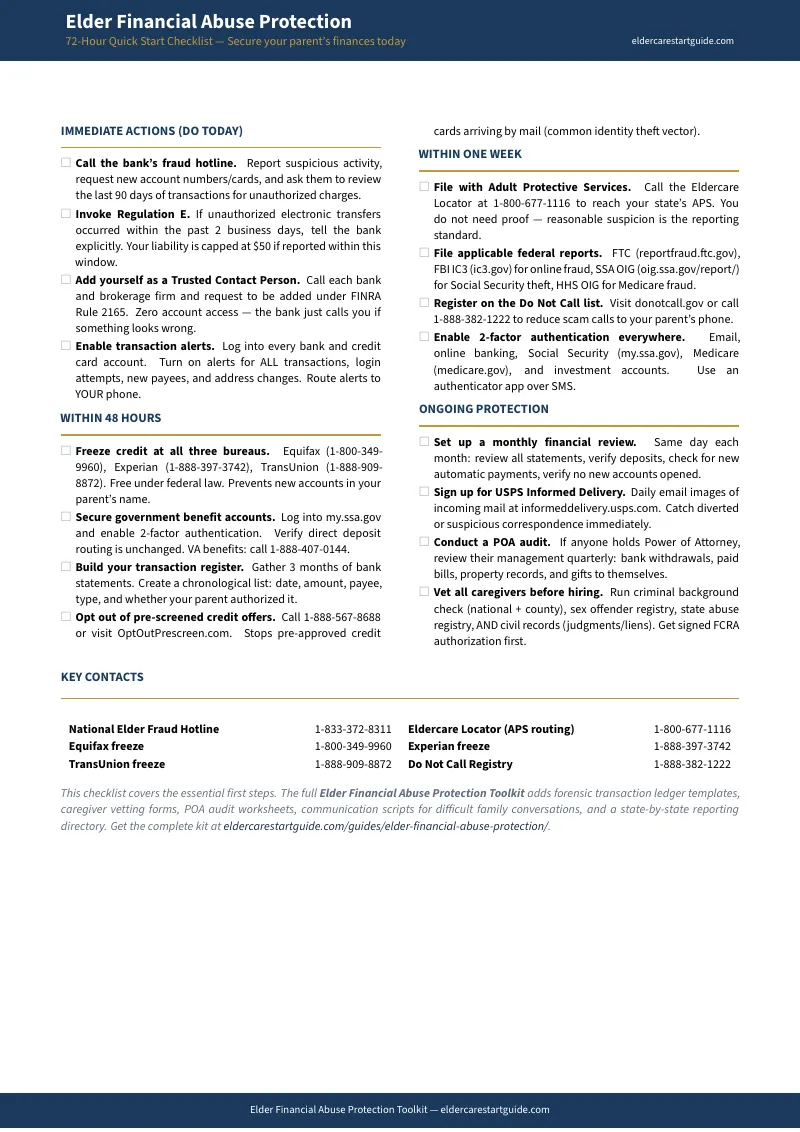
- 72-Hour Crisis Protocol — The emergency triage sequence for the first three days after discovering exploitation: bank fraud notifications, Regulation E invocation (caps unauthorized debit liability at $50 if reported within two business days), immediate credit freezes across all three bureaus, and evidence preservation steps — in priority order so you stop the worst bleeding first.
- Forensic Transaction Ledger — A fillable worksheet for documenting every suspicious transaction with the metadata investigators actually need: date, amount, recipient, authorization method, and your parent's capacity indicators on that day. This format is what APS caseworkers and law enforcement use to open cases.
- Three-Layer Defense Framework — Device-level security (robocall blockers, browser lockdown), bureau-level protection (credit freezes, fraud alerts, ChexSystems), and bank-level monitoring (transaction alerts, trusted contact designations under FINRA Rule 2165, view-only access setup). Each layer works independently so a gap in one doesn't expose the others.
- Caregiver Vetting System — FCRA-compliant background check authorization forms, the five-category screening protocol most agencies skip (criminal, sex offender, abuse registry, driving, and civil judgments), interview scoring rubric, reference verification scripts, and a 90-day probationary monitoring checklist.
- Multi-Agency Reporting Templates — Pre-written report templates for Adult Protective Services, local law enforcement, the Long-Term Care Ombudsman, and the CFPB. Each template captures exactly what that agency needs to open a case — formatted so caseworkers don't have to extract information from a rambling narrative.
- POA Oversight & Revocation Kit — Fiduciary auditing worksheets to monitor a power of attorney holder's actions, red-flag detection for self-dealing and excessive disbursements, demand-for-accounting letter templates, and court petition guidance for revoking a POA when the agent is the abuser.
- Communication Script Bank — Word-for-word scripts for calling the bank's fraud department, explaining the situation to APS without sounding hysterical, confronting a sibling you suspect of financial abuse, and approaching a resistant parent who insists nothing is wrong.
- Capacity & Autonomy Decision Tree — The hardest scenario: your parent still has legal capacity but clearly impaired financial judgment. This chapter maps the options between "they can do whatever they want" and "you need a guardianship" — including the structural safeguards that work without removing independence.
- Special Situations Playbook — Romance scams (how to intervene when a parent is in deep denial), predatory professionals (financial advisors, attorneys, contractors who target seniors), Medicare and insurance fraud detection, identity theft recovery, and undue influence over estate documents.
- Quick-Start Checklist (Free Download) — 16 immediate-action items organized by urgency: what to lock tonight, what to document this week, who to notify this month. The free version of the triage sequence — enough to stop the most urgent bleeding while you decide if you need the full system.
Who This Toolkit Is For
- Adult children who just discovered — or strongly suspect — that someone is stealing from an aging parent and need to act today, not after a $400/hour attorney consultation
- Long-distance caregivers who noticed something wrong at their last visit (suspicious new "friends," missing mail, sudden defensiveness about money) and need remote monitoring and protection systems
- Families where the person with power of attorney is the suspected abuser — and the rest of the family doesn't know their legal options for oversight or revocation
- Caregivers dealing with romance scams, predatory contractors, or professional exploitation where the senior actively denies that anything is wrong
- Proactive families whose parent's cognition is declining and who want structural safeguards in place before the vulnerability window opens — without triggering a family conflict
- Anyone who has already called APS or the police and been told "bring us documentation" but doesn't know what documentation means or what format they need it in
Why Free Information Isn't Solving This
The Consumer Financial Protection Bureau publishes excellent educational material about elder financial abuse. It explains types of exploitation, lists warning signs, and links to federal reporting resources. What it doesn't do: give you a sequential triage protocol, a fillable evidence ledger formatted for investigators, or a decision tree for the "my parent has capacity but terrible judgment" scenario that most families actually face.
AARP's articles are well-researched and emotionally supportive. They validate your anxiety and tell you that you're not alone. They do not give you the FCRA-compliant background check authorization form, the bank fraud department phone script, or the APS report template pre-filled with the categories caseworkers need to open a case.
Etsy and Canva sell beautifully designed caregiver binders for a few dollars. They track medications, meals, and appointments. They include zero financial forensics, zero legal protection templates, and zero reporting guidance. They're medical organizers, not exploitation defense systems.
Elder law attorneys provide deep expertise — and they should be your next step for contested guardianships, trust litigation, or asset recovery above $50,000. But at $200-$500 per hour, you'll spend more on the first consultation than this entire toolkit costs — and most of that consultation will be spent organizing information you could have prepared in advance.
Satisfaction Guarantee
If this toolkit doesn't give you a clear, actionable system for protecting your parent's finances, email [email protected] for a full refund. No questions, no time limit.
— Less Than 15 Minutes of an Elder Law Attorney's Time
An elder law attorney charges $200 to $500 per hour. A geriatric care manager's initial assessment runs $500 to $2,000. A single undetected month of financial exploitation averages $34,200 in losses for victims over 80. The cost of doing nothing is not zero — it's compounding daily.
This toolkit won't replace an attorney when you need one (and it tells you exactly when that threshold is). But it will save you the preparation hours, prevent the documentation mistakes that get cases dismissed, and ensure you walk into any meeting — with APS, with the bank, with law enforcement, or with an attorney — holding an organized dossier instead of a stack of anxiety.
Download the free Quick-Start Checklist to see the 16 most urgent action items. When you're ready for the complete triage system, the full toolkit is waiting.