
Every "free" referral site recommends the centers that pay the highest commission. This toolkit shows you how to choose the center that's actually right for your parent.
You searched "adult day care near me" and landed on a slick website that offered to match you with local programs for free. What it didn't tell you: the centers it recommends pay referral fees that can exceed $10,000 per placement. The "advisor" on the phone isn't evaluating your parent's needs — they're routing you to whoever pays the most.
Meanwhile, the nonprofit sites give you a three-paragraph overview and tell you to call your Area Agency on Aging. The elder-law attorney charges $300–$500 an hour just to help you organize the paperwork you should have sorted before the first consultation. And the government portals — Medicaid, VA, your local aging services — bury critical funding programs behind bureaucratic language that most families never decode.
Adult day care costs roughly $95 per day in the United States — significantly less than in-home care at $34 per hour or assisted living at $5,000+ per month. But the wrong program wastes every dollar. A social program can't manage your father's medications. A medical program may be clinical overkill for your mother's needs. A center with a 1:8 staffing ratio and high turnover isn't a program — it's a parking lot.
You need a decision system, not a recommendation from someone with a financial incentive to steer you.
The Care Placement Decision System — choose, fund, and monitor a program using the same framework geriatric care managers use, without their hourly rate
The Adult Day Care Selection Guide is the complete evaluation and enrollment toolkit: a structured decision framework that walks you from "I don't know where to start" through program comparison, provider screening, funding applications, contract negotiation, transition management, and ongoing quality monitoring — the 12-chapter guide plus 10 printable worksheets you can bring to every tour, every phone call, and every family meeting.
This isn't a directory of centers. It's the process for evaluating any center, anywhere — the operational questions, the financial worksheets, the contract clauses, and the transition scripts that geriatric care managers use when families pay them $150–$250 an hour. For a fraction of a single professional consultation, you get the same framework permanently.
What's inside
Program Types Decoded — Social vs. Medical vs. Memory Care — because enrolling your parent in the wrong model wastes months and money. The side-by-side comparison matrix maps your parent's cognitive profile, physical needs, and social requirements to the program type that actually fits — not the one the referral site gets paid to recommend.
Legal Authority Audit Checklist — the Health Care POA / LPA / EPOA, Financial POA, and HIPAA authorization you need before enrollment, and what happens without them (court-supervised guardianship, committeeship, or deputyship). Sign while your parent still has capacity, in the right order, with the right organizational prep.
Multi-Country Funding Walkthrough — the U.S. Medicaid HCBS waivers, VA Aid and Attendance, PACE programs, and dependent care FSAs that most families never apply for because nobody told them they qualified. Plus the Canadian provincial subsidies, U.K. local authority funding and Attendance Allowance, and Australia's Support at Home program — each with eligibility criteria and application steps.
The 40-Point Provider Screening Checklist — because a brochure tour shows you fresh paint, not the staffing ratio at 4 p.m. The questions most families forget: late pickup fees, billing for missed days, staff turnover rate, medication error reporting, and the red flags that should end a tour immediately.
Site Visit Scoring Sheets — what to observe beyond the lobby: staff-to-participant interactions, the ratio of engaged residents to passive ones, medication storage protocols, emergency signage, secured outdoor areas. Score each center on the same criteria and compare objectively instead of going with whichever director was friendliest.
Cost Anatomy and Contract Negotiation Checklist — the full breakdown of registration fees, daily rates, transportation surcharges, supply fees, and absenteeism penalties. Includes the clause-by-clause contract review checklist with the specific asks to make — trial periods, rate locks, illness-day credits, and termination notice periods — because the contract the center hands you is their starting position, not your final agreement.
Individualized Care Plan Template — what to demand in writing before the first day: medications with dosages, dietary restrictions, mobility limitations, behavioral triggers, emergency contacts, and the update cadence that keeps the plan current. A real care plan, not a generic intake form.
Transition Management Plan — the graduated introduction protocol (brief lunch visit → structured half-day → full schedule) plus the reframing scripts that position the center as a "senior club" or "class" instead of a facility. Includes the behavioral benchmarks that distinguish normal adjustment anxiety from genuine program mismatch.
Ongoing Quality Monitoring Framework — what to audit weekly, monthly, and quarterly after enrollment. The warning signs of declining care quality, the documentation trail for filing complaints, and the escalation path from center director to state licensing agency.
Professional Referral Decision Tree — when you actually need an elder-law attorney, a geriatric care manager, a Medicaid planner, or a patient advocate, and when this toolkit is enough. The hourly rates for each professional so you can budget honestly.
Caregiver Self-Care and Respite Framework — the clinical evidence that adult day programs preserve cognitive function longer than isolated home care, and the structured plan for using your parent's program hours to rebuild your own health before burnout forces a crisis.
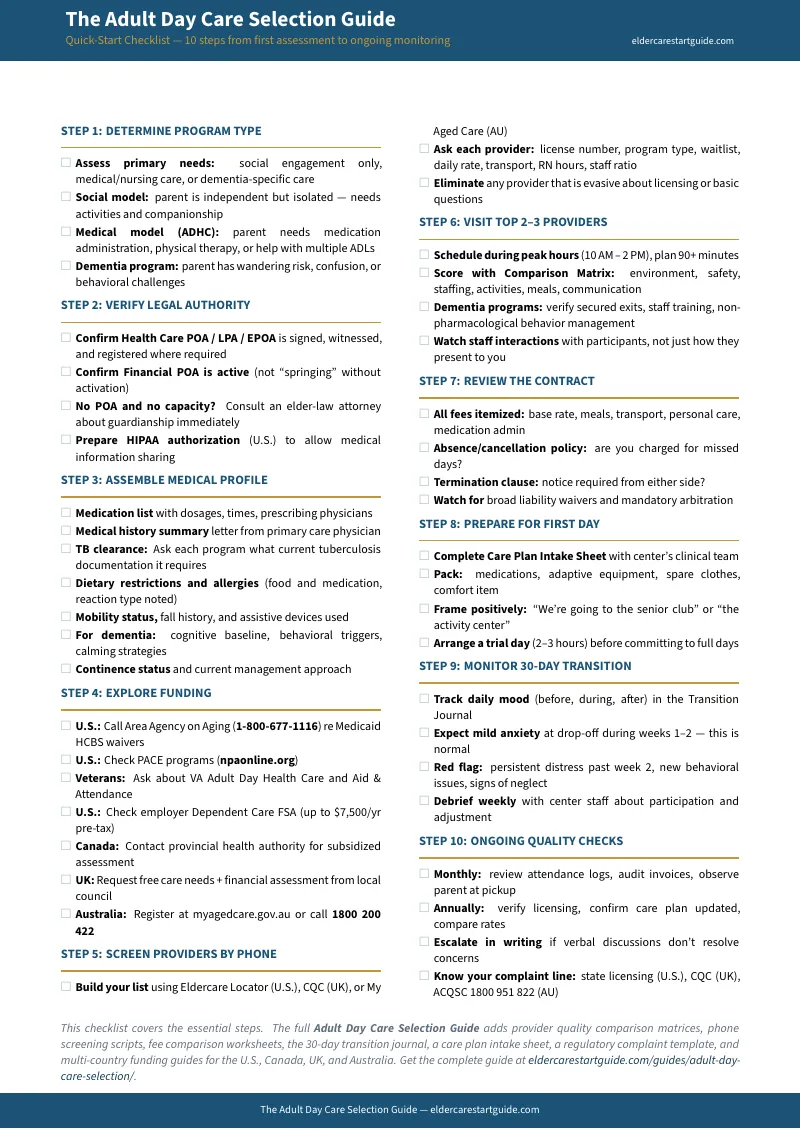
The Quick-Start Checklist — all 45 critical actions in a 10-step sequence on one printable page. Gather documents, screen programs, tour, negotiate, enroll, monitor — the entire decision process at a glance.
Printable files in the paid kit: legal-authority-audit.pdf, program-comparison-matrix.pdf, cost-comparison-worksheet.pdf, provider-directory-log.pdf, provider-quality-matrix.pdf, fee-comparison-worksheet.pdf, contract-review-checklist.pdf, care-plan-intake-sheet.pdf, transition-journal.pdf, and quality-monitoring-checklist.pdf — plus guide.pdf and checklist.pdf.
Who this is for
- The working caregiver who's run out of PTO. You need a vetted daytime care program — not a panic placement — so you can stop choosing between your job and your parent's safety. The screening checklist and funding walkthrough get you from overwhelmed to enrolled.
- The solo caregiver who hasn't slept through the night in months. You're doing the meals, the medications, and the 3 a.m. bathroom trips alone. This toolkit shows you how to find and fund structured respite so your own health doesn't collapse first.
- The family scrambling after a hospital discharge. Your parent had a fall or a stroke, the discharge planner is asking about your "care plan," and you need to move from crisis to stable care without a decision you'll regret.
- The adult child who doesn't trust the referral sites. You've noticed that every "free" advisory service steers you to the same centers. The toolkit gives you an unbiased evaluation framework built on staffing, clinical capability, and contract terms — not commission rates.
- The family arguing about what to do. Siblings disagree on whether your parent needs day care, who should pay, and who decides. The objective screening tools and cost worksheets replace opinions with data.
Why free resources aren't enough
The free referral sites (A Place for Mom, Caring.com, Care.com) have a structural conflict: they're paid by the centers they recommend. Their "advisors" are salespeople working on commission. They won't tell you about the center down the street that doesn't pay referral fees but has better staffing ratios and lower turnover.
The nonprofit resources (AARP, Alzheimer's Association) are trustworthy but generic — broad educational articles that don't give you a screening checklist, a contract review guide, or a transition plan you can actually execute.
The self-help legal publishers (Nolo) cover the legal and tax rules but skip the clinical and emotional reality — how to evaluate a center's actual care quality, how to get a resistant parent through the door, how to monitor quality after enrollment.
The government portals (Eldercare Locator, NHS, My Aged Care) are conflict-free but bureaucratically dense, and they offer no decision frameworks, family mediation tools, or emotional support for the transition.
This toolkit covers the ground that falls between all four: the operational decision process, the financial planning, the clinical evaluation, the legal prep, the emotional transition, and the ongoing monitoring — in one document, in the order you need it.
Peace of mind, in writing
If the toolkit doesn't help you make a more informed, more confident decision about your parent's care, email [email protected] and we'll make it right.
You're also getting the Quick-Start Checklist free — download it now to see the 45-item action sequence before you decide on the full toolkit.
Get the Full Toolkit — Instant Download
Start with the free checklist. When you're ready for the complete decision system — the comparison matrices, the 40-point screening checklist, the funding walkthroughs, the contract review checklist, and the transition plans — the full toolkit is waiting. For less than the cost of a single hour with a geriatric care manager, you get the framework to evaluate every program your parent will ever need.