
Your Parent Needs Help. Quebec Has a System for That — But Nobody Tells You How It Actually Works.
You called 811 and were told someone would "get back to you." You searched the Quebec.ca website and found policy documents written in dense bureaucratic language. You asked the hospital social worker and heard acronyms — CLSC, CISSS, ISO-SMAF, AAD, PEFSAD — like you should already know what they mean.
Meanwhile, your parent is struggling with daily tasks, and every week without help is another fall risk, another missed medication, another night spent worrying whether they're safe.
The Quebec Care Navigation System
This isn't a pamphlet about "exploring your options." It's an operational roadmap built around Quebec's specific programs, eligibility rules, and administrative processes — the same information a private geriatric social worker charges $180 per hour to explain, or a notary bills $300–$500 per hour to navigate.
The difference: instead of scattered government web pages, you get every step in the order you need it — from your first 811 call through CLSC intake, needs assessment, home care setup, tax credit claims, residential placement, and legal protection.
What You Get
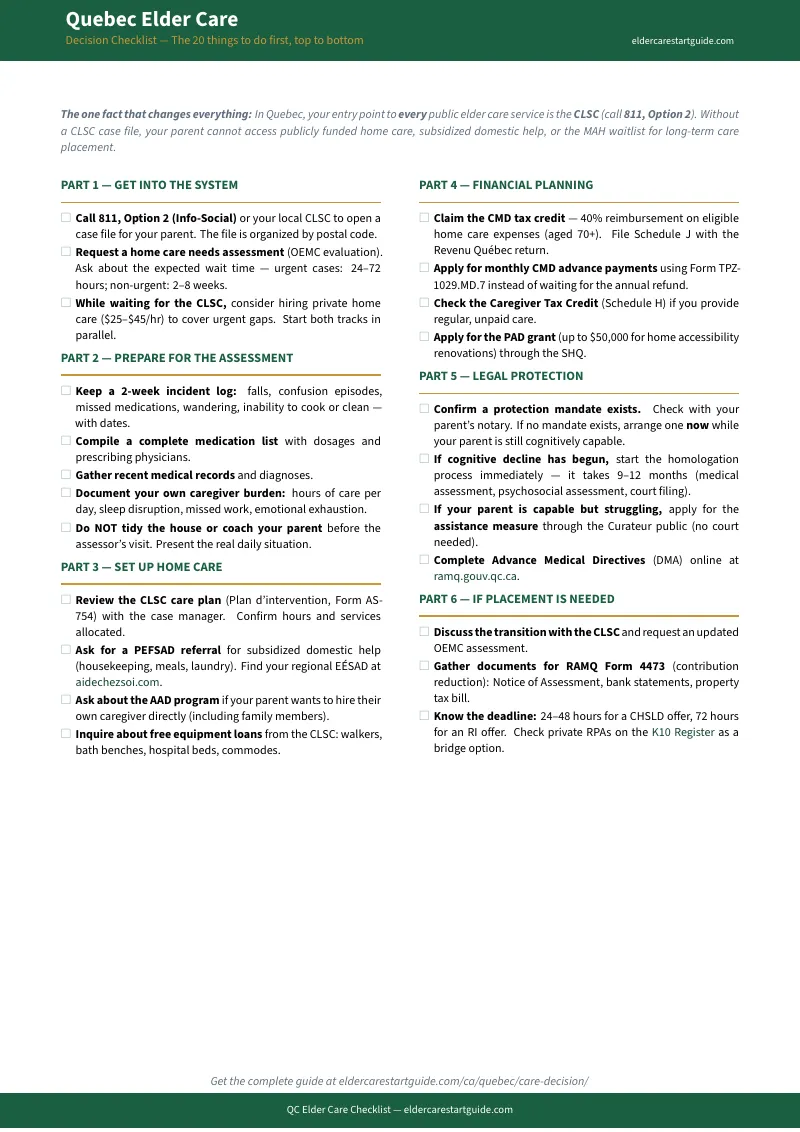
The complete guide (15 chapters), a 20-item action checklist, and 9 standalone printable worksheets — 11 PDFs total, ready to print, fill in, and file at your own pace:
- CLSC Intake Script — Exactly what to say when you call 811 Option 2 or walk into the Guichet d'accès. How to describe your parent's situation in clinical terms that trigger an urgent home safety evaluation — not a 6-week wait. Print it and keep it by the phone.
- ISO-SMAF Assessment Prep — A plain-language breakdown of the functional domains the assessor scores. What to document before the visit. Why families who say "she manages fine" during the assessment end up with fewer approved care hours — and how to avoid that mistake.
- Home Care Program Map — CLSC direct care vs. EÉSAD subsidized domestic help vs. AAD direct-hire (including hiring a family member as a paid caregiver). How each program works, who qualifies, and how to combine them.
- Tax Credit Stacking Worksheet — Fillable worksheet for calculating your total savings from the 40% provincial CMD tax credit, Schedule H caregiver credit, and the federal HATC. Stack provincial and federal credits on the same renovation.
- Residential Placement Comparison — RPA vs. RI vs. RTF vs. CHSLD compared side by side: cost structure, admission path, medical supervision, waitlists, and decision deadlines.
- RAMQ Contribution Calculator — Fillable worksheet for calculating your parent's monthly residential care cost. Includes the regulated fee scale ($1,395.30 to $2,242.20 per month), exemptions, and the Form 4473 document checklist.
- Protection Mandate Homologation Checklist — Every step from locating the original notarized mandate to booking the RAMQ-covered medical exam (billing code 98009) to filing the Superior Court application. Plus the Bill 18 mesure d'assistance alternative for parents who still have some cognitive capacity.
- Hospital Discharge Defence Kit — Your legal right to refuse an unsafe discharge. Template language for communicating with the hospital social worker. How to escalate to the Commissaire aux plaintes when the discharge plan doesn't match your parent's actual needs.
- Forms & Registries Quick Reference — Every government form, registry, and phone number you may need — tax credits, RAMQ applications, legal protection, complaint pathways — on one printable page.
Who This Is For
- The crisis navigator — Your parent is in the hospital and someone just told you they need to leave, but going home alone isn't safe. You have 48–72 hours to figure out the next step.
- The proactive planner — Your parent is still managing, but you can see the decline. You want to get into the CLSC system now, while there's time to set things up properly — not after a fall.
- The burned-out caregiver — You've been providing daily hands-on care and it's no longer sustainable. You need funded respite, paid caregiver options, and a path to residential support — not another self-care pamphlet.
- The out-of-province adult child — You live outside Quebec and you're trying to coordinate your parent's care from a distance. You need the roadmap without the guesswork.
Why Not Just Use the Government Websites?
The rules are technically public. They're also scattered across Quebec.ca, RAMQ.gouv.qc.ca, Revenu Québec publications, and regional CISSS websites — none of which are written for a stressed adult child trying to keep a parent safe. Government sites tell you what the programs are. This guide tells you what to do — in what order, with what documents, using what language on the phone.
Free senior placement advisors exist, but they earn commissions from private RPAs. They're helpful for the private market — but they don't cover public programs like CLSC home care, subsidized RIs, or CHSLD placement, which is exactly where most families need the most help.
What This Costs You
A private geriatric social worker charges $180 per hour. A psychosocial assessment for protection mandate homologation runs $1,000–$2,000. A notary for incapacity planning bills $300–$500 per hour.
This guide costs . One purchase. Every chapter, checklist item, and reference — ready to use tonight.
Satisfaction Guarantee
If the guide doesn't help you make progress on your parent's care situation, email us for a full refund. No forms, no hassle.
Start Tonight
Download the free checklist to get the CLSC intake prep and assessment preparation items immediately. Ready for the complete system? Get the full guide and start navigating Quebec's elder care network this week.