
The Nurse Is Coming Tuesday to Assess Your Parent. Nobody Told You What She Scores, How to Prepare, or What Happens if Your Parent Downplays Everything.
Your parent had a fall, a hospitalization, or a slow decline that finally crossed the line. Health PEI assigned a care coordinator, and now a nurse is scheduled to run an interRAI clinical assessment in your parent's home. That one visit determines every public service your parent can access — home care hours, the At Home Caregiver Benefit, respite beds, or a place on the long-term care waitlist.
But here is what makes PEI's system uniquely disorienting: nobody explains how the assessment works. The interRAI tool evaluates cognitive performance, physical function, communication, mood, and home safety across standardized clinical domains. It generates a MAPLe priority score that ranks your parent against every other Islander waiting for care. If your parent rallies for the visit — presenting as more capable than they actually are on a daily basis — the resulting scores will undercount their needs. And there is no way to course-correct after the fact without requesting a full reassessment.
Meanwhile, families across the Island operate under a devastating misconception: the belief that the government will seize the family home or cottage to pay for a nursing home bed. This fear is entirely unfounded. PEI's Long-Term Care Subsidization Program is 100% income-tested. The family home, property, savings, and investments are completely exempt from the subsidy calculation. But the myth delays placement by months — sometimes years — while families scramble for a private solution they do not need.
The Health PEI Continuing Care Navigator
The Arranging Elder Care in Prince Edward Island Guide is a process-navigation manual built for the adult child standing between a care assessment, a subsidy application, and a waitlist system that nobody in the hospital fully explains. It maps Health PEI's continuing care system into one sequential plan — from the first Home Care referral through the interRAI assessment, the At Home Caregiver Benefit application, and the long-term care placement process — with the exact clinical thresholds, financial formulas, and regional contacts that most families learn about too late.
This is not a pamphlet. It is not a generic "how to care for aging parents" guide. It is a 13-chapter, Prince Edward Island-specific reference that covers the interRAI scoring domains, the MAPLe priority system, the COACH program for frail seniors, the LTC subsidy formula including spousal income protections, and the rights you have during the facility placement process — all written for someone who needs answers this week, not next month.
What's Inside
The Home Care Referral — Starting the Clock
Anyone can initiate a referral — the family, a physician, or a hospital discharge planner. The guide explains the five regional Home Care intake offices, what information to have ready, and how to ensure the referral triggers a full interRAI clinical assessment rather than a basic wellness check.
The interRAI Assessment — Decoded
A Health PEI nurse evaluates your parent across cognitive performance, ADL function, communication, mood, and environmental safety using the interRAI Home Care tool. Seniors routinely "showtime" during these visits — rallying to present their best selves to the assessor. The guide details every domain the nurse scores, shows you how to document your parent's true daily challenges in writing before the visit, and explains the ADL, IADL, and MAPLe scores that gate access to every downstream program.
The At Home Caregiver Benefit — $250 to $1,500/Month
A tax-free monthly payment made directly to the care recipient to support an unpaid family caregiver. Eligibility requires specific interRAI threshold scores: ADL between 1 and 6, IADL between 5 and 6, MAPLe between 3 and 5. Most families do not know this program exists until after the assessment window has closed. The guide explains the clinical criteria, the application pathway through your care coordinator, and how the benefit level is determined.
The COACH Program — Complex Geriatric Care at Home
For frail seniors with multiple intersecting conditions, the COACH program provides comprehensive geriatric assessment, medication reconciliation, and coordinated care planning. Entry requires a Clinical Frailty Scale score of 6 or higher and coordination with a primary care provider. On an Island where over 37,000 residents lack a family doctor, the guide explains how to access the program even without an attached physician.
The Long-Term Care Subsidy — Income-Only, No Asset Seizure
PEI's subsidy formula is straightforward: the daily accommodation rate ($116.96) plus a $130/month comfort allowance minus the applicant's net income. The family home is exempt. Savings are exempt. The only input is line 23600 of the CRA Notice of Assessment. The guide walks through the formula, the spousal income-splitting options (individual vs. joint application), and the Low Income Measure protection that guarantees the community-dwelling spouse retains at least $30,255 annually.
Facility Placement — The Single Entry Point
Health PEI uses a centralized Single Entry Point to coordinate all long-term care placements. Families select up to three preferred homes — public manors like Beach Grove Home or Summerset Manor, or licensed private nursing homes — and join a waitlist ranked by MAPLe clinical priority, not chronological order. The guide covers the three-home preference, the interim bed rule, what happens if your parent's safety declines while waiting, and how to evaluate facilities during tours.
Community Care Facilities — A Different Path
PEI licenses 36 Community Care Facilities offering supervised personal care at a lower intensity than nursing homes — meals, bathing, medication management. Subsidization works through the Social Assistance Program with a $100,000 asset exemption (different from the LTC subsidy). The guide explains when a community care facility is a better fit, who qualifies, and how costs compare to public manors.
Home Support Programs and Financial Grants
The Seniors Independence Initiative provides up to $1,800/year for practical help like snow removal, housekeeping, and meal preparation. The Seniors Safe @ Home Program provides up to $10,000 for accessibility renovations. The Seniors Home Repair Program covers structural maintenance. The guide maps eligibility criteria, application steps, and how to layer these programs with publicly funded home care hours.
Legal Authority — Powers of Attorney and Guardianship
If your parent loses the capacity to make health or financial decisions, you need legal authority already in place. PEI elder law attorneys charge $300 to $500+ per hour for standard documents. The guide covers PEI's Power of Attorney requirements, health care directives, and the guardianship process if neither exists — helping you organize clinical and financial records before paying for expensive legal hours.
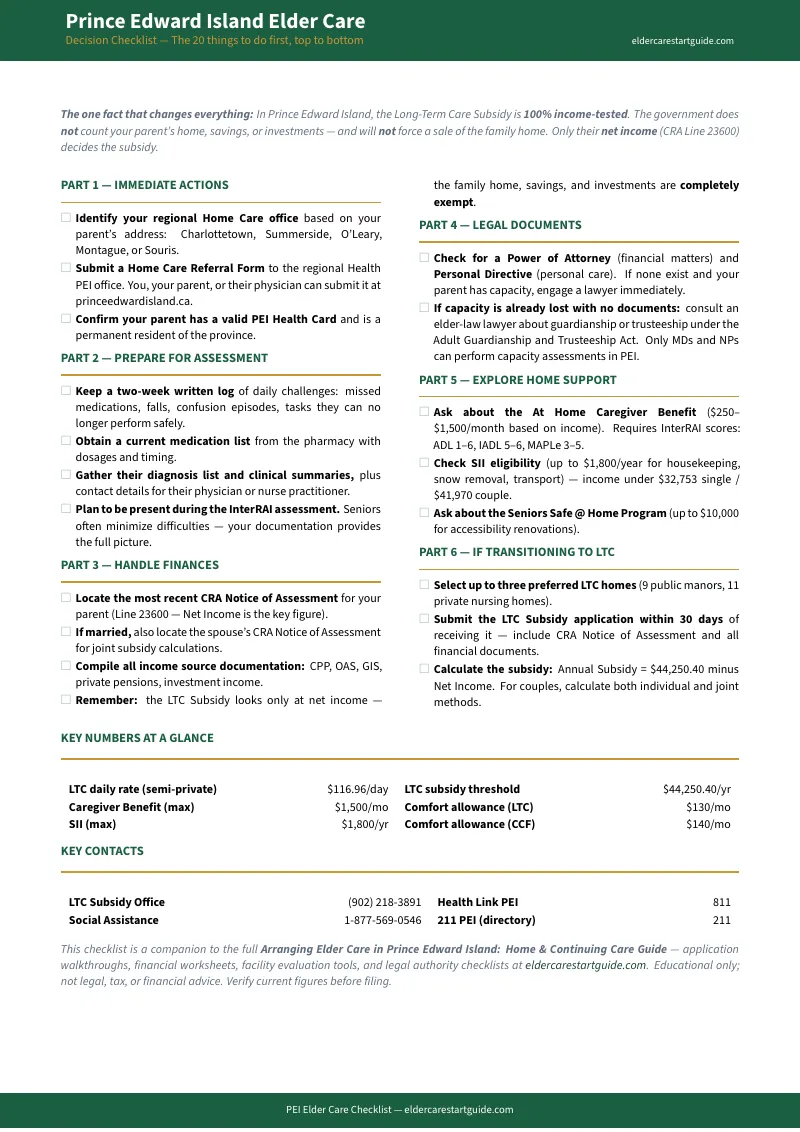
The PEI Elder Care Decision Checklist
One page. Priority order. Every action item from the first Home Care referral through the interRAI assessment, subsidy application, preferred-home selection, and waitlist management. The phone numbers, the regulation references, the deadlines — everything you need to track at a glance.
9 Standalone Printable Worksheets
Separate PDFs you can print and bring to appointments, assessments, and facility tours — without carrying the full guide:
- InterRAI Assessment Preparation Worksheet — ADL, IADL, and safety concern tables to fill in before the nurse visits
- Care Decision Framework — home care vs. long-term care comparison with cost crossover analysis
- LTC Subsidy Estimator — the income-only formula with individual and joint application calculations
- At Home Caregiver Benefit Eligibility Check — clinical score thresholds and application pathway
- Seniors Independence Initiative Eligibility — income and asset thresholds for up to $1,800/year in practical support
- Document Checklist — every document to gather before assessments and applications
- Facility Visit Checklist — staffing, environment, fees, and inspection questions for nursing home tours
- Key Contacts — all PEI elder care phone numbers and resources on one page
- Cost Comparison Sheet — every care rate, subsidy threshold, and benefit amount at a glance
Why Not Just Use the Government Website?
Health PEI publishes program descriptions and contact numbers. But it does not explain how to prepare a parent for the interRAI assessment so their actual needs are captured. It does not walk you through the subsidy formula with your parent's specific income. It does not tell you that the community-dwelling spouse is guaranteed a minimum income under the Low Income Measure, or that individual vs. joint application is a permanent decision with irreversible financial consequences.
Private home care agencies — Remember When HealthCare, Bayshore — provide excellent clinical services at $30 to $50+ per hour. But they do not help you navigate publicly funded programs, the LTC waitlist, or the subsidy system.
Elder law firms draft powers of attorney and wills. But they do not coordinate care assessments, home safety programs, or waitlist advocacy.
National lead-gen sites like A Place for Mom dominate search results but lack any PEI-specific policy context. They sell your phone number to facility sales teams.
The guide sits between all of these — translating raw Health PEI regulations into a sequential process you can execute yourself, covering the clinical, financial, and legal steps that no single professional service addresses end to end.
Who This Is For
- The adult child preparing for an interRAI assessment. The nurse is scheduled and you do not know what she evaluates or how to ensure your parent's actual daily needs are captured. The guide explains every scored domain and shows you how to prepare documentation in advance.
- The family dealing with hospital discharge pressure. Your parent is flagged ALC and the discharge planner is pushing a bed offer. The guide gives you the placement process, the interim bed rule, and the three-home preference so you can respond from knowledge rather than panic.
- The caregiver approaching burnout. You have been managing your parent's care alone and it is no longer sustainable. The guide walks you through the At Home Caregiver Benefit, respite options, and how to initiate the LTC placement process before a crisis forces it.
- The family member handling finances. You need to understand what a nursing home bed actually costs and whether the subsidy protects the family home. The guide walks through the income-only formula, spousal protections, and the appeal process if a subsidy is denied.
- The long-distance coordinator off-Island. Your parent lives in Charlottetown, Summerside, or a rural community and you are arranging everything remotely. The guide maps the regional intake offices, assessment steps, and key contacts so you can coordinate without flying in.
— Less Than One Hour of an Elder Law Attorney's Time
A single consultation with an elder law firm on PEI runs $300 to $500 — and that covers legal documents, not care navigation. The guide gives you the clinical, financial, and administrative framework that no attorney, home care agency, or government website provides in one place.
If it saves you one unnecessary private home care shift, one missed subsidy threshold, or one mishandled assessment — it has paid for itself many times over.
30-day satisfaction guarantee. If the guide does not give you a clearer path through Health PEI's continuing care system, email us for a full refund.