Your parent can't go home from the hospital. The nurse says they need continuing care. Nobody will tell you what happens next.
The hospital discharge planner says your parent is an Alternate Level of Care patient — they need a bed somewhere, but the two Elders' Homes in the territory are full and the continuing care waitlist is managed by a system nobody has explained to you. Maybe they go to Rankin Inlet. Maybe Cambridge Bay. Maybe a facility in Ottawa you've never visited, where nobody speaks Inuktitut.
Meanwhile, the bank won't release your parent's pension cheques to you because you don't have legal authority. The healthcare proxy your aunt found online turns out to be non-binding — Nunavut is the only jurisdiction in Canada without personal directives legislation. And nobody at the hospital can answer the question you're actually asking: if I don't act now, will my parent end up in a facility 3,000 kilometres from home?
The Northern Care Navigation System — every step mapped, in order, for Nunavut families
This guide translates Nunavut's entire elder care system into a single action sequence. It covers home care assessments, continuing care placement, medical travel logistics, legal authority, and the financial planning that nobody tells you about until it's too late. No jargon written for administrators, no southern Canadian assumptions, no referral commissions.
Every chapter addresses the specific regulatory environment of the territory — the territorial health system, the Powers of Attorney Act (S.Nu. 2005, c.9), the Guardianship and Trusteeship Act, and the medical travel policy guidelines — because the forms, timelines, and legal instruments that work in Ontario or British Columbia do not apply here.
What's inside
- The Home and Community Care assessment process — how to request an evaluation through your local community health centre, what the RAI/MAPLe clinical scoring measures, and how to present your parent's worst-day functioning to secure the maximum subsidized care hours (homemaking capped at five hours per week, personal care at two hours per day)
- Care levels and facility profiles — the full five-level continuum from home care through the Elders' Homes in Arviat, Baker Lake, and Iqaluit (Level 3, all at capacity) to the Continuing Care Centres in Cambridge Bay, Igloolik, Gjoa Haven, and Rankin Inlet (Levels 3–5), with what each level covers and who qualifies
- The Single Entry Access waitlist decoded — how Nunavut prioritizes continuing care beds by clinical urgency rather than chronological wait time, what the regional care teams and the Territorial Continuing Care Coordinator actually evaluate, and how to strengthen your parent's priority without misrepresenting their condition
- Medical travel and escort approvals — automatic escort approval criteria for unilingual Inuktitut-speaking elders aged 65+, the clinical documentation requirements for everyone else, escort agreement rules (minimum four-week stay, shared accommodation), and a fillable appeal template addressed to the Regional Director of Health with the specific Medical Travel Policy sections to reference
- Out-of-territory placement planning — what happens when Level 5 dementia care isn't available locally and your parent is sent to Embassy West in Ottawa, the hidden financial risks (the Government of Nunavut does not cover the return of remains for elders who pass away out-of-territory — costs can exceed $38,000), and the Repatriation Financial Safety Plan to protect your family
- Legal authority without personal directives — Nunavut has no personal directives or adult health proxy legislation, so a standard healthcare proxy carries no statutory weight. The guide provides the Enduring Power of Attorney (Form B) and Springing Power of Attorney (Form A) execution checklists, a Healthcare Wishes Evidence Template for building a non-statutory record that courts will consider, and the Tikkuaqtaujuq representative designation form under the Mental Health Act
- Court guardianship from start to finish — the Guardian Consent Form, Statutory Declaration of Relationship, coordination with the Office of the Public Guardian, and how to access Legal Aid through Maliiganik Tukisiinakvik (Iqaluit), Kivalliq Legal Services (Rankin Inlet), or the Kitikmeot Law Centre (Cambridge Bay)
- Federal benefits and the GIS clawback trap — how the Old Age Security Pension, Guaranteed Income Supplement, and territorial Senior Citizen Supplementary Benefit interact, and why a badly timed care transition can trigger a GIS-SCSB income clawback that costs your parent thousands
- 10 fillable worksheets — care assessment preparation, transition readiness checklist, facility comparison scorecard, family meeting consensus worksheet, agency communication log, Power of Attorney execution checklist, guardianship application checklist, medical travel escort checklist, benefits enrollment tracker, and the out-of-territory financial planning worksheet
Who it's for
This guide is for adult children in Nunavut arranging care for an aging parent — whether you're managing a hospital discharge crisis right now or watching a gradual decline and trying to plan ahead. It's especially useful if you're:
- Trying to keep your parent at home but unsure how to secure the maximum subsidized care hours before the system pushes toward institutional placement
- Facing a continuing care waitlist and unsure how the territory decides who gets a bed — and in which community
- Worried about your parent being sent to a facility in Ottawa, thousands of kilometres from family, where nobody speaks their language
- Discovering that the healthcare proxy you thought was valid has no legal force in Nunavut — and your parent's capacity is declining
- Coordinating care decisions across siblings scattered in different communities or provinces
- Trying to protect your parent's federal benefits from the income-threshold traps that trigger during care transitions
Why free government resources aren't enough
The Government of Nunavut's website lists programs that exist, but it does not explain how to access them in sequence. The 211 Nunavut directory gives you phone numbers, not a plan. National care portals like Comfort Life focus entirely on southern, private-pay models that don't exist in the territory. And the Legal Services Board can take weeks to process an intake when your parent needs legal authority now.
This guide organizes every fragmented step — from the home care assessment and the waitlist strategy to the legal forms and the financial safety plan — into a single, chronological action plan written specifically for Nunavut families.
Your files are protected
Every purchase includes instant PDF downloads and a full satisfaction guarantee. If the guide doesn't help you navigate your parent's care, contact us for a complete refund — no questions.
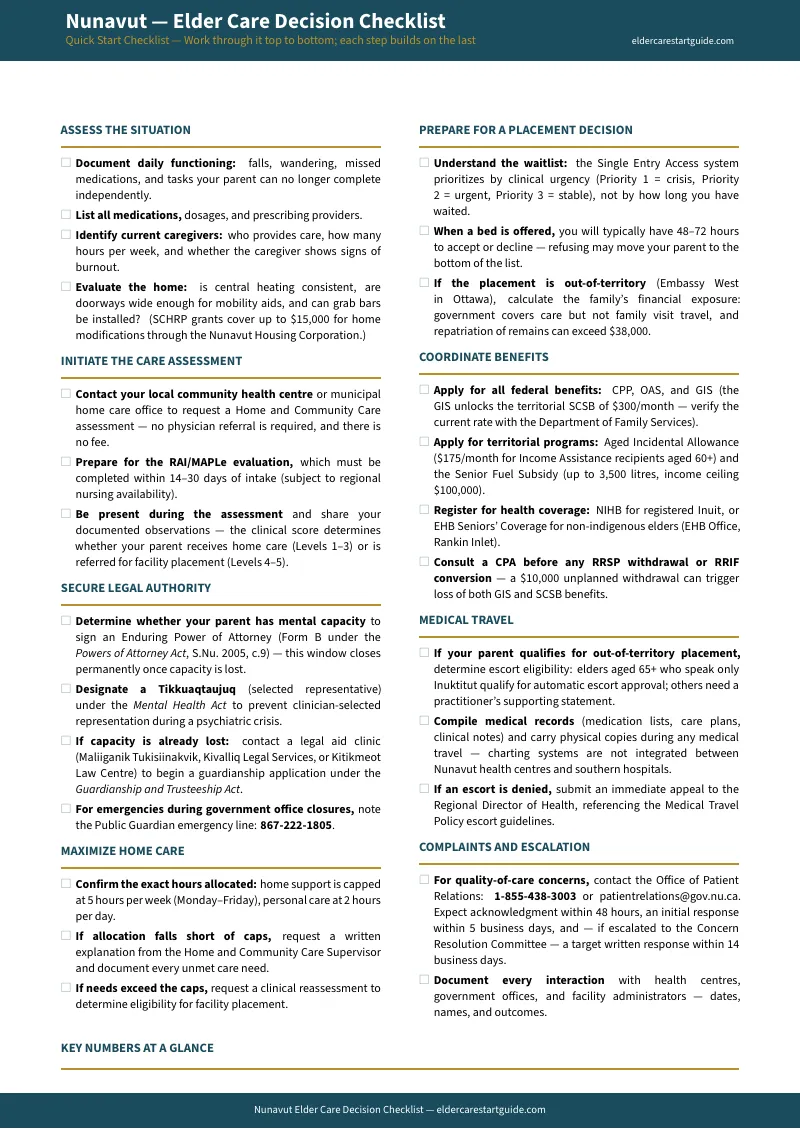
The free checklist gives you the 26-item decision sequence at a glance. The full guide gives you the step-by-step instructions, legal templates, financial worksheets, and facility profiles behind every item on that list.