Your parent's hospital discharge planner just gave you a deadline. The province's own manuals are hundreds of pages of policy language written for administrators, not for stressed families. You need the financial formula, the spousal protections, and the placement rules — in the order you'll actually use them.
The Continuing Care system in Nova Scotia is built on a simple principle: long-term care fees are income-tested, not asset-tested. Your parent's home, savings, and investments are entirely safe from seizure or forced sale. But the income-testing formula — Line 23600 minus Line 43500, assessed at 85%, with a Minimum Retained Income of $366 per month — is buried across disconnected government PDFs, and the consequences of getting it wrong are severe: miss a tax filing and the Eligibility Review Unit bills the full Standard Accommodation Charge of $114 per day with no reduction until the paperwork is complete.
The Nova Scotia Continuing Care Financial Roadmap translates the entire provincial system — from the first intake call to the final contract signing — into one chronological, plain-language manual. It is not a collection of policy summaries. It is an operational sequence: what to do first, what documents to gather, how to calculate the rate before the ERU does, and how to protect the community spouse's income at every step.
What's Inside
The Income-Testing Formula With Worked Examples
The province takes Line 23600 (Net Income) minus Line 43500 (Total Taxes Owed) from the most recent CRA Notice of Assessment and claims up to 85% of the result. Your parent keeps a guaranteed Minimum Retained Income of $366 per month. The guide walks through the full calculation at multiple income levels — single resident and married couple — so you can estimate the daily rate before the Eligibility Review Unit runs its own assessment. No spreadsheet skills required; every step is laid out in plain arithmetic.
The Spousal Income Protection System
When one spouse enters care and the other stays in the community, Nova Scotia protects 60% of joint family income for the community-dwelling spouse and applies a Spousal Income Threshold of $29,811 per year to reduce the institutionalized spouse's accommodation fees. On the federal side, the Involuntary Separation provision under the Old Age Security Act lets the couple be assessed as single individuals for GIS — often unlocking or dramatically increasing the community spouse's Guaranteed Income Supplement. The guide includes step-by-step instructions for completing the ISP3040 and ISP3025 Service Canada forms, with the exact filing sequence and timelines.
The Hospital-to-Care-Home Transition Sequence
If your parent has been designated Alternate Level of Care in hospital, the clock is running. Under Nova Scotia's First Available Bed Policy, an ALC patient must accept the first suitable bed within a 100-kilometre driving distance — with zero deferral rights. Refuse, and the province cancels the active application, removes your parent from all waitlists, and can begin charging a $373-per-day hospital overstay penalty. The guide maps the entire sequence: ALC designation, interim billing, bed-offer protocol, and the critical distinction between in-hospital patients (no deferral) and community-dwelling applicants (who may wait at home for a preferred vacancy but cannot defer an offer once it arrives).
The Financial Assessment Document Package
The ERU requires specific documents — the last two years of CRA Notices of Assessment, proof of spousal income, a copy of the Enduring Power of Attorney if active — and missing any of them triggers the full Standard Accommodation Charge until the file is complete. The guide provides the exact checklist, shows you how to expedite CRA documents when they are missing, and explains the annual reassessment process so a rate reduction earned this year is not lost next year because of a filing gap.
Home Care Fees and the Tipping-Point Calculator
Before facility placement, many families rely on publicly funded home support. Clinical nursing care is entirely free in Nova Scotia. Home support services — bathing, meal preparation, housekeeping — are billed on a sliding scale based on net income and family size. The guide explains each Home Care Income Category, the monthly billing caps, and the tipping point where median home care costs begin to rival a subsidized facility bed — so you can make the transition decision based on numbers, not guilt.
The Legal Authority Hierarchy — When a Power of Attorney Is Not Enough
A standard Power of Attorney covers financial matters only. It has no authority over healthcare consent or care placement decisions under Nova Scotia law. The Personal Directives Act establishes a statutory hierarchy of nearest relatives who can consent to placement when no formal directive exists. If your parent still has capacity, the guide walks through executing an Enduring Power of Attorney and a Personal Directive. If capacity is already diminished, it maps the statutory hierarchy and the court-ordered representation process under the Adult Capacity and Decision-making Act — including when the statutory safety net is sufficient and when you genuinely need a lawyer.
Tax Credits and Deductions That Offset Care Costs
The full nursing home accommodation charge qualifies as a medical expense under the Medical Expense Tax Credit (METC). The Disability Tax Credit provides a combined federal and provincial refund of up to $2,166. The Canada Caregiver Credit and attendant care deductions add further relief. The guide shows you when to claim 100% of nursing home fees versus splitting the DTC and attendant care, and how federal pension adjustments can reduce taxable income before the province even runs its income test.
The Care Home Contract Audit Checklist
Before signing the residency agreement, the guide walks you through the critical clauses: the bed-hold policy during temporary hospitalizations (licensed homes must hold the bed for up to 30 days), prohibited charges (no accommodation fee on the day of discharge), and the distinction between included services and permitted personal expense charges billed separately. One missed clause can cost hundreds of dollars a month in charges that should never have appeared.
Financial Hardship — Unlocking Locked-In Retirement Funds
If your parent's retirement funds are locked in a pension plan and their income does not cover the accommodation charge, the guide walks through the Form 12 Financial Hardship Application under the Nova Scotia Pension Benefits Regulations — including eligibility criteria, documentation requirements, and critical deadlines.
Seniors' Pharmacare and Prescription Drug Coverage
Prescription costs are not covered by the accommodation charge and come out of the $366 Minimum Retained Income. The guide explains Nova Scotia's Seniors' Pharmacare Program — premiums, co-payment thresholds, enrollment procedures, and how to coordinate Pharmacare with private drug plans to minimize out-of-pocket costs.
Who This Guide Is For
- The adult child in a hospital-discharge crisis — your parent has been designated ALC and the discharge planner is pushing for a bed decision within days. You need the placement rules, the financial application, and the penalty structure in one place.
- The family worried about losing the house — you have heard the government seizes assets to pay for care. In Nova Scotia, the assessment is strictly income-based. The guide explains exactly what is protected and where the real financial risk hides.
- The community spouse facing financial ruin — one partner is entering care and the other has a household to run. You need the 60% income protection, the Spousal Income Threshold, and the federal GIS unlock — not a 30-minute lawyer consultation.
- The exhausted home caregiver — you have been providing unpaid care for years and the home care costs are climbing. You need the numbers to compare home support fees against a subsidized facility bed and make the transition when it is time.
- The pre-crisis planner — your parent is not in crisis yet, but a cognitive decline diagnosis means the current arrangement will not last. You need to structure legal documents and CRA filings now so a future facility application is not sabotaged by this year's tax return.
Why Not Free Government Resources?
Every fact in this guide can be found — eventually — across dozens of disconnected government PDFs, legislative text, and fact sheets published by the Department of Seniors and Long-Term Care, Nova Scotia Health, Service Canada, and the CRA. The information is public. What does not exist anywhere is the sequence. No government page connects the clinical intake call to the ERU financial application to the spousal protection filing to the tax optimization strategy in chronological order. No fact sheet shows you how the 85% income formula interacts with the Involuntary Separation provision and the Spousal Income Threshold in a single worked example. The province writes manuals for its own administrators — families need a roadmap that starts from the intake phone call and ends at the signed contract.
Satisfaction Guarantee
If the guide does not give you a clearer path through the system than the hours you would spend assembling the same information from government websites, email [email protected] and we will make it right.
Get Started
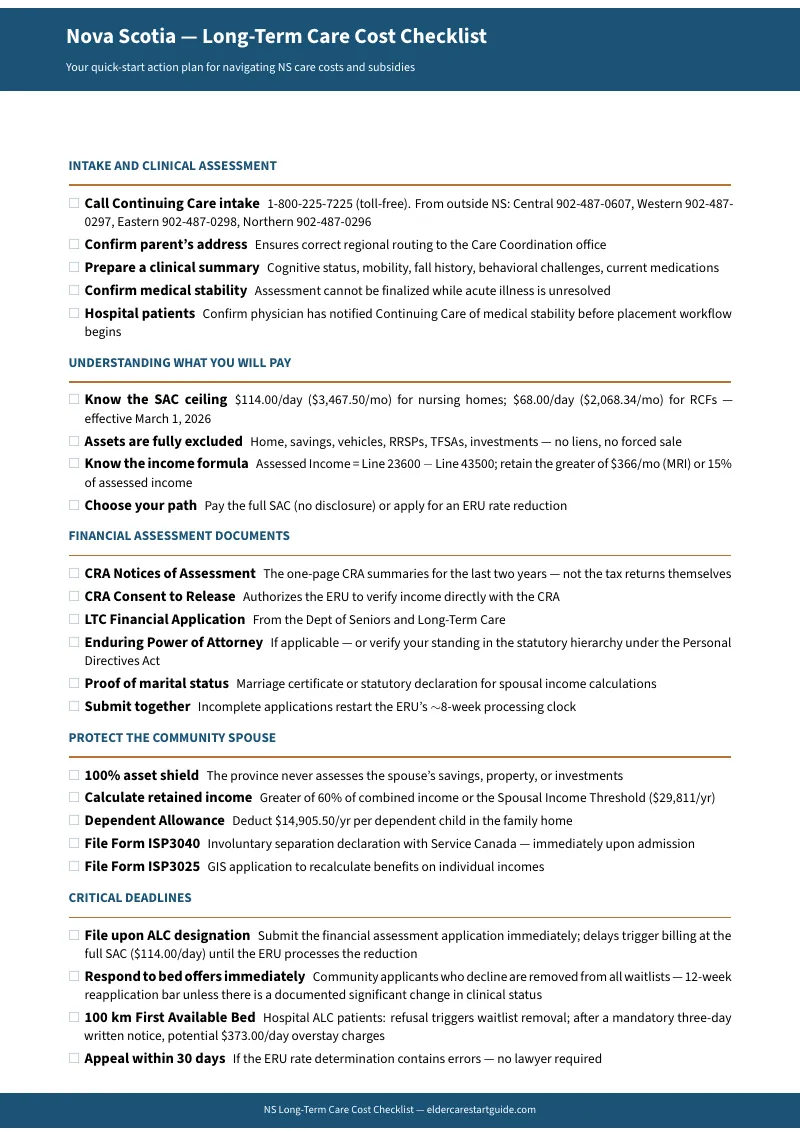
Download the free Nova Scotia Long-Term Care Cost Checklist — a two-page reference with the most critical action items, rates, and contacts. When you are ready for the full formula breakdowns, spousal protections, and the complete application sequence, the paid guide is available as an instant download — with 7 printable worksheets, calculators, and logs you fill in by hand and keep with your parent's care file.