
The Hospital Wants That Bed Back. And the System That Decides Your Parent's Care Runs on a 1-to-5 Score Nobody Explained to You.
Your parent had a fall, a stroke, or a sudden escalation of dementia. They are in a hospital bed in Halifax, Sydney, or Truro, and someone just told you they have been flagged as "Alternate Level of Care" — the hospital considers them medically stable and wants them moved. A discharge planner is talking about the First Available Bed policy: the first appropriate licensed bed within 100 kilometres, whether or not it is on your list. Refuse it, and your parent comes off the provincial waitlist — and the hospital can start charging a daily overstay rate.
Meanwhile, the entire public system runs through one phone line — Continuing Care at 1-800-225-7225 — and one in-home assessment. A Care Coordinator visits your parent, runs the standardized RAI-HC assessment, and the data produces a MAPLe priority score from 1 to 5. That single number gates publicly funded home care, facility respite, the $400-a-month Caregiver Benefit, and long-term care placement. And here is the part nobody warns you about: parents routinely tell the assessor they are managing fine. One proud sentence from your mother — "I get by on my own" — can downgrade the score that decides everything.
That is why Nova Scotia families make decisions they regret. They refuse a bed offer without knowing the 12-week reapplication penalty. They pay a private agency $30 to $35 an hour without knowing provincial nursing care at home is completely free. They assume the government will take the house to pay for a nursing home — when the financial assessment is income-only, and the home, vehicles, and investments are completely excluded. They find out their parent needed an Enduring Power of Attorney and a Personal Directive before capacity was lost — and now the family is staring at a Supreme Court application under the Adult Capacity and Decision-making Act.
The Continuing Care Navigation Blueprint
The Arranging Elder Care in Nova Scotia Guide is a process-navigation manual built for the adult child standing between a provincial bureaucracy and a hospital discharge deadline. It maps the entire Continuing Care system — intake, assessment, scoring, fees, waitlists, placement, and appeals — into one sequential plan, with the exact phone numbers, income thresholds, MAPLe criteria, and deadlines that decide outcomes.
This is not a pamphlet, and it is not a generic "how to care for aging parents" guide. It is a 12-chapter, Nova Scotia-specific reference covering the RAI-HC/MAPLe assessment, the income-tested fee tables, the $400 Caregiver Benefit eligibility tests, the First Available Bed and 100-km rules, the spousal income protections, and the legal authority documents — written for someone who needs answers this week, not next month.
What's Inside
The Intake Call — Scripted
Every publicly funded service in Nova Scotia starts with one call to Continuing Care. No doctor's referral needed. The guide gives you the exact preparation checklist — MSI number, medication list, safety summary — plus a first-call script that gets your parent triaged correctly from day one instead of routed into a months-long queue.
The Assessment — Where Families Win or Lose
A Care Coordinator evaluates your parent at home using the RAI-HC tool, and the resulting MAPLe score (1 to 5) controls access to nearly every program. The guide shows you what the coordinator actually measures, how to document falls, wandering, medication errors, and behavioural changes in advance, and how to present the full picture — so a parent performing independence does not sabotage their own eligibility.
Home Care — What's Covered and What It Costs
Personal care, essential housekeeping, respite, and nursing — with nursing services free and home support fees income-tested across provincial categories. The guide includes the fee table, the cost-share formula, the Self-Managed Care option that funds you to hire your own providers, and what to do when staffing shortages deliver fewer hours than approved.
The $400/Month Caregiver Benefit — Both Tests Decoded
The income test (net income of $31,661 or less single, $46,662 or less for a couple, from Line 23600 of the CRA Notice of Assessment) and the clinical test (MAPLe 5, or MAPLe 4 with severe cognitive or behavioural challenges), plus the 20-hour weekly care requirement. The guide walks through both so you know whether your family qualifies before you spend hours applying — plus the Seniors Care Grant and federal credits most families never claim.
The Real Numbers on Long-Term Care
The Standard Accommodation Charge, the income-only assessment that excludes the home and all assets, the 85%-of-income cap, the Minimum Retained Income your parent keeps for personal spending, and the spousal rules that protect 60% of joint income and every joint asset for the spouse at home. Fear of losing the house stops families from applying for care their parent is entitled to — this chapter ends that fear with the actual formula.
Waitlists and Placement — The Rules With Teeth
How the provincial waitlist actually prioritizes, how to choose preferred communities strategically, the one-day deadline to accept a bed offer, why charges run from the offer date rather than move-in, and the 12-week penalty for refusing a preferred bed. Plus the Life Partners in Long-Term Care Act provisions that keep spouses together.
Hospital Discharge — The ALC Pressure Point
What the ALC designation really means, how the First Available Bed policy and the 100-km radius apply to hospital patients, what the daily overstay charge is and when it starts, and word-for-word approaches for working with discharge planners — including how accepting an interim bed preserves your transfer rights to preferred homes.
Choosing a Facility — Tours and Inspections
What to evaluate on a facility tour, which inspection reports to request, the staffing and safety questions that reveal how a home actually operates, and the practical rules for comparing homes inside your 100-km radius before a bed offer forces the decision.
Legal Authority — Before Capacity Is Lost
The Enduring Power of Attorney (finances) and the Personal Directive (health and personal care) are separate documents under separate laws — neither works after capacity is gone. The guide covers the witness requirements, the statutory decision-maker hierarchy when nothing exists, and what an ACDMA court application actually costs and involves, including the province's capacity-assessment subsidies.
Appeals — The 30-Day Review Window
Denied services or inadequate hours? The Service Eligibility Decision Review Policy gives you 30 days to request a formal review in writing. The guide covers the request structure and the evidence — daily care logs, medical records — that makes reviews succeed.
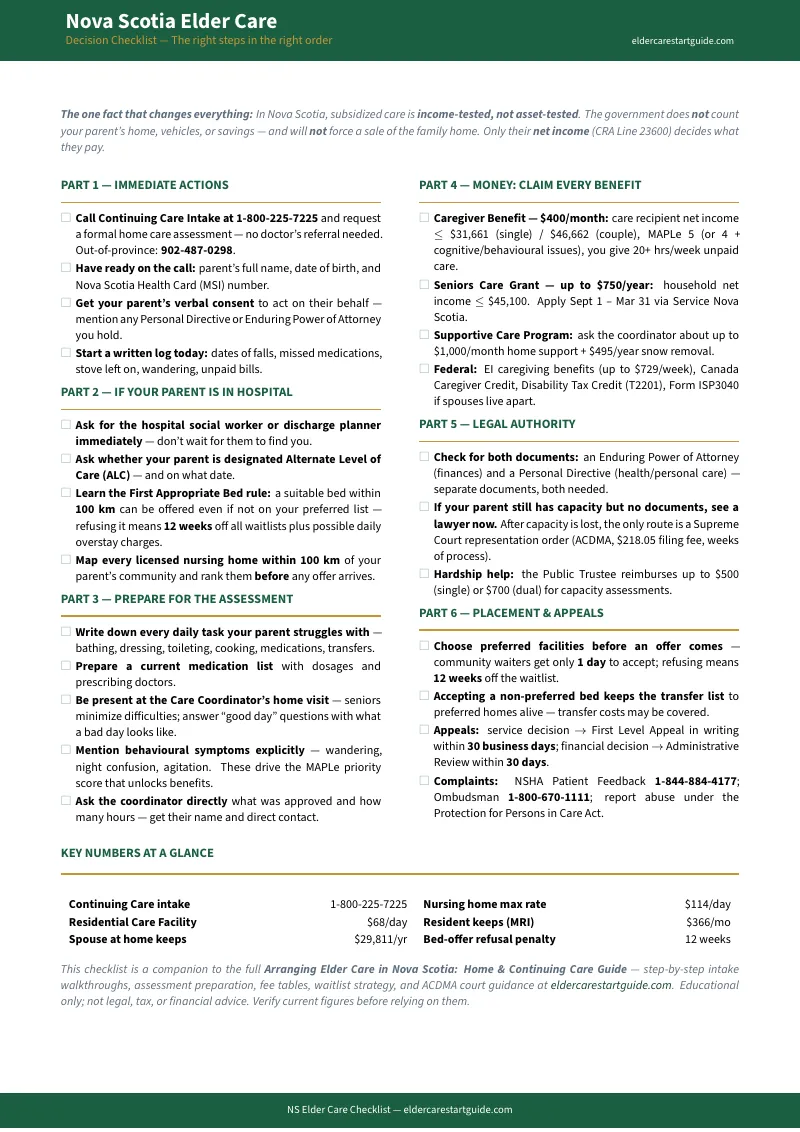
The Nova Scotia Elder Care Decision Checklist
One page. Priority order. The intake number, the assessment prep list, the MAPLe thresholds, the bed-offer deadlines, the income limits, and every key contact and rule at a glance.
Eight Printable Worksheets and Trackers
Every tool below is a standalone, fillable PDF — print it, write on it, bring it to the appointment:
- Intake Call Prep Card — everything to have in front of you before dialling 1-800-225-7225, with the first-call script and a call record
- Care Incident & Observation Log — the dated, specific incident record that drives the MAPLe score and wins appeals
- Assessment Preparation Worksheet — documents to gather, your speaking points for the visit, caregiver-distress answers, and the questions to ask afterward
- Caregiver Hours Weekly Tracker — document the 20+ weekly hours the $400/month Caregiver Benefit requires
- Facility Tour & Comparison Worksheet — the questions that reveal how a home actually runs, with a scoring grid — one print per facility
- 100-km Facility Mapping Worksheet — map and rank every licensed facility inside the First Available Bed radius before an offer forces the decision
- Bed Offer Decision Worksheet — price the refusal against the acceptance before you answer the one-day deadline
- Legal Authority Document Tracker — EPOA and Personal Directive status, witness requirements, and the ACDMA checklist if court is the only route
Who This Is For
- The adult child in a discharge crisis — your parent is ALC, the discharge planner is pushing a bed decision, and you need the First Available Bed rules and the overstay-fee exposure explained before you agree to anything.
- The family trying to keep a parent at home — you are paying a private agency out of pocket and you need to know what the province funds, from income-tested home support to free nursing care to Self-Managed Care.
- The exhausted caregiver — you provide 20+ hours of unpaid care a week and need respite options and the $400 Caregiver Benefit, with the exact eligibility thresholds spelled out.
- The sibling without legal authority — the bank will not talk to you and no POA or Personal Directive exists. The guide maps your options, from the statutory decision-maker hierarchy to the ACDMA.
- The long-distance coordinator — your parent lives alone in Nova Scotia and you are arranging everything from another province. The guide maps the contacts, the sequence, and the timelines so you can do it remotely.
Why Not Just Use the Government Website?
Nova Scotia Health and novascotia.ca list program criteria and phone numbers. They do not tell you how to prepare for the assessment so your parent is not under-scored. They do not explain how the waitlist prioritizes or what the refusal penalties really cost. They do not map intake, assessment, fees, placement, and legal authority into one sequential plan — because those pieces live across three different government departments. The excellent Caregivers Nova Scotia handbook informs; it does not hand you scripts, checklists, and decision rules for the week you are actually in.
Hospital social workers are invaluable, but their mandate is to free up acute care beds — they are structurally constrained from advising you on assessment strategy or financial protection. An elder-law lawyer charges $150 to $500 per hour — money well spent for executing an Enduring Power of Attorney, but an expensive way to learn how the care system works. A private geriatric care manager runs $90 to $250 per hour, plus an $800 to $2,000 initial assessment.
This guide fills the gap between free government portals that list rules without explaining strategy and professional consultations that bill by the hour. It is the preparation that makes every later professional conversation shorter, cheaper, and more effective.
100% Satisfaction Guarantee
If the guide does not help you navigate the Nova Scotia care system, email [email protected] for a full refund. No forms, no waiting period.
— A Fraction of One Hour With a Care Manager
A private geriatric care manager charges $90 to $250 per hour, after an $800 to $2,000 assessment. An elder-law consultation runs $150 to $500 per hour. Private home care costs $3,000 or more per month at agency rates. This guide covers the entire public system — intake, assessment, fees, waitlists, placement, and legal authority — for less than any of those first hours.
Start with the free checklist to see the action items. When you are ready for the full 12-chapter guide with the assessment preparation, the MAPLe criteria, the fee tables, and the waitlist strategy, the complete toolkit is one click away.
Instant PDF download. Printable. Every phone number, threshold, and deadline in one place.