Your parent's care crisis in Newfoundland won't wait for you to figure out the system.
A fall. A stroke. A slow decline that crossed the line last Tuesday. Your parent is in a hospital bed — classified as Alternate Level of Care — and the discharge team is pushing for a decision. You have days, not weeks. And nobody at the nursing station is going to explain that the provincial co-payment formula will consume 87% of your parent's income, that a standard Power of Attorney dies the moment your parent loses capacity, or that filing the wrong paperwork locks the family into the maximum billing rate.
Meanwhile, the government websites are a maze. NL Health Services absorbed the province's four regional health authorities, scattering intake forms, clinical jargon, and outdated archives across multiple portals. The co-payment calculations are buried in policy manuals. The legal requirements are spread across three different statutes. You would need days to piece together what you need — and your parent's discharge planner is calling again this afternoon.
The NL Continuing Care Navigator — one document that replaces weeks of research
The Arranging Elder Care in Newfoundland and Labrador Guide consolidates the province's clinical assessment system, financial formulas, home support programs, placement process, and legal requirements into a single step-by-step manual. It is written for the adult child who needs to make decisions this week — not a policy analyst reviewing the system at arm's length.
This is not a generic Canadian eldercare overview. Every formula, threshold, contact number, and legal requirement is specific to Newfoundland and Labrador's provincial system as it operates today.
What's inside
The co-payment calculator you can't find anywhere online. A single resident entering long-term care pays 87% of net monthly income, leaving a $150 comforts allowance. When a spouse stays in the community, the co-payment drops to 23% of combined income. The guide walks through both formulas with worked examples, including the 3-month home maintenance deduction for homeowners and the funeral policy exemption — so you can project what your parent will actually pay before accepting a bed offer.
The five-zone intake directory with direct phone numbers. NL Health Services operates through Eastern-Urban, Eastern-Rural, Central, Western, and Labrador-Grenfell health zones. The guide provides the direct Community Support Program intake numbers for each zone — bypassing hospital switchboards and main reception lines that route you in circles.
Three home support models compared side by side. Self-Managed Care lets the family hire and direct workers. Agency-Managed Care uses a contracted agency. Paid Family Caregiving compensates a relative (excluding spouses) for providing care. Each model has different income-tested contributions and employer obligations. The guide explains who qualifies for each, how the contribution is calculated, and when switching models makes sense.
The legal authority audit that prevents a $10,000 court battle. Under NL law, a standard Power of Attorney becomes void the moment the donor loses mental capacity. Only an Enduring Power of Attorney — with specific enduring clauses and independent witness requirements — survives incapacity. Without one, the family's only option is an application to the Supreme Court for Letters of Guardianship under the Mentally Disabled Persons' Estates Act. The guide explains both documents, the Advance Health Care Directive, the Section 10 substitute decision-maker hierarchy, and the 12-month contact rule that can disqualify a family member.
The Adult Needs Assessment preparation guide. A community health nurse evaluates your parent's Activities of Daily Living, cognitive function, and behavioural needs. The result determines whether your parent qualifies for Level 1/2 care (Personal Care Home) or Level 3/4 care (long-term care facility). The guide explains exactly what the assessor measures, how to document your parent's true daily challenges before the visit, and what to do if the assessment doesn't capture reality.
The placement process and waitlist mechanics. Long-term care beds are assigned by clinical urgency, not chronological order. The guide covers the single preferred home policy, what happens when a bed is offered, the consequences of refusing, and strategies for managing the wait — including up to 30 days of annual respite care in a licensed facility.
Who this is for
- The adult child facing a hospital discharge crisis — your parent is flagged ALC and the discharge team is pushing a placement decision. You need to understand the co-payment formula, the placement process, and your rights under Home First before you agree to anything.
- The long-distance caregiver in Alberta or Ontario — your parent lives in Newfoundland and you are coordinating everything by phone. You need the zone-by-zone intake numbers, the financial thresholds, and the legal documents to manage remotely.
- The family caregiver approaching burnout — you have been providing daily care and you need to know what public home support is available, how the Paid Family Caregiving model works, and how to initiate placement before the situation becomes a crisis.
- The proactive planner — your parent is managing for now, but you see the decline. You need to establish legal authority and understand the system before a fall or cognitive event forces decisions under pressure.
Why not piece it together from government websites?
You could. In theory, every policy referenced in this guide is public information. In practice, the consolidation of the province's four regional health authorities into NL Health Services left the public web presence fragmented — archived pages from Eastern Health, Central Health, Western Health, and Labrador-Grenfell sitting alongside new NL Health Services portals. The co-payment formulas are buried in policy manuals that assume clinical vocabulary. The legal statutes are scattered across three separate acts. The intake contact numbers are region-specific and rarely listed in one place.
The guide is what you would build for yourself if you had 40 hours, legal training, and clinical familiarity with the provincial system. It costs less than a 30-minute lawyer referral through PLIAN — and it ensures you don't waste that referral asking questions the guide already answers.
What you get
- The Complete Guide (49-page PDF) — the full step-by-step manual covering assessments, financial formulas, home support models, placement, and legal authority
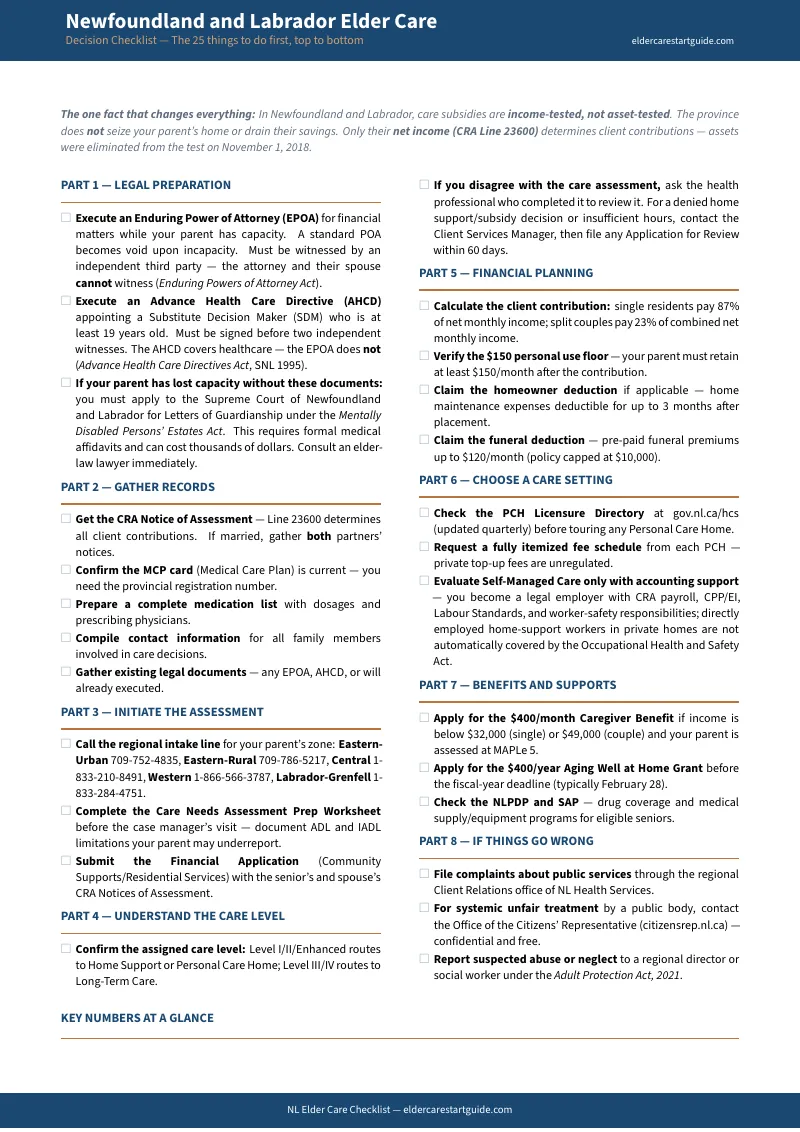
- The NL Elder Care Decision Checklist (printable PDF) — a two-page action-item reference with every critical contact, deadline, and document requirement
- Care Needs Assessment Prep Worksheet — document your parent's ADL and IADL challenges before the case manager's visit
- Financial Documentation Organizer — every document the financial assessment officer needs, in one checklist
- Client Contribution Calculator — fill-in worksheet for the 87% single-resident and 23% split-couple formulas
- Personal Care Home Evaluation Checklist — structured scoring sheet for facility tours, including the quality indicators flagged by the April 2025 Auditor General's report
- Agency Communication Log — track every call, meeting, and commitment with NL Health Services and facility administrators
- Legal Authority Readiness Checklist — the requirements for executing an Enduring Power of Attorney and Advance Health Care Directive under NL law
All 8 files are yours permanently. Download, print, and reference as many times as you need.
Satisfaction guarantee
If the guide does not give you a clear, actionable understanding of Newfoundland and Labrador's continuing care system, email [email protected] and we will refund your purchase. No forms, no conditions.
Your parent's care decisions should not be made under pressure with incomplete information.
Or download the free checklist first — a two-page intake readiness reference to get started tonight.