
In New Hampshire, 44 Hours of Weekly Home Care Costs the Same as Assisted Living
Your parent needs more help than you can give. You've started searching for care options in New Hampshire and the first thing you discover breaks every assumption: home health aides average $7,436 per month for 44 hours of weekly care. The statewide median for assisted living is $7,431 per month. Part-time home care — far from around-the-clock supervision — costs virtually the same as a residential placement. The option you assumed was affordable isn't cheaper than the facility you assumed was out of reach.
That's only the first complication. New Hampshire splits assisted living into two licensing tiers that most families don't discover until mid-crisis: He-P 804 for residents who can self-evacuate during a fire alarm, and He-P 805 for those who cannot. Place a wheelchair-dependent parent in an He-P 804 facility, and they face involuntary discharge the moment a quarterly fire drill reveals the mismatch. The state has no standalone memory care license — dementia programs run inside standard facilities under RSA 151:47-52, with training requirements most families don't know to verify. And the main Medicaid home-care program, the Choices for Independence waiver, cannot pay for assisted living room and board — a distinction that catches families mid-application, after months of paperwork.
The New Hampshire Care Decision System
This guide maps the complete care decision pathway through New Hampshire's regulatory framework — from the initial needs assessment through care setting comparisons, Medicaid eligibility, the CFI waiver application via NH EASY, facility licensing and vetting, contract review, and ombudsman advocacy. Every cost figure, asset threshold, waiver rule, and contact number is specific to New Hampshire's DHHS Health Facilities Administration, the regional ServiceLink ADRCs, and the Long-Term Care Ombudsman.
What separates this from government portals and placement referral sites: it connects systems that New Hampshire treats as separate processes. Your parent's Medical Eligibility Assessment through ServiceLink, their CFI waiver application on NH EASY, the licensing tier of the facility you're touring under He-P 804 or He-P 805, and the inspection history on that facility's DHHS record all interact. The guide shows how these pieces fit together so you can sequence each decision in the right order — instead of discovering halfway through that the assisted living community you chose can't legally provide nursing services, or that the Braiterman ruling means your parent's irrevocable trust doesn't actually protect the family home from Medicaid recovery.
What's Inside — Printable PDFs
- The Complete Guide — twelve chapters covering every stage of the care decision: recognizing decline through ADL and IADL tracking, understanding New Hampshire's full care spectrum (home care, assisted living under He-P 804/805, supported residential, memory care, nursing homes), Medicaid financial eligibility and the Medically Needy spend-down pathway, the Choices for Independence waiver vs. nursing home Medicaid, legal authority (Durable POA under RSA 564-E, Healthcare Advance Directives under RSA 137-J, guardianship under RSA 464-A), facility vetting and contract review, crisis hospital discharge planning, a complete forms directory, professional referral triggers, and printable worksheets
- Care Needs Assessment Worksheet — a standalone printable evaluation of your parent's ADLs, IADLs, and cognitive concerns that mirrors what ServiceLink assessors measure during the Medical Eligibility Assessment, so you walk into any professional evaluation already knowing where your parent stands
- Care Setting Comparison Card — home care, assisted living (He-P 804), supported residential (He-P 805), memory care, and nursing homes compared side by side with New Hampshire median costs, the home-to-facility tipping point calculation, and Medicaid coverage status for each setting
- Financial Snapshot & Lookback Audit — a standalone worksheet for income sources, countable assets, exempt property, spousal protections (CSRA up to $162,660 and MMMNA), and the full 60-month transfer audit with New Hampshire's estate recovery rules and the Braiterman irrevocable trust implications
- Crisis Roadmap — a one-page survival guide for the hospital discharge window: who to call, what to request from the discharge planner, legal priorities, and how to resist a rushed placement when Medicare's skilled nursing benefit runs out
- Facility Vetting Checklist — a printable checklist for desktop research (DHHS Health Facilities License Search, CMS Care Compare, complaint hotline 1-800-852-3345) and unannounced tours with questions about licensing tier, staffing ratios, overnight coverage, and discharge triggers
- Facility Tour Comparison Scorecard — a side-by-side scorecard to rate up to three facilities on cleanliness, staffing, inspection history, emergency protocols, activity programming, and overall impression
- Essential Contacts & Ombudsman Directory — every state agency, regional ServiceLink offices, the Long-Term Care Ombudsman (1-800-442-5640), online portals, key state forms, and the formal complaint process
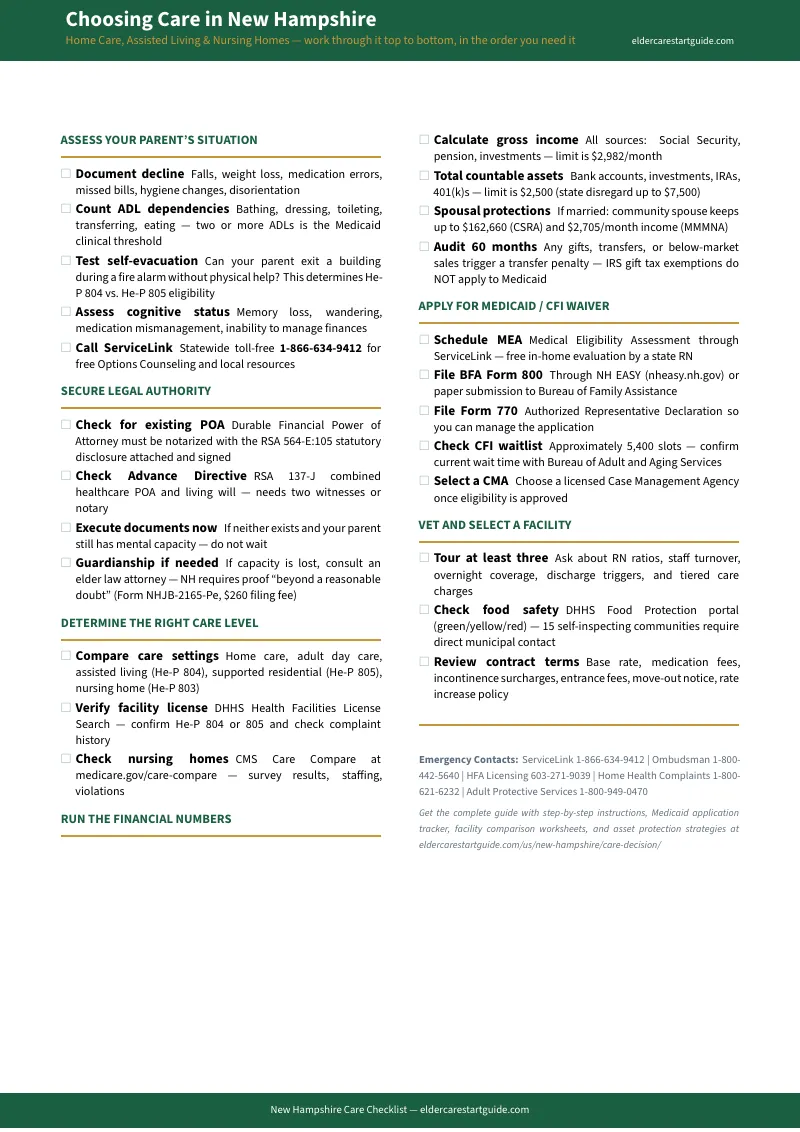
- 20-Item Decision Checklist — a printable quick-start checklist covering the key actions from needs assessment through post-placement monitoring
Who This Is For
- Adult children watching a parent's slow decline — missed medications, skipped meals, unexplained bruises — who need a structured way to evaluate whether it's time for outside help
- Families in a hospital discharge crisis, with a discharge planner pushing for a quick decision about what comes next and Medicare's skilled nursing benefit running out
- Anyone comparing home care vs. assisted living vs. nursing home care in New Hampshire and trying to understand the real cost differences — especially the counterintuitive math where home care matches facility costs
- Families trying to qualify for the Choices for Independence waiver and navigating the Medical Eligibility Assessment, the $2,500 asset limit, and the 60-month look-back period
- Siblings who disagree about what level of care is appropriate and need a clinical framework based on ADL deficits rather than competing opinions
- Out-of-state adult children coordinating care from Nashua, Manchester, or the Seacoast while their parent lives in the Lakes Region or North Country
Why Free Resources Leave You Stuck
New Hampshire DHHS publishes facility lists, licensing rules, and waiver descriptions. But these resources are written for surveyors and facility administrators — He-P 804, He-P 805, and RSA 151 are not family care-planning guides. You can find the CFI waiver eligibility criteria scattered across the administrative code, but you won't find a walkthrough that connects the Medical Eligibility Assessment to the financial application to the Case Management Agency assignment in a sequence a family can follow.
Senior living referral services like A Place for Mom will match you with communities for free — because the facilities pay them a percentage of the first month's rent as a commission. They have a structural incentive to recommend private-pay communities over Medicaid-funded programs, and they don't help families navigate the CFI waiver application or the NF Level of Care assessment. Their recommendations are shaped by revenue, not your parent's needs.
Elder law attorneys provide expert guidance on asset protection and Medicaid planning — at $300 to $500 per hour. For families with complex estates or questions about irrevocable trusts after the Braiterman ruling, professional counsel is essential. But you shouldn't need to pay attorney rates to learn the basic difference between He-P 804 and He-P 805 licensing or understand how the Medically Needy spend-down works. Using this guide to organize your records and understand the system before your first consultation can save hours of billable time.
Satisfaction Guarantee
If the guide doesn't help you identify at least one care setting, waiver program, or vetting step you weren't already aware of, email us for a full refund. No forms, no waiting period.
Start Navigating New Hampshire Elder Care with Confidence
Download the free checklist to get the care decision overview — or get the full toolkit for and have all the printable PDFs: the complete guide, standalone worksheets, comparison tools, vetting checklists, and contact directories you need to choose the right care for your parent in New Hampshire.