
Memory Care in Delaware Costs $8,558 a Month. The Asset Limit Is $2,000. Nobody Mentioned That Delaware's Managed Care Capitation Recovery Can Bill Your Family for Services Your Parent Never Used.
Your parent is wandering. The facility wants private-pay rates. The social worker mentioned "Diamond State Health Plan Plus" and told you to call the ADRC. You Googled it and found two managed care organizations — Highmark Health Options and Delaware First Health — and no clear explanation of what either one actually does for dementia patients, what they cover, or how to choose between them.
Then you found the financial numbers: $2,000 in countable assets for a single applicant. A $2,982 monthly income cap that Delaware enforces rigidly — no spending down excess income on medical bills like other states allow. If your parent earns a dollar over the cap, you need a Qualified Income Trust (Miller Trust) with the State of Delaware named as the remainder beneficiary. And if your parent's home equity exceeds $752,000 — not hard in Hockessin, north Wilmington, or the Rehoboth Beach corridor — the house itself becomes a countable asset.
What the discharge planner didn't mention: under Delaware's managed care capitation system, the state pays MCOs a flat monthly rate regardless of what services your parent actually receives. When your parent passes, the Medicaid Estate Recovery Program (MERP) can bill your family for the entire accumulated capitation amount — not what care cost, but what the state paid the MCO every month. A parent who received minimal care coordination can generate a recovery claim nearly identical to one who used every available service.
The Delaware Dementia Care Navigation System
This isn't a summary of DSHP-Plus rules you could piece together from DHSS.Delaware.gov, elder law blogs, and A Place for Mom listings. The Delaware Dementia Care Navigation System maps the exact sequence of clinical screenings, legal authority decisions, MCO enrollment choices, facility evaluations, and asset-protection strategies your family needs — starting from wherever you are right now — so you don't lose the family home because you did things in the wrong order.
The critical mistake most Delaware families make: they place a parent in a memory care facility before establishing legal authority. A durable Power of Attorney only works if your parent has the cognitive capacity to sign it. Once that window closes — and dementia closes it permanently — your only option is a formal guardianship petition in the Delaware Court of Chancery, where the court appoints an Attorney Ad Litem to investigate you, requires annual financial accountings (Form CM22), annual medical statements (Form CM21), and charges you legal fees that can run into thousands of dollars. The guide puts you in the right order: legal authority first, then clinical screening, then financial planning, then placement.
What You Get
- 13-Chapter Guide — The complete Delaware Dementia Care Navigation System: the diagnosis and clinical evaluation process, legal planning (POA vs. healthcare directives), Court of Chancery guardianship (forms, Attorney Ad Litem investigation, annual reporting), home safety and community supports, wandering prevention and Gold Alert enrollment, facility selection using Chapter 25K dementia disclosures, DSHP-Plus Medicaid eligibility (Pre-Admission Screening, financial thresholds, Miller Trust requirements), MCO comparison and enrollment, Medicaid appeals, estate recovery defenses (probate-only limitation, caregiver-child exemption, sibling-with-equity exemption), and professional referral thresholds. Every dollar figure reflects 2026 Delaware regulations.
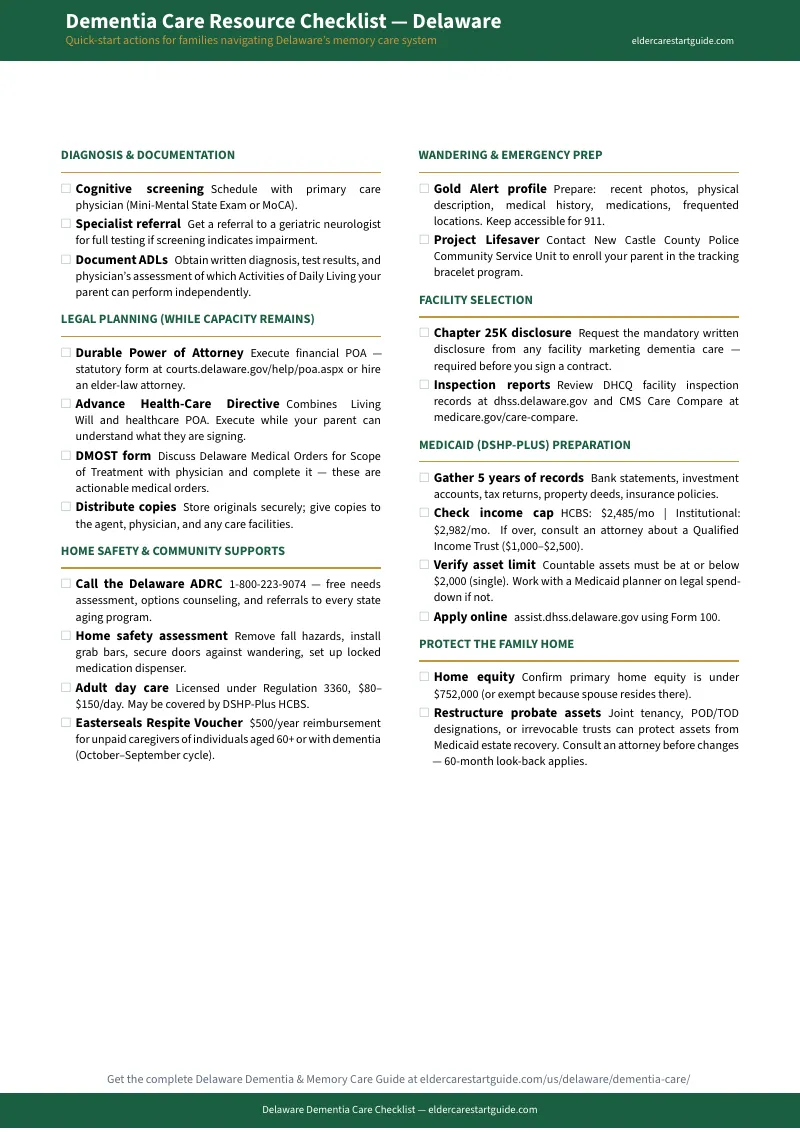
- Quick-Start Checklist (Free Download) — 21 actionable items organized across 7 sections: immediate safety measures, legal authority assessment, financial snapshot, Medicaid eligibility check, facility evaluation prep, estate protection steps, and professional consultation triggers. Know exactly what to do tonight, this week, and this month.
- 6 Standalone Printable Tools — Ready to print and bring to facility tours, attorney meetings, and emergency situations:
- Chapter 25K Facility Comparison Worksheet — Side-by-side comparison for touring up to 3 memory care facilities, based on Delaware's mandatory disclosure law
- Asset Protection Worksheet — Audit which assets pass through probate and which are safe from Medicaid estate recovery
- Medicaid Eligibility Quick Reference — One-page fridge sheet with all 2026 DSHP-Plus financial thresholds, asset rules, and key contacts
- Guardianship Requirements Tracker — Court of Chancery compliance deadlines, annual reporting forms (CM21/CM22), and end-of-guardianship actions
- Crisis Contacts Fridge Sheet — Every Delaware phone number you need at 2am: ADRC, DMMA, DHCQ, Ombudsman, Alzheimer's Association, Project Lifesaver
- Gold Alert Emergency Profile — Pre-filled form with your parent's description, medical info, vehicle details, and likely wandering destinations — ready to read to a 911 dispatcher
Who This Guide Is For
- Adult children in Delaware coordinating memory care for a parent with dementia — whether you're managing a crisis today or planning ahead after an early-stage diagnosis
- Families trying to understand whether DSHP-Plus covers memory care costs, what Highmark or Delaware First Health actually coordinate, and what you still pay out of pocket
- Caregivers whose parent can no longer sign a Power of Attorney and who need to navigate the Court of Chancery guardianship process without an attorney on retainer
- Families facing the $2,000 asset limit, the $2,982 income cap, or the 60-month lookback period who need a clear spend-down sequence before filing
- Anyone touring memory care facilities in Delaware who wants to use the Chapter 25K Dementia-Care Disclosure Law to demand staffing ratios, specialized fees, and medication policies in writing before signing an admission agreement
- Out-of-state siblings coordinating a Delaware parent's care remotely and needing every ADRC contact, DHCQ number, MCO enrollment deadline, and Chancery Court form in one place
Why Free Information Isn't Getting You Anywhere
The Delaware ADRC publishes phone numbers and brochures. DSAAPD has caregiver support pages. The Division of Medicaid and Medical Assistance posts eligibility thresholds. The Court of Chancery has downloadable guardianship forms. All of this is public, all of it is free, and none of it tells you what to do first.
A Place for Mom and Caring.com rank well on Google, but their business model is referral fees from private-pay facilities. They are structurally incentivized to steer your parent toward a placement, not to help you qualify for DSHP-Plus home and community services that carry no referral fee. They won't explain the Pre-Admission Screening, the MCO enrollment decision, or the consumer-directed option that lets you get paid to care for your own parent.
The elder law firms in Wilmington, Newark, and Dover publish helpful blog posts about Medicaid planning. Every one ends with a call to schedule a consultation at $300 to $500 per hour. A comprehensive Medicaid planning package runs $5,000 to $12,000. Their content is designed to sell legal services, not to give you a complete, executable sequence you can follow yourself.
This guide fills the gap between the state website that gives you facts without sequence, the law firm that gives you sequence through a five-figure engagement, and the referral site that steers you toward placements you may not need.
Satisfaction Guarantee
If this guide doesn't give you a clear, actionable path through Delaware's dementia care, Medicaid, and legal systems, email [email protected]. We read every message.
— Less Than One Hour of an Elder Law Attorney's Time
Delaware elder law attorneys charge $300 to $500 per hour. A guardianship petition in the Court of Chancery costs thousands in legal fees and Attorney Ad Litem expenses. A single procedural mistake — a lookback penalty from a gift to a grandchild, a Power of Attorney executed after your parent lost capacity, a Miller Trust without the state named as remainder beneficiary — can delay Medicaid eligibility by months and cost your family tens of thousands in private-pay rates.
This guide won't replace an attorney when you need one (and it tells you exactly when that is). But it will save you hours of research, prevent the most expensive mistakes, and ensure you walk into any conversation — with the ADRC, the MCO, the nursing facility, or the elder law firm — knowing exactly what Delaware law requires.
Download the free Quick-Start Checklist to see the 21 most urgent action items. When you're ready for the complete system, the full guide is waiting.