Your Parent Has Dementia. Arkansas Has Three Medicaid Pathways, Two Waivers With Separate Waitlists, and a 300-Question Assessment Standing Between You and Coverage.
The neurologist said "Alzheimer's" and left the room. Now your mother is wandering at 2 a.m., the stove has been disconnected, and you are spending every evening scanning DHS websites trying to figure out which program pays for what. You find the ARChoices waiver but can't tell whether she qualifies. You see the Living Choices waiver but realize it doesn't cover room and board. You call the Area Agency on Aging and get a voicemail.
Meanwhile, private-pay memory care in Arkansas runs roughly $6,000 per month. Each month without Medicaid coverage is another month draining savings. Each day without legal authority is another day the bank won't let you access her accounts. And once she can no longer understand the documents she's signing, the window to establish a simple power of attorney closes permanently — forcing you into a probate guardianship that costs thousands and takes months.
The Arkansas Dementia Care Navigation System
This isn't a pamphlet with a hotline number. The Arkansas Dementia Care Navigation System walks you through every clinical, legal, and financial step of managing a parent's dementia care in Arkansas — from the first diagnosis through Medicaid qualification, the ARIA assessment, care placement, wandering safety, and long-term asset protection — in the order you actually need them.
The guide is built around the reality that Arkansas splits dementia care funding across three separate Medicaid pathways (ARChoices in Homecare, the Living Choices Assisted Living Waiver, and Institutional Medicaid), each with its own eligibility rules, application process, and waitlist. One wrong move — applying for the wrong waiver, missing the Miller Trust requirement when income exceeds $2,982, or letting the ARIA assessor see your parent on a good day — costs months of coverage and thousands in private-pay bills you didn't need to shoulder.
What You Get
- The Complete Arkansas Dementia Care Guide (guide.pdf) — 15 chapters covering the full journey from diagnosis through legal authority, home safety, ARIA assessment preparation, Medicaid eligibility, care setting comparison, waiver enrollment, wandering safety, asset protection, and planning ahead. Every dollar figure, program threshold, and agency contact is Arkansas-specific and current for 2026.
- ARIA Assessment Preparation Worksheet (aria-assessment-prep.pdf) — A printable worksheet covering ADL limitations, cognitive and behavioral issues, and the documents to gather before the 300-question state evaluation. Includes the four ARIA tiers and assessment-day strategies so the nurse's evaluation reflects your parent's actual daily limitations.
- Daily Care Log (daily-care-log.pdf) — A one-page-per-day log for tracking ADL help, cognitive and behavioral incidents, medication compliance, and supervision needs. Print multiple copies and keep this log for at least two weeks before the ARIA assessment — it's your evidence of what happens every other day.
- Miller Trust Setup Guide (miller-trust-setup.pdf) — Step-by-step instructions for the Qualified Income Trust that resolves Arkansas's strict $2,982 monthly income cap. Includes the four required trust elements, bank account setup, monthly disbursement order, and a fill-in monthly trust worksheet.
- Spousal Protection Worksheet (spousal-protection-worksheet.pdf) — Fillable CSRA and MMMNA calculators for married couples, with the 2026 asset floors, ceilings, and income allowance figures. Bring this to your financial planning session.
- Medicaid Application Document Checklist (medicaid-application-checklist.pdf) — Every document DHS needs for your Medicaid application, organized by category: identity, income, assets (60 months of records), property, legal authority, and medical forms. Check off each item as you assemble the file.
- Home Safety Audit Checklist (home-safety-audit.pdf) — Room-by-room walkthrough covering wandering prevention, fall prevention, and kitchen and medication safety. Each item is marked Urgent, High, or Medium priority.
- Wandering Safety Plan (wandering-safety-plan.pdf) — Silver Alert activation steps, Project Lifesaver enrollment, additional safety registrations, and a fill-in section for your parent's identifying information. Post this on the refrigerator.
- Care Setting Comparison (care-setting-comparison.pdf) — Side-by-side analysis of in-home care, adult day care, Level I and Level II assisted living, nursing facility, and hospice — with monthly costs and Medicaid coverage for each. Includes the critical Level I vs. Level II capability differences.
- Facility Evaluation Checklist (facility-evaluation-checklist.pdf) — Bring this to every facility tour. Covers licensing, staffing, Medicaid enrollment, and care quality observations with space for notes.
- Key Contacts & Forms Reference (key-contacts.pdf) — Every state agency, regional Area Agency on Aging, and official form number on one printable sheet. Post next to the phone.
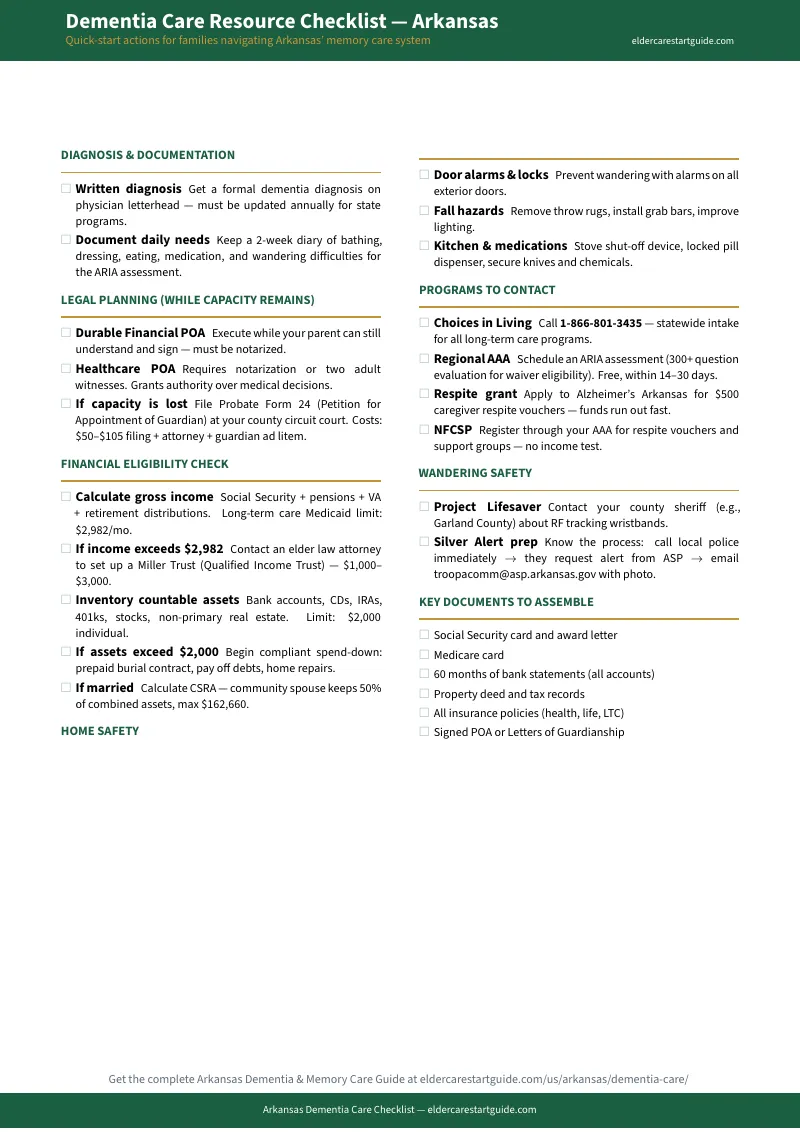
- Quick-Start Checklist (Free Download) (checklist.pdf) — 20 action items across legal, financial, safety, and program enrollment categories. Know exactly what to do tonight, this week, and this month — from immediate home safety modifications through power of attorney execution and Choices in Living Resource Center intake.
Who This Guide Is For
- Adult children in Arkansas whose parent has been diagnosed with Alzheimer's or a related dementia — whether the diagnosis happened yesterday or years ago
- Families facing a crisis placement decision after a hospital discharge, a severe wandering incident, or an unsafe living situation at home
- Caregivers providing daily unpaid care who need to understand how Arkansas Medicaid waivers work — and whether they can get paid through the Independent Choices program
- Anyone whose parent earns more than $2,982 per month and has been told they don't qualify for Medicaid — the Miller Trust section explains the legal mechanism that resolves this
- Families worried about losing the family home to estate recovery who need to understand how Arkansas's probate-only recovery rule works and what protective steps to take before filing
Why Free Government Pages Don't Cover This
The Arkansas Department of Human Services publishes program rules. The Area Agencies on Aging provide intake counseling. Facility directories list licensed providers. None of them give you the operational sequence — which step triggers which assessment, what happens when the ARIA score comes back wrong, how to structure finances before filing so the application isn't denied, and when the self-help approach isn't enough and you need an elder law attorney.
Here's what the free sources leave out:
- How to prepare for the ARIA assessment so the 300-question evaluation captures your parent's worst days, not the composed version they present to strangers
- The difference between ARChoices (nursing-facility level of care, capped enrollment with waitlist) and State Plan Personal Care (lower acuity, physician referral, no waitlist) — and why applying to the wrong one wastes months
- How to set up a Miller Trust when your parent's income is $100 over the $2,982 cap — without paying an elder law attorney $5,000 to $15,000 for the full Medicaid planning package
- Whether your parent's home deed is already structured to avoid estate recovery, or whether it needs a Beneficiary Deed before you file the Medicaid application
- When your parent's cognitive decline has progressed past the point where a simple power of attorney is legally possible — and what the probate guardianship process actually costs in court fees, attorney time, and annual bond premiums
The gap between knowing these programs exist and knowing how to navigate them in the right order is where families lose months of coverage, spend thousands on private-pay care they didn't need to absorb, and make irreversible legal and financial mistakes under crisis pressure.
Satisfaction Guarantee
If this guide doesn't give you a clear, step-by-step path through the Arkansas dementia care system, email [email protected]. We read every message.
— Less Than One Hour of an Elder Law Attorney's Time
Arkansas elder law attorneys charge $250 to $500 per hour. A standard Medicaid planning retainer runs $5,000 to $15,000. A single month of private-pay memory care costs roughly $6,000 at the state median.
This guide won't replace an attorney for complex asset trusts or contested guardianship — and it tells you exactly when those situations apply. But it will save you weeks of scattered research, prevent the application mistakes that trigger Medicaid denials, and ensure you walk into every conversation — with a DHS caseworker, an ARIA assessor, a facility admissions coordinator, or an elder law firm — knowing how the Arkansas system works and which steps come next.
Download the free Quick-Start Checklist to see the 20 most urgent action items. When you're ready for the complete navigation system, the full guide is waiting.