Your parent needs care in Scotland. The system is uniquely complex — and the generic UK guides don't cover half of it.
Scotland's devolved care system runs on different rules from the rest of the UK. Different capital limits. Different benefits (Pension Age Disability Payment, not Attendance Allowance). Free Personal and Nursing Care that England doesn't offer. A Power of Attorney system governed by the Adults with Incapacity Act, not the Mental Capacity Act. Interest-free deferred payments. And a deprivation-of-capital regime with no statutory lookback period.
You've probably discovered that most online guides mix English and Scottish rules freely — quoting the wrong capital thresholds, referencing NHS Continuing Healthcare (which Scotland replaced in 2015), or ignoring the Free Personal Care payments that could save your family thousands each year.
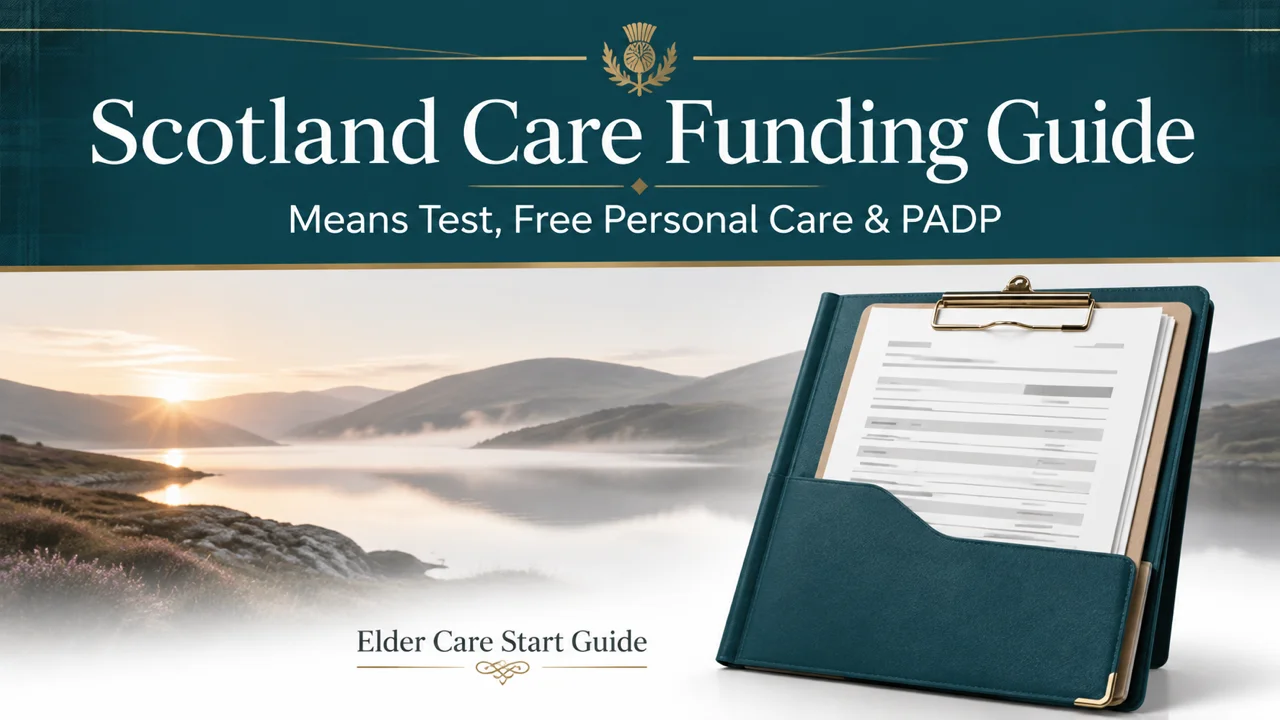
The Scotland Care Funding Navigator cuts through the confusion. It takes every funding pathway, legal authority requirement, and benefit interaction specific to Scotland and arranges them in the order you actually need them — from the first financial assessment form to the final care contract.
What's inside
- Means test walkthrough with worked examples — the exact Scottish capital limits (£36,750 / £22,750 for 2026/2027), how tariff income is calculated, which assets are disregarded, and what the spouse pension protection rule means for your family's income
- Free Personal Care and Free Nursing Care explained — how to claim FPC and FNC as a self-funder through a "Route 2" contract, plus the 2026/2027 rates and how they interact with accommodation charges
- PADP application and care home interaction guide — when Pension Age Disability Payment continues in a care home, when it's suspended after 28 days, and how to structure the funding arrangement so your parent keeps their benefit
- HBCCC eligibility and the 5-day appeal window — what replaced NHS Continuing Healthcare in Scotland, the single clinical test, and the exact timeline for challenging a hospital discharge decision
- Property protection strategies — the 12-week disregard, occupied property disregards, and Scotland's interest-free deferred payment agreements (interest only accrues 56 days after death)
- Deprivation of capital defence — why the "7-year rule" is a myth in social care, how Scottish councils actually assess timing and foreseeability, and a spending log template to document legitimate expenditure
- Power of Attorney and guardianship roadmap — Continuing and Welfare PoA registration with OPG Scotland, the expedited 10-day registration for urgent cases, and the full guardianship application process when capacity is already lost
- Self-Directed Support options — how to receive Direct Payments under SDS Option 1 to hire and manage home carers directly, including budget and payroll responsibilities
Who this guide is for
You're the adult child — probably aged 45 to 65 — coordinating care for a parent who lives in Scotland. You might be facing a sudden hospital discharge, watching savings approach the upper capital limit, or realising that nobody in the family has Power of Attorney. You need answers that reflect Scottish law, Scottish thresholds, and Scottish institutions — not a rehash of the English system with a saltire on the cover.
Why free guides leave you exposed
Care Information Scotland, Age Scotland, and NHS Inform all provide useful factsheets. But those resources are deliberately cautious: they describe the rules without telling you how to navigate them. They won't show you how to structure a funding arrangement so PADP continues. They won't walk you through the financial assessment with worked examples showing your family's actual exposure. They won't give you template letters for OPG's expedited registration. And they certainly won't explain the deprivation-of-capital rules in terms specific enough to protect past financial decisions.
Meanwhile, solicitors who specialise in care-fee planning charge £300 to £500 an hour in Edinburgh and Glasgow. The guide is designed to help you organise records, understand your options, and clarify your legal position before that first solicitor appointment — so you spend their time on decisions, not education.
Your purchase is risk-free
If the guide doesn't give you a clearer picture of your family's care funding situation, email us and we'll refund you — no questions, no forms.
Get started now
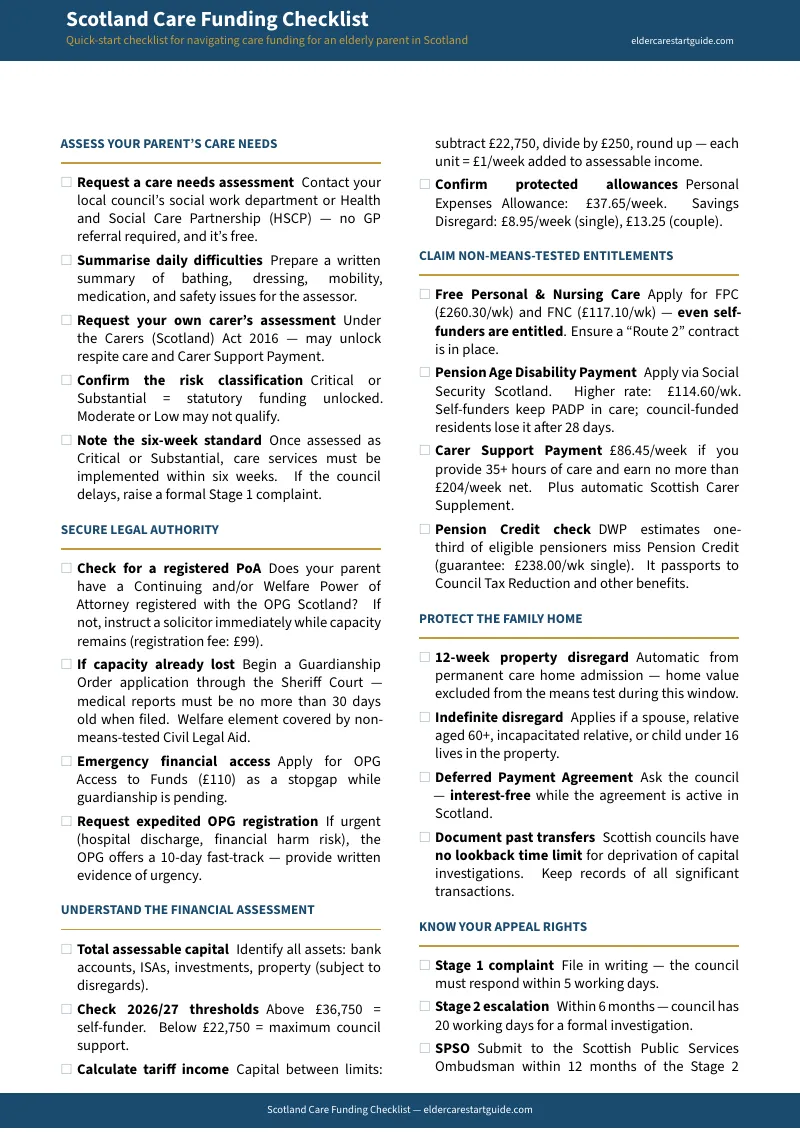
Download the free Scotland Care Funding Checklist to see the full assessment timeline at a glance. When you're ready for the worked examples, template letters, printable worksheets, and step-by-step funding strategies, the full kit is .