
Your Parent Has Dementia — And Scotland's Care System Has No Single Map
The diagnosis changes everything. Suddenly you are the person managing GP referrals, memory clinic appointments, medication reviews, safety risks, and a care system that splits responsibility between the NHS, local Health and Social Care Partnerships, Social Security Scotland, and the Office of the Public Guardian. Each body has its own forms, thresholds, waiting lists, and terminology — and none of them hands you a plan.
Meanwhile, the questions keep stacking up. Does your parent qualify for free personal care? What happens if they wander? How do you pay for a care home that charges £1,600 a week when you have been told care is "free in Scotland"? And who has legal authority to make decisions if your parent can no longer sign a Power of Attorney?
The Scotland Dementia Care Navigator: Every Step from Diagnosis to Residential Funding
The Dementia Care in Scotland guide translates Scotland's dementia care system — the Adults with Incapacity Act, free personal care, PADP benefits, HBCCC eligibility, Self-Directed Support, the Care Inspectorate, and the Office of the Public Guardian — into a single step-by-step action plan. It starts at the GP referral, walks you through securing legal authority while capacity remains, and ends with care home funding calculations using the current year's capital thresholds.
This is not a generic UK overview. Every threshold, phone number, form reference, and funding rule is specific to Scottish legislation and policy.
What's Inside
The Diagnosis-to-Support Pathway — the exact sequence from GP cognitive screening through memory clinic referral to formal diagnosis, including your parent's statutory right to one year of Post-Diagnostic Support coordinated by a trained Link Worker under the Alzheimer Scotland 5-Pillar Model. Covers what to bring to the first GP appointment, how to request your Link Worker, and how to claim Pension Age Disability Payment immediately — because PADP cannot be backdated before your date of first contact.
Power of Attorney — The Complete Execution Guide — fewer than one in ten adults have a PoA in place. This chapter walks through drafting a combined Continuing and Welfare PoA, the certificate of capacity requirement, OPG registration (£99 fee, 6+ month processing), and the exact pitfalls that cause automatic rejection. If your parent has already lost capacity, the guide covers the Guardianship Order process — forms, medical reports, Mental Health Officer suitability assessment, court timelines, and legal aid eligibility.
Home Safety and Wandering Prevention — a practical framework for making your parent's home safer: colour-contrast adaptations, reflective surface removal, occupational therapy assessments (free through the HSCP), and funded telecare devices. Includes the Herbert Protocol — a pre-completed police form with your parent's physical description, medications, and likely wandering destinations — and Purple Alert registration for community search support.
Hospital Discharge and HBCCC — if your parent is in hospital and the discharge team is pushing for rapid placement, this chapter explains Section 13ZA of the Social Work (Scotland) Act 1968, the Summary Assessment Tool for Hospital Based Complex Clinical Care eligibility, and the appeals process. England's NHS Continuing Healthcare does not apply in Scotland — this guide explains what does, including the single eligibility test and how to challenge a negative decision through PASS (Patient Advice and Support Service).
Residential Care Funding with Current-Year Thresholds — the capital limits for 2026/27 (upper: £36,750, lower: £22,750), tariff income calculations, the 12-week property disregard, deprivation of capital rules, and the precise distinction between free personal care (£260.30/week) and free nursing care (£117.10/week) versus accommodation charges. Includes the National Care Home Contract standard rates so you know what the council will pay — and when you need to negotiate top-up fees.
Benefits and Financial Support — a complete map of PADP (both rates), Adult Disability Payment, Carer Support Payment, Council Tax Reduction, and how benefits interact with residential care (PADP stops 28 days after council-funded placement but continues for self-funders). Covers the Carer's Allowance Supplement unique to Scotland and the upcoming changes under the Care Reform (Scotland) Act 2025.
Care Home Selection with Inspection Data — how to use Care Inspectorate reports to evaluate quality grades, read the six key quality indicators, identify enforcement actions, and compare facilities. Includes average weekly fees for residential dementia care (~£1,603) and nursing dementia care (~£1,659), the legal requirements for personal plans within 28 days of admission, and what to look for beyond the marketing brochure.
Safeguarding and Adult Protection — the three-point test under the Adult Support and Protection (Scotland) Act 2007 that triggers a council investigation, how to report concerns about neglect or financial abuse, the role of the council officer in adult protection, and how Protection Orders work. Covers both care home safeguarding and community-based risks.
Quick-Reference Tables — all capital thresholds, benefit rates, OPG fees, NCHC contract rates, and key contact numbers on one page for quick lookup during assessments and conversations with professionals.
Plus: 8 Printable Standalone Worksheets — a PoA application checklist (take to the solicitor), financial assessment worksheet (complete before the council's means test), hospital discharge rights card (bring to the MDT meeting), care home comparison worksheet (fill in on visits), benefits eligibility card (post on the fridge), home safety assessment (walk through room by room with the OT), forms and contacts reference (every phone number and form on one page), and guardianship application tracker (timeline for reports and court).
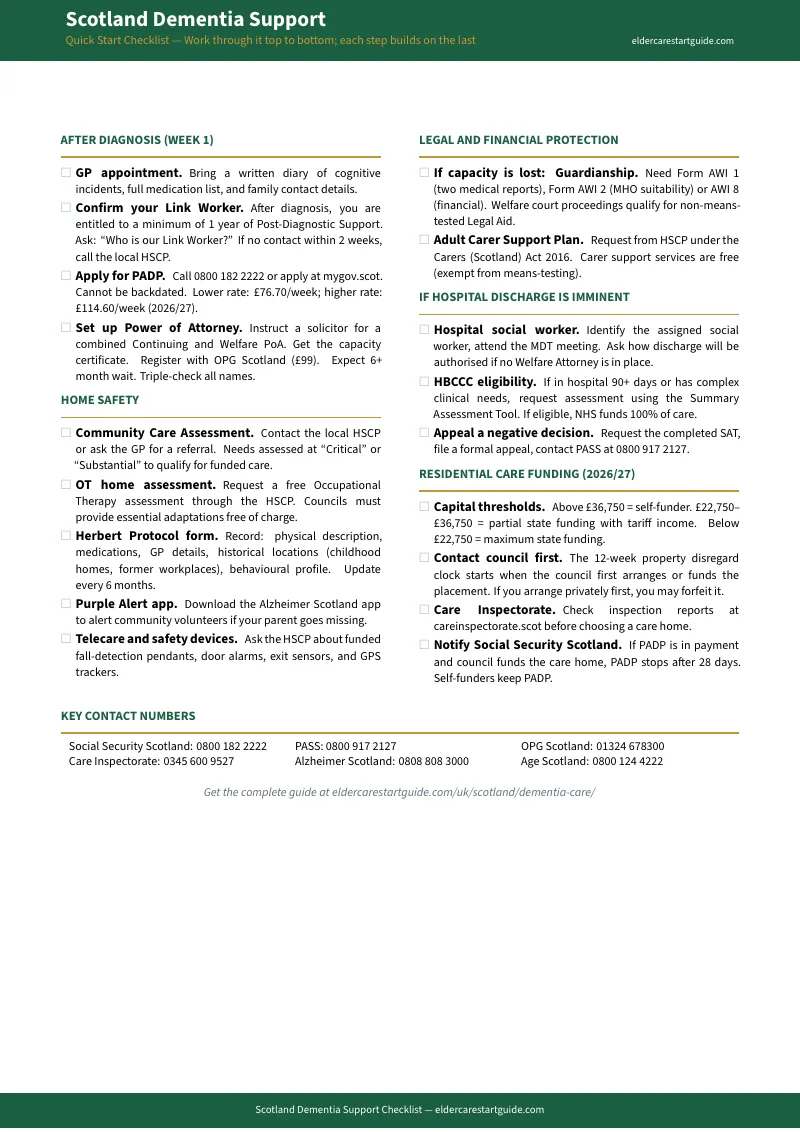
Plus: The Scotland Dementia Support Checklist — an 18-item printable reference covering every critical action from booking the GP appointment through care home placement, with phone numbers, form references, and deadlines in priority order.
Who This Is For
- The family that just got the diagnosis — your parent has been referred to a memory clinic or received a formal diagnosis, and you need to know what to do first: secure legal authority, claim benefits, and access post-diagnostic support before the window closes
- The carer approaching burnout — you have been managing everything alone and need to understand what funded support Scotland provides, from respite care through Self-Directed Support to an Adult Carer Support Plan
- The family facing hospital discharge — the MDT is pushing for rapid discharge, your parent cannot return home safely, and you need to know whether HBCCC applies and how to challenge an unsafe discharge plan
- The family navigating the means test — your parent needs residential care and you are trying to understand whether the family home is at risk, how the 12-week property disregard works, and what the council will actually fund
- The distant coordinator — you live outside Scotland and are managing your parent's care from afar, needing every phone number, form, threshold, and process step mapped in one place
Why Not Use Free Resources?
The Scottish Government, Age Scotland, Alzheimer Scotland, and local HSCPs all publish useful information — and you should use those services alongside this guide. But public bodies explain the rules without showing you how to prepare for them. They tell you the capital threshold is £36,750 but do not provide a worksheet for auditing your parent's assets before the council's financial assessment. They list Self-Directed Support options but do not show you how to calculate whether a Direct Payment covers enough home care hours. They explain the PoA process but do not warn you about the name-matching errors that trigger automatic rejection from the OPG.
Alzheimer Scotland provides outstanding emotional and community support — but their guides are structured as long policy documents, not crisis-response action plans. When you have 48 hours before a hospital discharge decision, you need the specific steps, scripts, and contact numbers, not a 60-page overview of national dementia policy.
A specialist solicitor charges £300 to £600 for Power of Attorney drafting alone. A care fees adviser charges £90 for an initial consultation, often focused on selling insurance products rather than navigating local authority funding. This guide helps you organise your facts and structure your questions before engaging expensive professionals — potentially saving hundreds of pounds in hourly fees by arriving prepared rather than paying a solicitor for basic information gathering.
The Dementia Care in Scotland guide is 100% independent — no placement commissions, no facility partnerships, no sponsored recommendations. It organises Scotland's dementia care system into one clear action plan for .
100% Satisfaction Guarantee
If the guide does not help you navigate Scotland's dementia care system more confidently, email us for a full refund. No conditions, no time limit.
Start with the free checklist or get the complete guide
Download the Scotland — Dementia Support Checklist at no cost — an 18-item printable reference with every critical action, contact number, and deadline in priority order. If you need the full system mapped out, the complete guide covers every chapter from diagnosis through residential funding for .