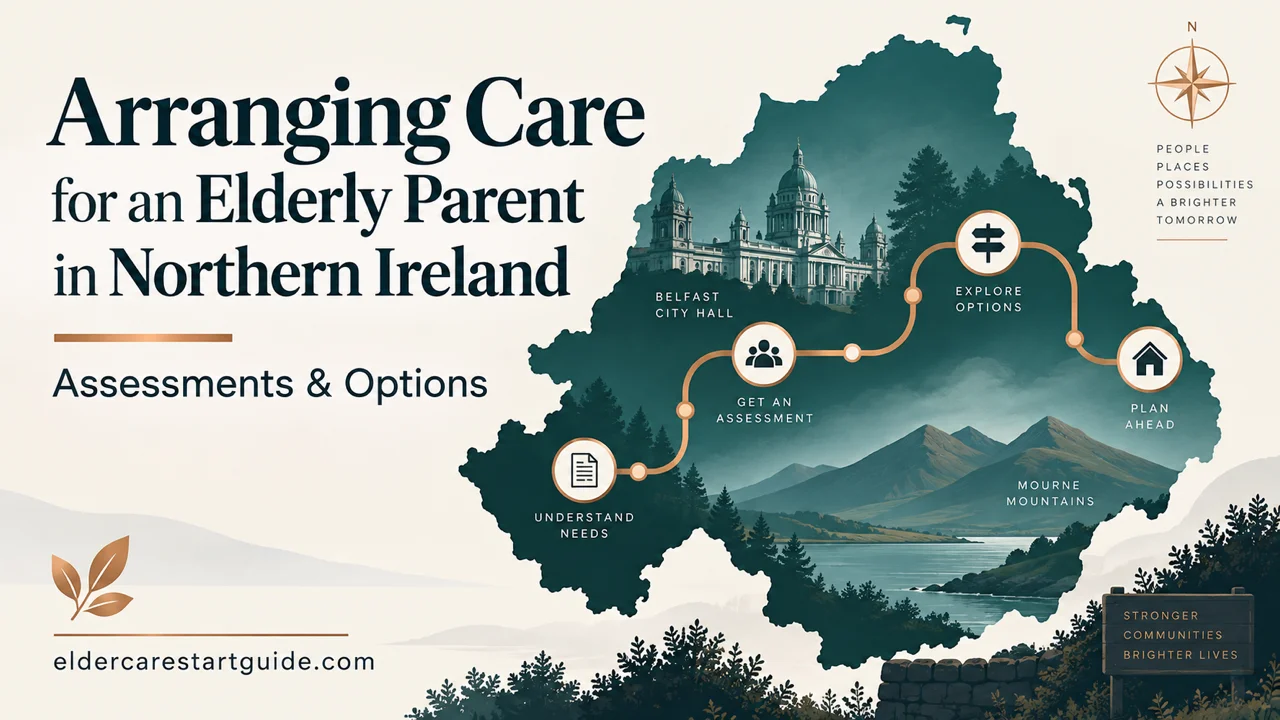
You just became your parent's care coordinator in Northern Ireland. Nobody handed you the manual. This is the manual.
It usually starts without warning: a hospital discharge coordinator telling you the bed is needed, a social worker mentioning something about a NISAT assessment, or a neighbour phoning to say your parent left the gas on again. Within days you're trying to work out which of the five HSC Trusts handles your parent's area, whether an Enduring Power of Attorney covers care decisions (it doesn't), and why the English advice your colleague shared doesn't match anything the care manager is telling you.
Northern Ireland's care system runs on its own legislation — the Health and Personal Social Services (NI) Order 1972, the Enduring Powers of Attorney (NI) Order 1987, the Mental Capacity Act (NI) 2016 — with its own financial thresholds, its own legal authority framework, and three critical absences that catch every family who arrives with English assumptions: no Health and Welfare LPA, no statutory deferred payment scheme, and no free personal care. Most families learn these rules too late, in the wrong order, and from advice sites that apply to England. By then the expensive mistakes are already locked in.
The Northern Ireland Care Navigation System
This guide works the way the system actually works: crisis response and hospital discharge first, legal authority second, care options and funding last. It is not a stack of information — it is a sequenced playbook, current to Northern Ireland's 2025/26 rules, that tells you what to do this week, what to demand in writing, and what to check before you sign anything.
What's Inside
- The HSC Trust Navigator — how Northern Ireland's five Health and Social Care Trusts (Belfast, Northern, South Eastern, Southern, Western) work as both clinical provider and social care commissioner, with direct contact numbers for every adult intake and adult protection gateway team.
- The Hospital Discharge Playbook — your right to demand a full NISAT assessment before discharge, how reablement services work (up to six weeks, entirely free), what contingency beds are and when to accept one, how to request a 28-day medication supply, and the scripts to use when the ward is pressuring you to accept a plan that is not safe.
- Enduring Power of Attorney — Northern Ireland's financial-affairs-only EPA under the 1987 Order, what it covers and what it cannot cover (no health or welfare decisions), the prescribed form, how to register with the Office of Care and Protection using Forms EP1 and EP2, and why waiting until capacity is lost turns a straightforward process into a six-month court application.
- High Court Controllership — the route when no EPA exists and your parent has lost capacity: the OCP application process, the commencement and appointment fees, the six-month-plus timeline, the ongoing court oversight, and what you can and cannot do as a Controller.
- The NISAT Assessment Explained — how Northern Ireland's standardised assessment tool scores your parent's needs, how to keep a two-week care diary that stops your parent minimising their difficulties, and how to request a parallel Carer's Assessment that unlocks respite, equipment, and counselling for you.
- Care Options Framework — home care (generally free when Trust-arranged) vs residential care homes vs nursing homes, real 2025/26 cost benchmarks, the £100/week Registered Nursing Care Contribution that nursing home residents are entitled to regardless of assets, and the critical financial difference between staying at home and moving into a facility.
- The CRAG Financial Assessment — the £23,250 upper capital limit, the £14,250 lower limit, tariff income (£1/week per £250 between thresholds), the £34.10/week Personal Expenses Allowance, and what the means test actually counts. Because the English limits you Googled — and the Scottish limits your friend mentioned — do not apply here.
- Property and Deprivation of Assets — the mandatory disregard rules (spouse, relative aged 60+, dependent child, disabled relative in the home), the twelve-week property disregard after admission, third-party top-up contracts, and the deprivation-of-assets trap that catches families who transfer property too late.
- Continuing Healthcare — the narrow but fully funded pathway for parents with a "primary health need," how the Decision Support Tool works, and how to challenge a refusal through the Trust's review process. If your parent qualifies, all care costs — including residential — are covered by the HSC system.
- The 2026 Deprivation of Liberty Ruling — what the Supreme Court decision means for families whose parent is in a care home or supported living, and how it intersects with the Mental Capacity Act (NI) 2016.
- Complaints and Escalation — the formal Trust complaints procedure, the Patient and Client Council's free advocacy service, and when to escalate to the Northern Ireland Public Services Ombudsman (NIPSO).
- RQIA Inspection Reports — how to find and read them, what "Areas for Improvement" and "Quality Improvement Plans" actually mean, and the red flags that should rule out a care home before you visit.
Plus 7 printable planning worksheets — the NISAT Assessment Preparation Diary (14-day evidence log), Financial Assessment Document Checklist, Care Home Comparison Worksheet, Benefits Entitlement Tracker, Agency Communication Log, EPA Registration Tracker, and Complaint Letter Template. Print them, fill them in, and bring them to assessments, ward meetings, and care home visits.
Who It's For
Adult children in Northern Ireland who have just realised a parent cannot safely manage alone. The daughter coordinating remotely from England who keeps running into rules that do not match the system she looked up. The son staring at a hospital discharge notice who needs the first 72 hours mapped out under Northern Ireland rules. The self-funding family above £23,250 who want to understand CRAG, claim every entitlement, and avoid signing a care home contract with hidden top-ups. The siblings who cannot agree and need an objective framework based on the NISAT criteria rather than a family argument.
Why Not Just Use Free Information?
NI Direct and Age NI explain each rule accurately — in isolation, across dozens of pages, in the order the legislation is structured rather than the order events actually happen to your family. The HSC Trust websites are fragmented across five separate organisations with different layouts and different contact structures. None of them hand you the assessment evidence diary, the means-test preparation worksheet, the discharge objection script, or the care home comparison grid. This guide closes that gap: every chapter ends in something you can send, print, or tick off.
And it is honest about the things free sources do not cover — the three critical absences in Northern Ireland's system (no welfare LPA, no deferred payments, no free personal care), the real cost of Controllership when families wait too long on the EPA, and the contract clauses care homes hope you will not question.
One wrong assumption — that English capital limits apply, that an EPA covers care decisions, that the Trust must defer care home fees against your parent's property — costs families thousands. The guide costs , less than a single hour of the home care it is about to help you arrange properly.
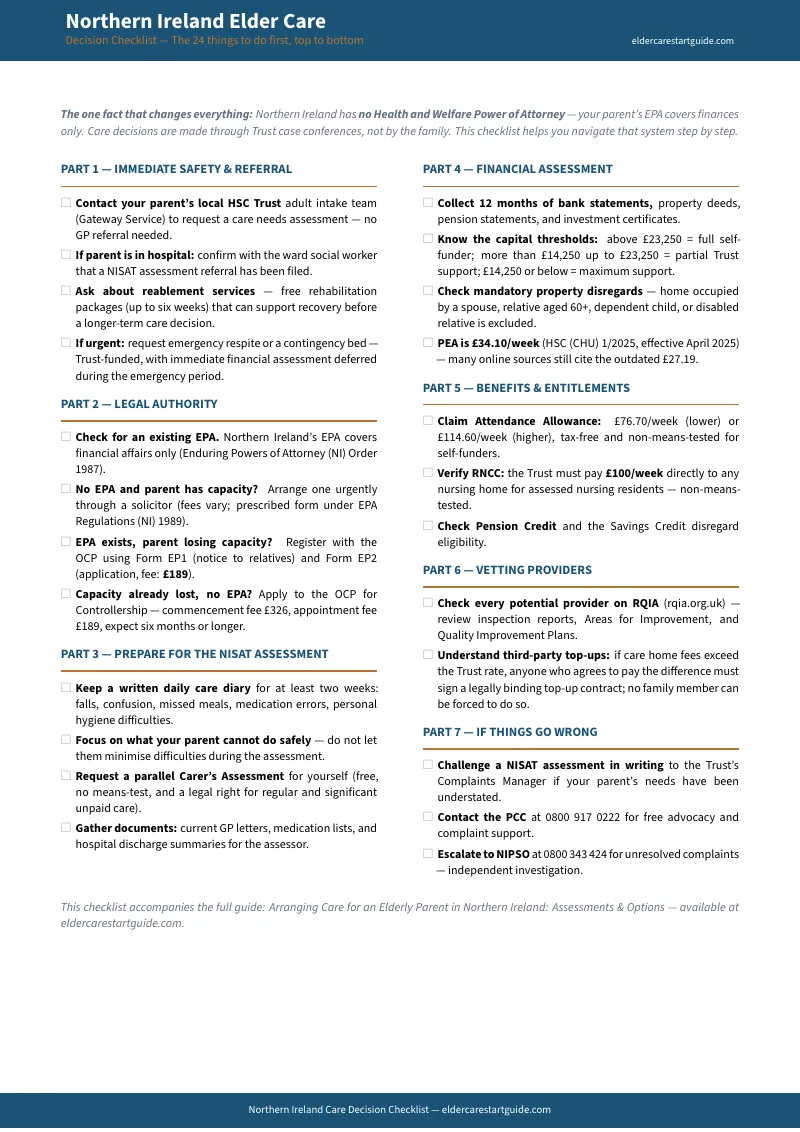
Start With the Free Checklist
Not sure yet? Download the free Northern Ireland — Care Needs Assessment Checklist — a quick-start checklist covering the first assessments to request, the capital thresholds, the legal authority steps, and the critical missteps to avoid. It is the fast version of the same system. When you are ready for the full playbook — templates, worksheets, and the complete 14-chapter guide — the full toolkit is waiting.
Get the complete Northern Ireland care decision guide now — instant download, printable worksheets, and a plan you can act on this week.