Your Parent's Nursing Home Costs £1,512 a Week. The Council Says They Are a Self-Funder. The Hospital Wants Them Out by Friday. And Nobody Told You That a Single Missed Assessment Could Be Costing Your Family £13,919 a Year.
The discharge coordinator just handed you a list of care homes. Your parent is "medically optimised for discharge" — which means the hospital needs the bed. Pathway 3. Residential or nursing care. The local authority financial assessment form arrived by post and asks for 12 months of bank statements, pension award letters, and a property valuation. Your parent's savings are above £23,250, so the council says they pay the full cost. Nobody mentioned that a separate NHS screening — the Continuing Healthcare Checklist — could mean the NHS pays everything.
Or maybe the immediate crisis has passed. Your parent is already in a care home, self-funding at £1,100 a week. The capital is draining. You want to know when the council starts contributing, whether the family home is at risk, and what "deprivation of assets" actually means — because your parent gave your sibling £30,000 toward a house deposit three years ago and someone on a forum said the council can claw it back.
The England Care Funding Guide is a Care Funding Navigation System — a step-by-step manual covering the local authority means test, NHS Continuing Healthcare, Attendance Allowance, Funded Nursing Care, deferred payment agreements, property disregards, deprivation of assets defences, Lasting Power of Attorney, and the appeal routes when funding is denied. Not a summary of what the Care Act 2014 says. A tactical playbook for the order in which English families actually encounter these decisions — starting with the hospital discharge crisis and working through to long-term financial protection.
What's Inside the Care Funding Navigation System
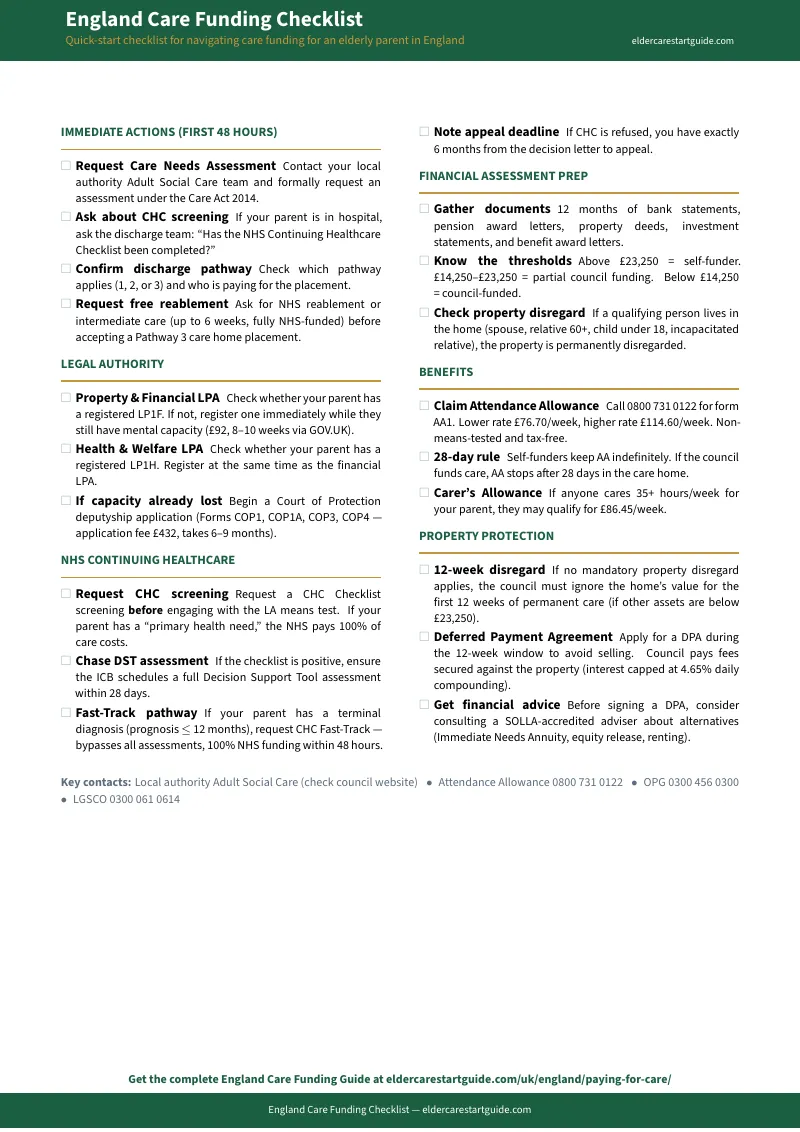
A 15-chapter guide plus 8 standalone printable PDFs — hospital discharge questions, CHC evidence diary, financial assessment checklist, deprivation defence ledger, appeal letter templates, care funding decision worksheet, LPA vs deputyship comparison, and a key contacts reference sheet — plus a 20-item quick-start checklist:
Hospital Discharge — The Five Questions Before Your Parent Leaves the Ward
The NHS "Discharge to Assess" framework pushes patients off acute wards fast. Pathway 1 and 2 placements come with free NHS reablement for up to six weeks. Pathway 3 means the local authority charges from day one. The guide gives you the exact questions to ask the Care Transfer Hub — including whether the CHC Checklist has been completed (it must be screened before discharge, not after) and whether reablement was offered before a permanent placement. It covers how to challenge an unsafe discharge in writing and what to do when you feel pressured to sign a care home contract within 48 hours.
NHS Continuing Healthcare — The Assessment That Could Save Your Family £78,000 a Year
CHC is a non-means-tested NHS package that covers 100% of care costs — accommodation, board, nursing, and personal care. No financial assessment. No contribution from the family. Eligibility turns on whether your parent has a "primary health need" assessed across four criteria: nature, intensity, complexity, and unpredictability. The guide walks through both stages — the 11-domain CHC Checklist screening and the full Decision Support Tool meeting with the multidisciplinary team — and shows you how to prepare a clinical evidence diary that documents falls, cognitive distress, swallowing difficulties, and unpredictable episodes. It covers the six-month appeal deadline, the Local Resolution stages, and the route to an NHS England Independent Review Panel when eligibility is denied.
NHS Funded Nursing Care — The £13,919 a Year That Self-Funders Keep Missing
If your parent is in a CQC-registered nursing home but does not meet the CHC threshold, they are almost certainly entitled to NHS Funded Nursing Care — a flat-rate weekly payment of £267.68 (2026/2027) paid directly by the NHS to the care home. This is non-means-tested and available to every nursing home resident who needs registered nursing care. The guide explains the eligibility test, how to ensure the care home is claiming it, and what to do if FNC has never been applied to your parent's fees.
The Means Test — Capital Limits, Tariff Income, and the Financial Assessment
The local authority financial assessment determines how much your parent pays. Capital above £23,250 means full self-funding. Between £14,250 and £23,250, the council adds "tariff income" — £1 per week for every £250 of capital. Below £14,250, capital is disregarded entirely. The guide covers every document the financial officer will request, how joint assets are evaluated (the standard 50/50 split rule), the personal expenses allowance of £31.80 per week that must be left to the resident, and the third-party "top-up" fees when a family chooses a care home that costs more than the council's standard rate.
Property Disregards — Protecting the Family Home
The 12-week property disregard provides a mandatory grace period after permanent care home admission — the home's value is ignored from day one, provided other capital is below £23,250. Mandatory permanent disregards apply when a spouse, partner, relative aged 60 or over, or disabled relative continues to live in the property. Discretionary disregards can protect a long-term live-in carer. The guide maps every disregard scenario, the evidence required to secure each one, and what happens when the local authority disputes the disregard.
Deferred Payment Agreements — The Compound Interest Nobody Mentions
A DPA lets your parent defer care fees against the value of their home, avoiding an immediate forced sale. The council places a legal charge on the property and charges compound interest from day one — currently 4.65% per annum (July to December 2026). Setup fees typically run £400 to £650 before the first care fee is deferred. The guide covers when a DPA genuinely protects the family, when compound interest makes it more expensive than selling early, and the alternatives — renting the property (noting that rental income must contribute to care fees) or arranging care at home where the property is disregarded entirely.
Deprivation of Assets — The "7-Year Rule" That Does Not Exist
Under the Care Act 2014, local authorities can investigate asset transfers with no statutory time limit. If the primary or significant motivation was to reduce care fees, the council assesses your parent using "notional capital" — as if they still own the asset — and can pursue the recipient to recover costs. The common "7-year rule" applies to inheritance tax, not social care. The guide explains the legal test, the common triggers that prompt an investigation, and the legitimate planning steps that can be taken without crossing the deprivation line. It includes a template ledger for documenting historical family gifts to demonstrate that avoiding care fees was not the motivation.
Attendance Allowance — Up to £114.60 Per Week, Non-Means-Tested
Attendance Allowance is a tax-free benefit for people over State Pension age who need help with personal care. The higher rate is £114.60 per week (2026/2027) for day and night supervision needs. It is not means-tested — capital and income are irrelevant. Self-funders in care homes can claim it indefinitely. The guide covers the eligibility criteria, the claim form strategy, and the critical 28-day rule: if the local authority starts contributing to care fees, Attendance Allowance stops. It also maps the interaction with other benefits including Pension Credit, Council Tax reductions, and Carer's Allowance for the person providing care at home.
Lasting Power of Attorney — Before the Window Closes
Without a registered LPA, you cannot access your parent's bank accounts, sign care home contracts, or communicate with the local authority about their financial assessment. If capacity is lost before an LPA is registered, the only alternative is a Court of Protection deputyship — which costs upwards of £2,000, takes four to six months minimum, and requires ongoing annual supervision fees of £320. The guide covers both LPA types (Property and Financial Affairs, Health and Welfare), the exact signing order that prevents OPG rejections, the 2026 fee remission rules, and the deputyship application process when the LPA window has closed.
Direct Payments, Care Contracts, and Professional Referrals
The guide also covers direct payments (receiving the council-allocated personal budget as cash to purchase care independently), the employment responsibilities of hiring private carers directly, what to look for in a care home contract before signing, CQC inspection reports and how to read them, and when to engage a solicitor, independent financial adviser, or NHS CHC advocate — with guidance on what each professional costs and when the investment is justified.
Who This Guide Is For
- Your parent is being discharged from hospital — and you need to know your rights before you sign a care home contract under pressure from the discharge team
- Your parent has savings above £23,250 — and you want to understand exactly when the self-funding threshold is crossed, how long the capital will last, and what happens when it drops below the limit
- You think your parent might qualify for NHS-funded care — and you need to understand the CHC screening process, what evidence strengthens the case, and how to appeal if eligibility is denied
- Nobody in the family has legal authority — and a bank, care home, or local authority has just halted a transaction because there is no registered Lasting Power of Attorney
- Your parent gave away money or property — and you need to know whether the council can treat it as deliberate deprivation and assess your parent as if they still own the asset
- Your parent is already self-funding in a care home — and you want to check whether Funded Nursing Care has been claimed, whether Attendance Allowance applies, and what changes when the capital drops below £23,250
Why GOV.UK and Age UK Will Not Get You Through This
Government portals and charity factsheets are accurate on what the law says. They define the capital limits, list the benefit rates, and explain the CHC eligibility criteria. Here is what happens when you try to navigate the system using those sources alone:
- GOV.UK tells you the upper capital limit is £23,250 — but does not give you a document checklist for the financial assessment, a template to contest a property valuation, or a calculator to model how quickly self-funding depletes your parent's estate
- Age UK explains the CHC Checklist — but does not show you how to build a clinical evidence diary that maps your parent's daily care needs to the four eligibility criteria, or how to prepare for the Decision Support Tool meeting
- The NHS website lists the Attendance Allowance rates — but does not explain the 28-day trap for residents whose local authority starts contributing to fees, or how to claim it simultaneously with Pension Credit to increase total income
- Local authority websites describe deferred payment agreements — but do not publish the compound interest calculations that show a three-year DPA on a £300,000 property costs over £45,000 in accrued interest alone
Free resources explain the rules. This guide gives you the step-by-step process, the document templates, the appeal letter scripts, and the standalone printable worksheets to navigate those rules under pressure — 10 PDFs covering the exact order English families encounter these decisions.
Your Parent's Care Cannot Wait. Neither Can Your Preparation.
For less than the cost of a single hour with a care fees adviser, you get a complete navigation system covering every funding pathway, every assessment, and every appeal route in the English care system. The free checklist gives you the triage framework. The full guide gives you every template, calculator, and letter script you need to protect your parent's care and your family's finances.