The moment your parent's bank freezes their account, nothing else matters
It doesn't start with a dramatic diagnosis. It starts with a phone call — the bank won't process a standing order, the GP's receptionist says they can't share test results, or the hospital discharge team announces your parent is being moved to a care home on Thursday and nobody has asked the family.
You've been running their life for months — paying bills, arranging appointments, managing medications. But legally, you're a stranger. No bank, no NHS trust, and no local authority is required to listen to you without a registered Lasting Power of Attorney or a Court of Protection deputyship order.
The window to fix this problem cheaply and privately is exactly as long as your parent's mental capacity lasts. Once capacity is gone, the LPA route closes permanently, and the only path left is a deputyship application through the Court of Protection — a process that costs over £1,000 in the first year, takes six months to a year, and places your family under permanent judicial supervision.
The Authority Lockdown Protocol
This isn't another generic "what is power of attorney?" explainer. It's a procedural system designed around the exact failure points that cause the OPG to reject over 133,000 applications per year — and the financial traps that catch families who secure legal authority but then lose their parent's savings to a care funding system they don't understand.
The kit integrates both pathways (LPA and deputyship) with the care funding framework (means test, CHC, Attendance Allowance, Deferred Payment Agreements) because in practice, these are the same problem. You cannot protect your parent's finances without legal authority, and legal authority is worthless if you don't know how the funding system works.
What's inside
- The OPG Error-Prevention Protocol — the strict signing sequence (Donor → Certificate Provider → Attorneys → Replacement Attorneys) that must be followed to the letter, the witness eligibility rules, and 14 pre-approved Section 7 preference templates so your custom clauses survive the caseworker review. One signature out of order means a rejected form, a lost £92 fee, and another 8–10 weeks at the back of the queue.
- The Capacity Assessment Playbook — how to arrange a GP COP3 assessment for a parent with early- or mid-stage dementia, what the four-part Mental Capacity Act test actually measures (understand, retain, weigh, communicate), and how to document a "lucid window" so the LPA holds up if someone challenges it later.
- The Fee Remission Navigator — the complete LPA120 process including the February 2026 rule change (Universal Credit alone no longer qualifies for remission; the donor must now prove gross income under £12,000), and the exact evidence portfolio the OPG requires. Submit the wrong documents and you pay the full £92 per LPA — this module stops that happening.
- The Bank Registration Playbook — step-by-step registration with major banks and building societies using OPG digital access codes, the common friction points (frozen online access, third-party payment blocks, pension provider holdups), and the escalation path when a bank's internal compliance team stalls.
- The Deputyship Emergency Manual — for families who missed the LPA window. Every Court of Protection form mapped (COP1 application, COP1A/B financial and welfare annexes, COP3 medical assessment, COP4 deputy declaration), notification requirements (COP15), the £432 court fee, security bond procurement, and the annual OPG102 reporting template that deputies must file every year.
- The Care Funding Decoder — means-test capital limits (£23,250 upper, £14,250 lower), tariff income calculation, the property disregard rule, and how to apply for a Deferred Payment Agreement so the council pays care home fees as a secured loan against the home instead of forcing a fire sale.
- The CHC Screening Matrix — how to identify whether your parent has a "primary health need" that qualifies for 100% NHS-funded care, the 12-domain Decision Support Tool preparation, and how a Health and Welfare LPA gives you the standing to attend, challenge, and appeal an assessment outcome.
- The Deliberate Deprivation Defence Checklist — the exact legal test the local authority applies under Section 49 of the Care Act 2014, how to document legitimate motivations for past asset transfers, and the "notional capital" trap that can leave a family liable for care fees with no assets left to pay them.
Who this kit is for
- Adult children whose parent still has mental capacity — who want to secure both LPA types (Property and Financial Affairs + Health and Welfare) before the window closes
- Families in crisis — a parent is in hospital, capacity is fluctuating, and the discharge team is pressing for a care placement decision this week
- Siblings who need a structured framework for deciding who gets appointed, how attorneys should act (jointly vs jointly and severally), and what preferences to record in Section 7
- Anyone whose parent has already lost capacity and now faces the Court of Protection deputyship process with no idea where to start
- Self-funding families whose parent has assets above £23,250 — who need to understand the means test, CHC screening, and deferred payment options before their parent's savings are depleted
Why not just use the free forms on GOV.UK?
The forms are free. Getting them through the OPG isn't. The government gives you blank templates and dry instructions that don't mention signing order, don't flag the witness rules that catch most first-time applicants, and don't explain how to write Section 7 preferences that the caseworker won't strike. They also don't tell you how to handle a borderline capacity situation, how to register the LPA with your parent's bank once it's approved, or what to do if your parent's situation suddenly deteriorates mid-application.
This kit fills the gap between "here are the forms" and "here's how to get through the system without losing money, time, or your parent's last window of capacity."
Why not use a solicitor?
High-street solicitors charge £300–£600 per LPA — for a standard estate, that's £600–£1,200 just for both documents. They use the same OPG templates you can access yourself. For most families with a straightforward estate, the solicitor's value is the process knowledge and error prevention — which is exactly what this kit provides at a fraction of the cost. The guide clearly flags when a family's situation (complex trusts, contested dynamics, high-value cross-border assets) genuinely requires a specialist lawyer.
The maths
An LPA pair costs £184 in OPG registration fees. A rejected application costs £92 plus another 8–10 weeks — time a parent with declining capacity may not have. A deputyship application, when the LPA window closes, costs over £1,000 in court and supervision fees in the first year alone, and the supervision charges never stop.
This kit costs less than a single resubmission fee — and its entire purpose is to make sure you never pay one.
Satisfaction guarantee
If the kit doesn't save you time, money, or confusion, email [email protected] and we'll refund you. No forms, no wait.
Get started now
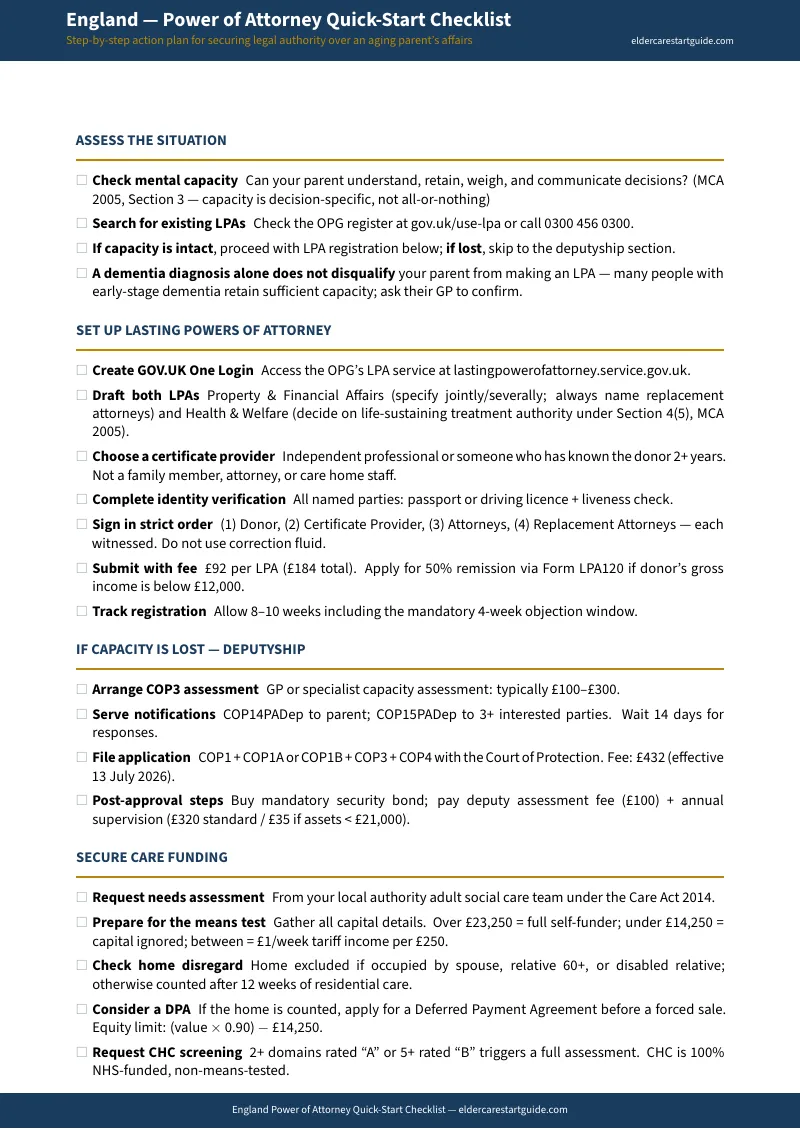
Download the free checklist to see the 25-item quick-start overview. When you're ready for the complete system — the 45-page guide, 14 Section 7 wording templates, deputyship cost calculator, care funding preparation sheet, and 5 more standalone worksheets — upgrade to the full kit for .