You're suddenly the care coordinator for a parent. Nobody gave you the manual. This is the manual.
It usually starts with a phone call: a fall, a hospital admission, a neighbour who's worried. Within days you're expected to understand the Care Act 2014, council means tests, NHS Continuing Healthcare, Discharge to Assess pathways, and a care market where self-funders quietly pay 30–40% more than the council rate for the exact same bed.
Most families learn the rules in the wrong order — after the discharge has happened, after the contract is signed, after the family home is already counted in the means test. By then the expensive mistakes are locked in.
The England Care Decision System
This guide works the way the system actually works: assessment first, funding second, provider decisions last. It's not a pile of information — it's a sequenced playbook, current to England's 2026/27 rules, that tells you what to do this week, what to demand in writing, and what to check before you sign anything.
What's Inside
- The Hospital Discharge (D2A) Playbook — the four Discharge to Assess pathways decoded, the five questions to ask before agreeing to anything, and the written objection scripts for when a discharge is unsafe. Because the first 72 hours decide everything that follows.
- The Care Needs Assessment Navigator — every adult in England is legally entitled to a free assessment under Section 9 of the Care Act 2014, whatever their savings. You'll learn how to request it in writing, document the two statutory "daily living outcomes" that trigger eligibility, and prepare so the assessor sees reality — not the brave-face version your parent performs on the day.
- The Funding Decoder — the £23,250 and £14,250 capital limits, tariff income, the £31.80/week Personal Expenses Allowance, and the right most self-funders never use: asking the council to arrange care at its lower negotiated rates even when you're paying yourself.
- The NHS CHC Screening System — NHS Continuing Healthcare pays 100% of care costs, no means test at all, yet families are routinely means-tested before anyone mentions it. You get the checklist domains, the screening thresholds, and the evidence-gathering protocol — including the Subject Access Request template for building an appeal pack. Plus how to verify the £267.68/week Funded Nursing Care rate is actually deducted from a nursing home invoice.
- The Home Care vs Care Home Framework — real 2026 numbers (£26–£38/hour home care, £1,200–£1,500/week live-in care, £800–£1,500/week residential) and the property-disregard rule that flips the financial maths depending on where care happens.
- The Family Home Protection Chapter — mandatory property disregards, the 12-week disregard, and Deferred Payment Agreements at 4.65% interest — so a care crisis doesn't force a fire-sale of the house your parent still lives in (or your other parent does).
- The Legal Authority Module — both Lasting Powers of Attorney at £92 each versus Court of Protection deputyship, a decision whose timing can cost a family thousands. Do it while capacity remains; here's exactly how.
- The Provider Audit Toolkit — 24 inspector-style questions built on the CQC Single Assessment Framework, how to read "Safe" and "Well-led" sub-ratings, and the contract clauses — guarantor clauses, self-funder transition clauses — to strike before signing.
Plus 8 printable tools to send, fill in, and bring with you: the Assessment Request Letters (care needs + carer's), the 7-Day Assessment Diary, the Hospital Discharge Question Card & Objection Script, the NHS CHC Evidence Pack (with the Subject Access Request letter), the Means-Test Funding Calculator, the 24-question Provider Audit Worksheet, the Family Home Protection Checker, and the LPA Action Tracker.
Who It's For
Adult children in England who've just realised a parent can't safely manage alone. The daughter coordinating from 200 miles away. The son staring at a discharge notice with 48 hours to respond. The self-funding family who suspects — correctly — that they're overpaying and wants to know exactly where.
Why Not Just Use Free Information?
Age UK and GOV.UK explain each rule well — in isolation, across dozens of pages, in the order the law is written rather than the order events actually happen to your family. None of them hand you the request letter, the evidence log template, the objection script, or the tour checklist. This guide closes that gap: every chapter ends in something you can send, print, or tick off. And it's honest about the things free sources tiptoe around — the self-funder premium, the top-up fee trap, the clauses care homes hope you won't read.
One wrong assumption — that the house must be sold, that the council decides who qualifies for NHS funding, that a guarantor clause is standard — costs families thousands. The guide costs , less than a single hour of the home care it's about to help you arrange properly.
Start With the Free Checklist
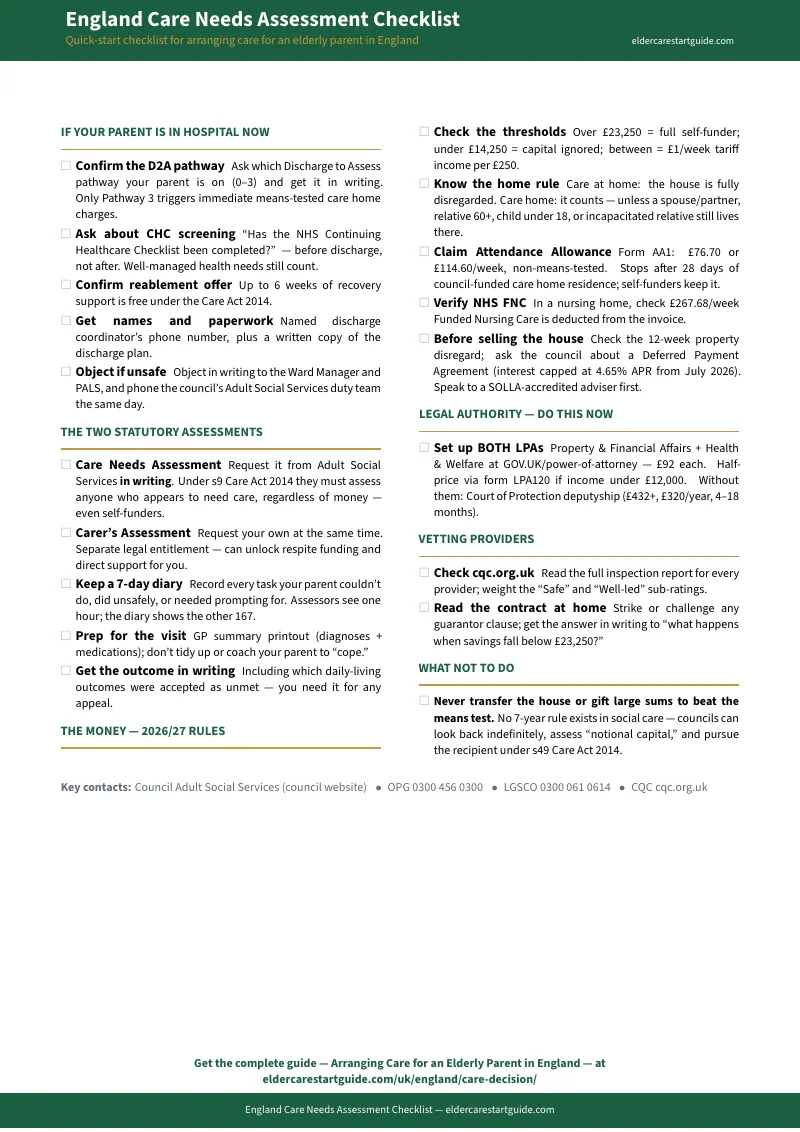
Not sure yet? Download the free England Care Needs Assessment & Options Checklist — 20 items covering the first assessments to request, the 2026/27 money rules, the legal authority steps, and the "what not to do" list. It's the fast version of the same system. When you're ready for the full playbook — templates, scripts, calculators, and the complete D2A and CHC chapters — the full guide is waiting.
Get the complete England Care Decision guide now — instant download, printable worksheets, and a plan you can act on this week.