Your Parent Left the House Last Night. You Found Out This Morning.
That is the moment most caregivers describe as the turning point — the morning after. Your father was found two blocks away in his slippers. A neighbor brought him back. Nobody called you. And now you are lying awake at 3 a.m. every night, listening for the front door.
You have tried the obvious fixes. You locked the deadbolt. You hid the keys. You told your parent not to go outside alone. None of it worked, because none of it addresses the actual problem: a brain that no longer processes exits, boundaries, or danger the way it once did.
The Wandering Prevention and Safe Return Planning toolkit gives you a structured system — the Invisible Safety Net Blueprint — that secures your parent's environment without turning their home into a locked ward. It covers the environmental modifications, legal instruments, family agreements, tracking technology, and emergency protocols that professional care managers charge $150 to $350 per hour to assemble. You implement the same system yourself, in a single weekend, for a fraction of one billable hour.
What Is Inside
The toolkit includes a 13-chapter implementation guide plus 8 standalone printable worksheets — every form, checklist, and template referenced in the guide, extracted as separate PDFs you can print and fill in by hand.
- Home Environment Lockdown Protocol — because hiding the keys is not a strategy. A room-by-room modification system with a printable Door and Exit Security Audit: door camouflage that exploits cognitive changes to make exits invisible, dark floor mats that create visual barriers your parent will not cross, lock relocation outside the natural line of sight, window restrictors, and bed occupancy sensors for nighttime monitoring. Every modification includes fire-safety guidance — you never trade wandering risk for fire risk.
- Tracking Device Decision Matrix — because the wrong tracker wastes months and hundreds of dollars. An unbiased side-by-side comparison of cellular GPS watches, hidden shoe insoles, RF transmitters like Project Lifesaver, and Bluetooth tags, plus a printable Tracking Device Comparison Worksheet. Upfront costs, monthly subscription realities, battery charging frequencies, and — critically — strategies for parents who rip devices off their wrists within hours.
- First-Hour Search Protocol — because the first 60 minutes after elopement determine whether this ends with a phone call or a search-and-rescue operation averaging $1,500 per hour. A printable, time-coded emergency checklist you can post on your refrigerator: where to search first (closets, crawlspaces, vehicles, the direction of your parent's dominant hand), the exact 911 script that triggers Silver Alert activation, Search Angel grid coordination, and K-9 scent article preparation.
- Comprehensive Emergency Profile — the fill-in one-page document that police, neighbors, and search teams need to identify and safely interact with your parent. Physical description, medications, MMSE score, calming techniques, and emergency contacts — all in one printable sheet.
- Legal Authority Templates — because managing your parent's safety without the right legal instruments means any decision you make can be blocked by a hospital, a sibling, or a state agency. Plain-language guidance on Durable Power of Attorney, Healthcare Proxy, HIPAA Authorization, and the capacity threshold that determines whether voluntary POA or court-ordered guardianship is your path.
- Family Care Agreement — because unequal caregiving loads destroy families. A fill-in-the-blanks personal care agreement that divides responsibilities, documents tasks transparently, and — critically — satisfies Medicaid five-year look-back audit requirements so that payments to a family caregiver at reasonable market rates are recognized as legitimate care expenses, not penalized asset transfers.
- FMLA Intermittent Leave Strategy — because your employer does not know you left early three times this month because your parent was found wandering. Pre-written notification templates, the exact certification process, and a strategy for requesting intermittent leave that protects your job while you manage recurring care crises.
- Medicaid HCBS Waiver and VA Funding Guide — because door alarms, motion sensors, and secure fencing do not have to come out of your pocket. A physical audit checklist matched against state Medicaid Home and Community-Based Services waiver criteria, with the process for obtaining physician recommendations and navigating service limits typical in state waiver programs.
- Neighbor Alert Scripts and Contact Registry — because telling your neighbor "my dad has dementia" over the fence is not a safety plan. Copy-and-paste letters that inform your immediate community without exposing unnecessary medical details, plus a printable registry documenting neighbors' phone numbers, secure yards, and outdoor cameras that could provide instant footage during a search.
Who This Toolkit Is For
You are the adult child who became the primary caregiver because nobody else stepped up. You are employed. You are managing 20-plus hours of caregiving duties alongside a full work schedule. Your parent's cognitive decline has moved past the stage where occasional confusion could be written off as "just getting older." You have seen the exit-seeking behavior — the pacing toward the door, the coat grabbed from the closet, the insistence on going "home" while standing in their own living room.
You do not need another article telling you that wandering is dangerous. You need the actual tools: the door modifications, the tracking comparison, the emergency protocol, the legal templates, and the family agreement. This toolkit gives you all of them in one place, organized in the order you need to use them.
Why Free Guides and Government Portals Are Not Enough
The Alzheimer's Association and AARP publish excellent clinical information. They will tell you to "inform your neighbors," "create a care schedule," and "consider a tracking device." What they will not give you is the pre-written neighbor notification letter, the legally vetted sibling care contract, the tracking device comparison with actual subscription costs and compliance strategies, or the minute-by-minute search protocol.
Free resources tell you what to do. This toolkit gives you the documents, scripts, and templates to actually do it — without spending 40 hours piecing together scattered advice from a dozen government websites, or paying a care manager $150 to $350 per hour to organize information you could have assembled yourself.
National referral directories like A Place for Mom earn their revenue by steering families toward expensive facility placement. This toolkit exists to help you keep your parent safely at home — for as long as that is clinically appropriate — by implementing the same physical and environmental safety measures that locked memory care facilities use.
The Free Checklist
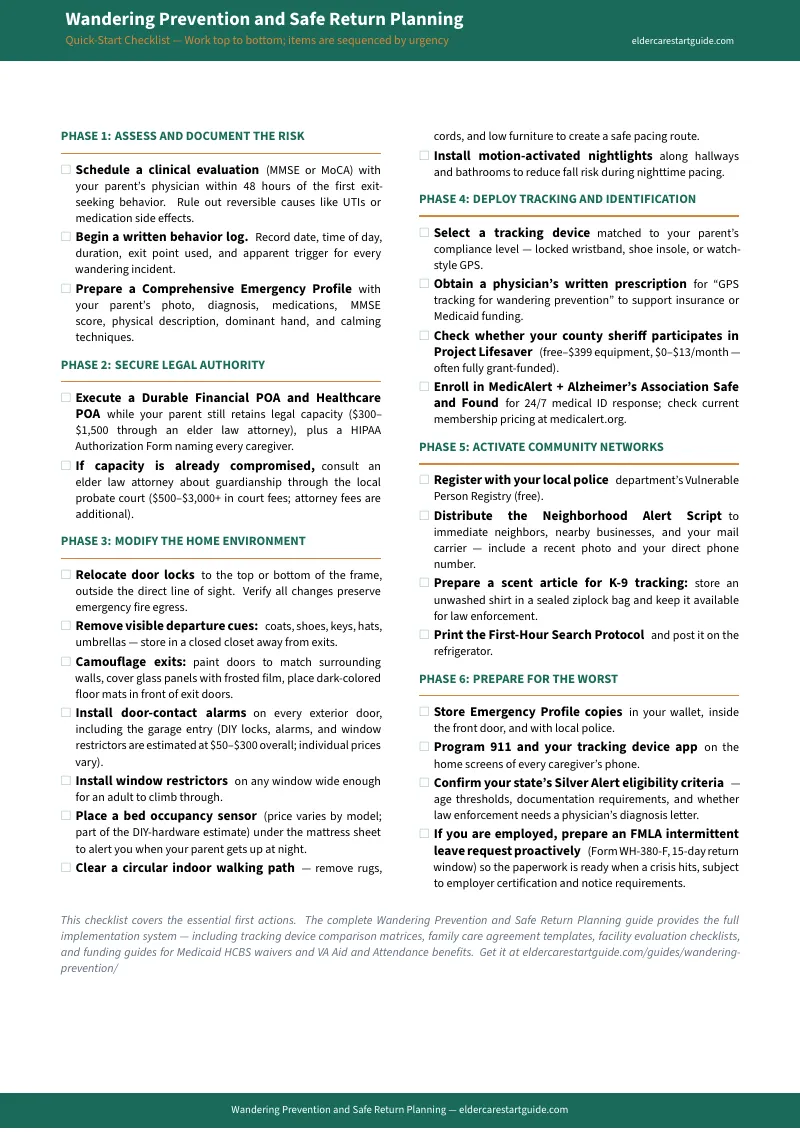
Not sure where to start? Download the free Quick-Start Checklist — a single-page reference covering the six essential phases: risk assessment, legal authority, home modifications, tracking deployment, community networks, and emergency preparation. Each checklist item maps directly to a detailed chapter in the full guide.
Satisfaction Guarantee
Full refund, no time limit. If this toolkit does not give you a clear, actionable system for securing your parent's environment, email [email protected] and you will receive a complete refund. No forms, no hoops.
Get Started
Every day without a system in place is another day where a single unlocked door stands between your parent and a search-and-rescue operation. The checklist is free. The full toolkit costs less than 15 minutes of a care manager's time. Download either one now and secure your parent's environment before the next close call.