
Your Parent Served. Now They Need Care — and the VA Has Money to Help.
The doctor just told you your father can't live alone anymore. Or maybe your mother fell again, and this time the bruise won't heal. Either way, you're suddenly the person responsible for figuring out how to pay for care that costs $4,000–$6,000 a month for assisted living and $25–$35 an hour for home aides.
Then someone mentions Aid and Attendance — a VA benefit that pays up to $2,874 per month, tax-free, for wartime veterans and surviving spouses who need help with daily activities. That sounds life-changing. So you go to va.gov, and within thirty minutes you're drowning: Form 21P-527EZ or 21P-534EZ? What's a "Fully Developed Claim"? What is VA Form 21-2680, and how do you get your parent's doctor to fill it out correctly? What counts as "net worth" and what's excluded? How far back do they look at asset transfers?
You could hire an elder law attorney for $300–$500 per hour — a $3,000–$5,000 retainer just to file a benefit application. You could call a pre-filing consultant who charges $795–$1,495 upfront. Or you could wait six weeks for an appointment with an overwhelmed Veteran Service Officer who can help — but only if you show up with every document gathered and organized yourself.
The Claim Preparation System
The Veterans' Benefits for Elder Care toolkit doesn't file claims — that would be illegal. What it does is something no free resource, overworked VSO, or $1,000 consultant actually provides: a complete, fill-in-the-blank organizing system that walks you through the entire Aid and Attendance application from eligibility screening to post-approval compliance.
Where free government websites give you information to read, this toolkit gives you worksheets to complete. Every page has a specific job: screen eligibility, calculate net worth, identify deductible medical expenses, prepare your parent's doctor for Form 21-2680, structure a caregiver agreement, or organize three years of financial records for the look-back audit. Complete one worksheet and you've made measurable progress — even if you only have twenty minutes between work calls.
What's Inside
- Eligibility Screening Worksheets — three tests your parent must pass: wartime service verification, clinical needs assessment (ADLs, bedridden status, cognitive impairment), and the 2026 net worth calculation. Work through them in order, and you'll know within an hour whether your parent qualifies — before you spend a dime on professional help.
- Form 21-2680 Doctor Instruction Sheet — the medical evaluation form that makes or breaks your application. Vague doctor notes ("patient has dementia") trigger denials. This instruction sheet tells your parent's physician exactly what clinical language the VA needs: specific functional limitations, ADL deficits, wandering risk, and supervision requirements. Hand it to the doctor before the appointment, not after.
- 2026 Net Worth Calculator Worksheet — the VA adds countable assets plus annual gross income to calculate net worth against the $163,699 cap. This worksheet separates exempt assets (primary home, one vehicle, burial contracts) from countable assets, applies the income offset for unreimbursed medical expenses, and tells you whether you're over or under the limit before you file.
- Medical Expense Deduction Tracker — the hidden lever most families miss. The VA subtracts qualifying out-of-pocket care costs from gross income, which can bring a family that looks "too wealthy" on paper well under the net worth limit. This tracker itemizes eligible deductions: Medicare premiums, prescription costs, home care payments, assisted living fees, and more — with the 5% deductible floor already calculated.
- Caregiver Agreement Template — paying a family member to provide in-home care is allowed, but the VA requires a formal written agreement documenting care duties, hours, and fair-market compensation. Without it, those payments are treated as gifts — potentially triggering look-back penalties. This template covers the legal requirements so your arrangement withstands audit.
- 36-Month Look-Back Audit Worksheet — the VA reviews every asset transfer from the past three years. Transfers that pushed net worth above the limit create penalty periods of denied benefits. This worksheet helps you inventory all transfers, identify which ones are flagged, and calculate potential penalty months before you submit — so there are no surprises.
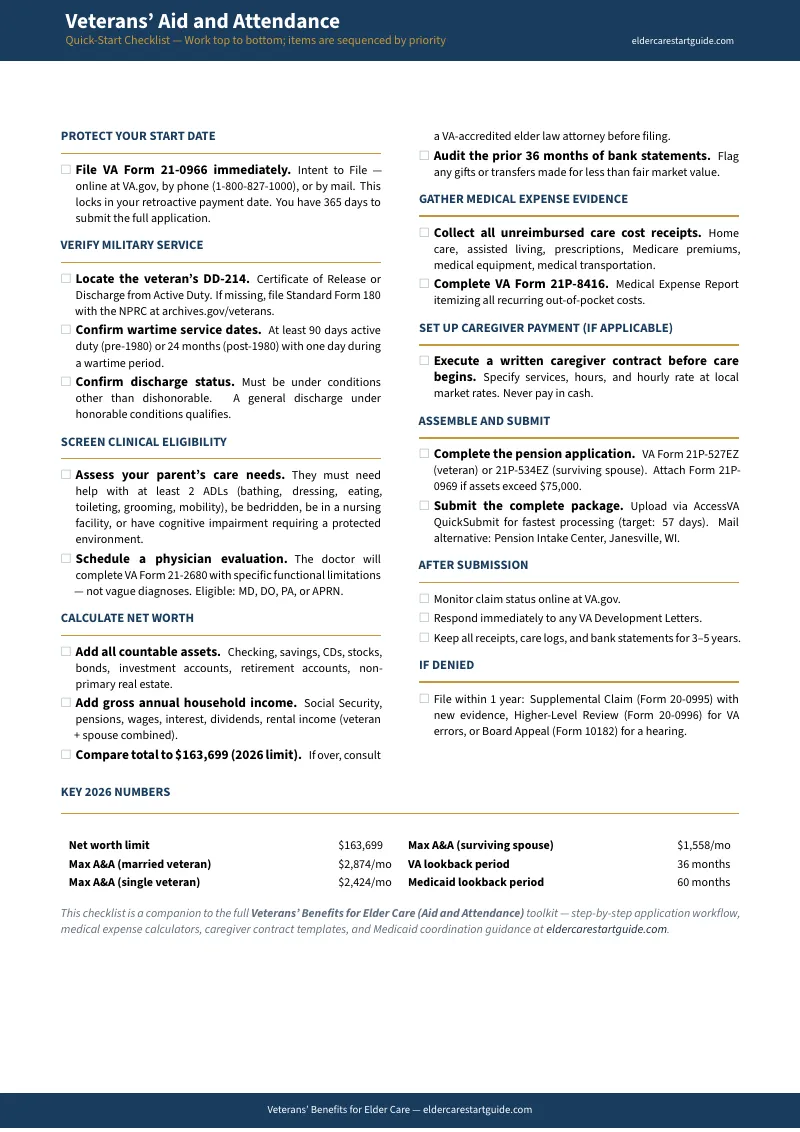
- Application Filing Checklist — a sequential checklist covering Intent to File (Form 21-0966), the primary pension application (21P-527EZ for veterans or 21P-534EZ for surviving spouses), DD-214 verification, marriage and death certificates, three years of bank statements, and the Fully Developed Claim package assembly. Check each box, and your application is complete on the first submission.
- Medicaid Coordination Reference — many families need both VA pension and Medicaid simultaneously. The VA's 36-month look-back and Medicaid's 60-month look-back create conflicting constraints. This reference explains how to structure asset decisions so you don't solve one eligibility problem while creating another.
- VA Fiduciary & Legal Authority Guide — if your parent can't manage their own finances, the VA may appoint a fiduciary. This section covers Durable Power of Attorney, Healthcare Proxy, HIPAA authorization, and VA Form 21-0972 (fiduciary appointment) so you have the legal standing to manage the benefit once it's approved.
- Scam Protection Checklist — the Aid and Attendance space attracts unaccredited consultants who charge illegal fees to "file claims" and financial planners who push unnecessary annuity products. This checklist teaches you how to verify VA accreditation, recognize predatory tactics, and report scam operators to the VA Office of Inspector General.
Who This Toolkit Is For
- Adult children who just learned their aging parent is a wartime veteran and want to explore every financial resource before committing to expensive care
- Families already paying out of pocket for home care or assisted living who suspect the VA owes their parent a benefit nobody told them about
- Surviving spouses of wartime veterans — or their adult children — who don't realize the spouse may qualify independently at any age
- Caregivers preparing for a VSO appointment who need to arrive with an organized, complete application packet instead of a folder of loose papers
- Families whose first application was denied and need to understand what went wrong before filing a Supplemental Claim or Higher-Level Review
Why Free Resources Aren't Solving This
The VA website publishes every form and regulation. AARP and Nolo provide excellent legal primers. Your county Veteran Service Officer will file the claim for free. So why do thousands of applications get denied or delayed by 8–12 months every year?
Because information isn't the bottleneck — organization is. Free resources tell you what documents you need but don't give you a system to gather and organize them. They explain the net worth formula but don't provide a worksheet to calculate it. They mention that doctor letters need specific clinical language, but they don't give you an instruction sheet to hand your parent's physician.
Pre-filing consultants solve the organization problem — for $795–$1,495 upfront. Elder law attorneys solve it for $3,000–$5,000. This toolkit solves it for a fraction of those fees, and you keep the knowledge for Supplemental Claims, annual reporting, and future Medicaid applications.
The VSO Force Multiplier
This toolkit doesn't replace your Veteran Service Officer — it makes every minute with them count. VSOs are skilled at filing, but they see hundreds of families. They don't have time to sit with you while you sort through three years of bank statements, or explain to your parent's doctor how to fill out Form 21-2680, or help you calculate whether a $20,000 home repair will bring your net worth under the limit.
Walk into your VSO appointment with every worksheet completed, every document gathered, every medical evaluation properly annotated — and your application goes from "come back when you have everything" to "let me submit this today."
100% Satisfaction Guarantee
If this toolkit doesn't help you feel organized and in control of your parent's Aid and Attendance application within 30 days, email us for a full refund. No questionnaires, no hassle. Your family is navigating one of the most stressful financial decisions of their lives — the last thing you need is purchase anxiety.