
Your Parent Paid Into This Policy for Decades. Now the Insurer Is Counting on You Giving Up.
Mom's discharge planner just told you Medicare stops paying on Friday. The nursing home costs $9,000 a month. And somewhere in her files is a long-term care insurance policy she's been paying into for twenty years — a policy that should be covering exactly this moment. So you call the insurer, and instead of help you get a 40-page claim packet, a "service-day" elimination period nobody explained, and an adjuster who keeps asking for documents you've never heard of.
You're not imagining it. Claims are processed by third-party administrators whose job is to limit payouts. They count on families making paperwork mistakes, missing deadlines, and abandoning claims during a crisis. Every week of delay is a week the family pays out of pocket.
The Claims Navigation System — built for the way insurers actually process claims
Understanding Long-Term Care Insurance is not another explainer article. It's a complete administrative system that walks you through the claim the way the carrier's contract defines it — so every form, every certification, and every care day counts the first time. For — less than one hour of an elder law attorney's time — you get the exact sequence professionals use to file clean claims and overturn denials.
What's Inside
- The Five Numbers That Matter — every policy comes down to its daily/monthly benefit, lifetime pool, inflation growth, elimination period, and covered settings. Learn to pull these out of any contract in 20 minutes, so you know exactly what the policy owes before you spend a dollar on care.
- Benefit Trigger Decoder — the 2-of-6 ADL trigger and the cognitive impairment trigger, defined the way tax-qualified contracts (IRC Section 7702B) define them — including the difference between hands-on assistance, standby assistance, and verbal cueing, because those distinctions decide whether the claim qualifies.
- Elimination Period Playbook — calendar-day vs. service-day counting is where thousands of dollars leak out. A 90-service-day period with part-time care can mean 30 weeks of out-of-pocket payments. Learn which model your policy uses and how to document care days so they actually count.
- The Six-Phase Claim Workflow — from locating the policy and validating your Power of Attorney, through the intake call, the five standard claim documents (Claimant Statement, Attending Physician Statement, Provider Statement, Plan of Care, HIPAA authorization), to submission and follow-up. In order, with nothing skipped.
- Care Provider & Family Caregiver Rules — which settings and agencies the policy will pay for, when family members can be compensated (reimbursement vs. cash indemnity policies), and the written personal care agreement that keeps caregiver payments from becoming Medicaid look-back penalties.
- Dementia Claims & the Nurse Assessment — parents with Alzheimer's routinely "pass" the insurer's 45-minute in-home assessment and get denied, because they mask their decline in front of a stranger. Learn what carriers accept as proof (MMSE, neuropsychological evaluations, imaging) and how to prepare so the assessment reflects your parent's real day-to-day condition.
- Denials, Delays & Appeals — how to demand the carrier's complete claim file, decode the denial reason, and build an appeal around objective medical evidence that refutes it — for both ERISA and individual policies, with the deadlines for each, plus when to escalate to your state department of insurance.
- Rate Increases, Taxes & Medicaid Coordination — what to do when the premium jumps, the age-indexed tax deductions for tax-qualified premiums, and how Partnership policies protect assets dollar-for-dollar if your parent eventually needs Medicaid.
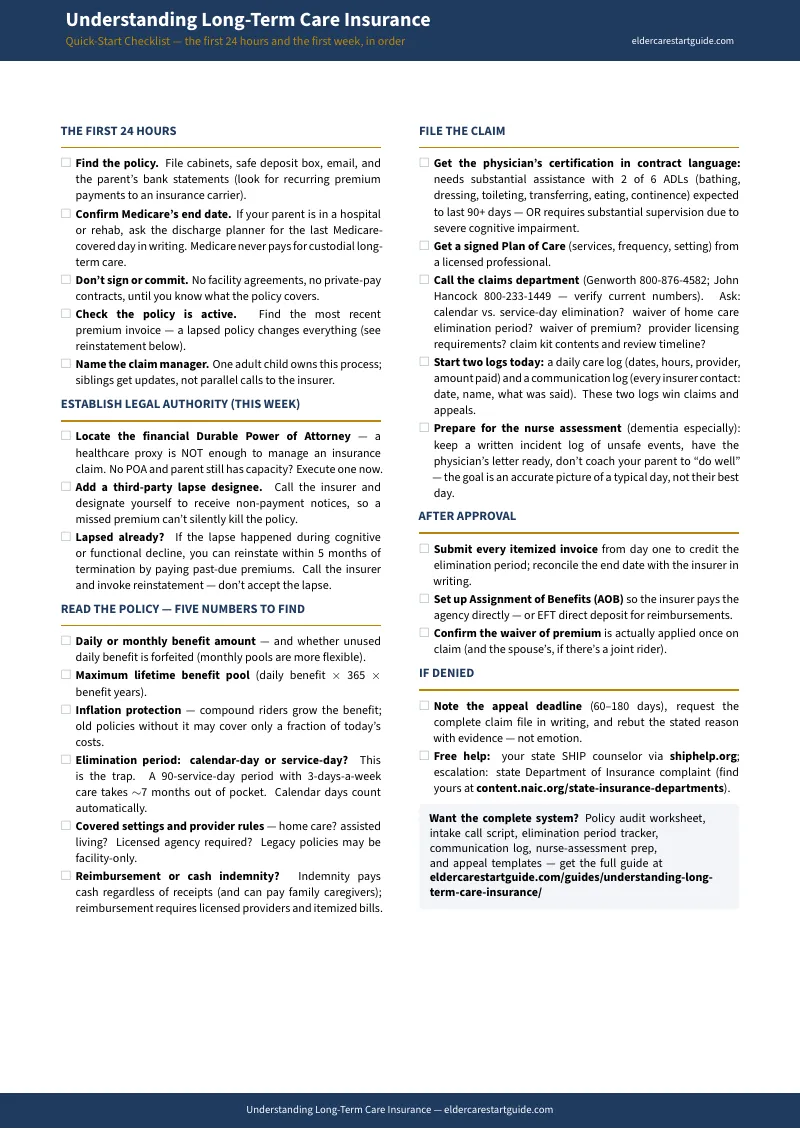
- 22-Item Quick-Start Checklist — the whole system on one printable page, so you can act today even if you never read another word.
- Five Printable Working Tools — the Policy Snapshot Worksheet (every number that matters, filled in from the contract), the Claim File Document Checklist (every document the claim packet needs), the Insurer Intake Call Script (the seven questions to ask, with space for the answers), the Elimination Period Tracker (40 rows to log every paid care day), and the Communication Log (one row per contact — the paper trail that wins appeals).
Who It's For
- The adult child who just found a parent's policy — or premium payments on a bank statement — and needs to file a claim this week
- The family managing a parent with dementia who's physically capable but unsafe alone, terrified the insurer will deny on a technicality
- Anyone whose claim was denied or stalled and needs to appeal before the deadline expires
- Pre-crisis planners reviewing a parent's coverage, facing a premium rate increase, or weighing whether the policy is still worth keeping
Why Not the Free Sites?
Medicare.gov and AARP tell you what the rules are — and stop there. They can't give you the insurer's playbook: how to word a physician certification so it satisfies the contract's trigger language, how to keep a service-day elimination period from stretching past 200 days, or what to say (and not say) when the nurse assessor asks your mom how she's feeling today. Free sites are neutral by design; this guide is on your side by design. Elder law attorneys will do it all for you — at $300–$500 an hour, including the hours they spend organizing paperwork you could organize yourself. This guide is the middle path: professional-grade execution, self-directed, for .
Our Guarantee
If the guide doesn't help you understand your parent's policy and move the claim forward, email us at any time for a full refund. No forms, no questions.
Get Started Now
Not ready for the full guide? Download the free Quick-Start Checklist — the 22 essential steps from claim intake to benefit approval — and see exactly what the process demands.
Ready to file the claim properly the first time? Get Understanding Long-Term Care Insurance for and have the full system in your hands in the next two minutes.