
The Doctor Said "Dementia" — and Then Sent You Home Without a Plan
Maybe the neurologist handed you a pamphlet and a prescription. Maybe a social worker mentioned "getting your affairs in order." But nobody told you what to do first, in what order, or how fast the window closes on the decisions that actually matter — the power of attorney that can only be signed while your parent still has capacity, the Medicaid lookback clock that started ticking years ago, the financial accounts that need to be locked down before a confused parent writes a check to a phone scammer.
So you do what every family does. You search. And you find forty open tabs: Alzheimer's Association fact sheets that explain the disease but never tell you which form to file. AARP articles that cover caregiver stress but skip the legal deadlines. Government portals that bury the Medicaid eligibility rules in bureaucratic language across seventeen linked PDFs. Elder-law attorney blogs that describe the stakes in terrifying detail and then ask you to book a $500 consultation.
None of them hand you a single, start-to-finish plan that tells you: here's what to do in the first 30 days, here's what changes at each stage, here's the legal track for your country, and here's how to manage daily care when your parent can no longer do it alone.
The Stage-by-Stage Dementia Navigation System
Understanding Dementia Stages: A Family Roadmap is the missing plan. It integrates the medical, legal, financial, and daily care steps into one chronological workflow — organized by stage, not by topic — so you always know what's urgent, what's next, and what can wait. Instead of researching across disconnected sites, you work through one connected system with fill-in worksheets, jurisdiction-specific legal tracks, and behavioral scripts that cover the entire journey from diagnosis day through end-of-life care.
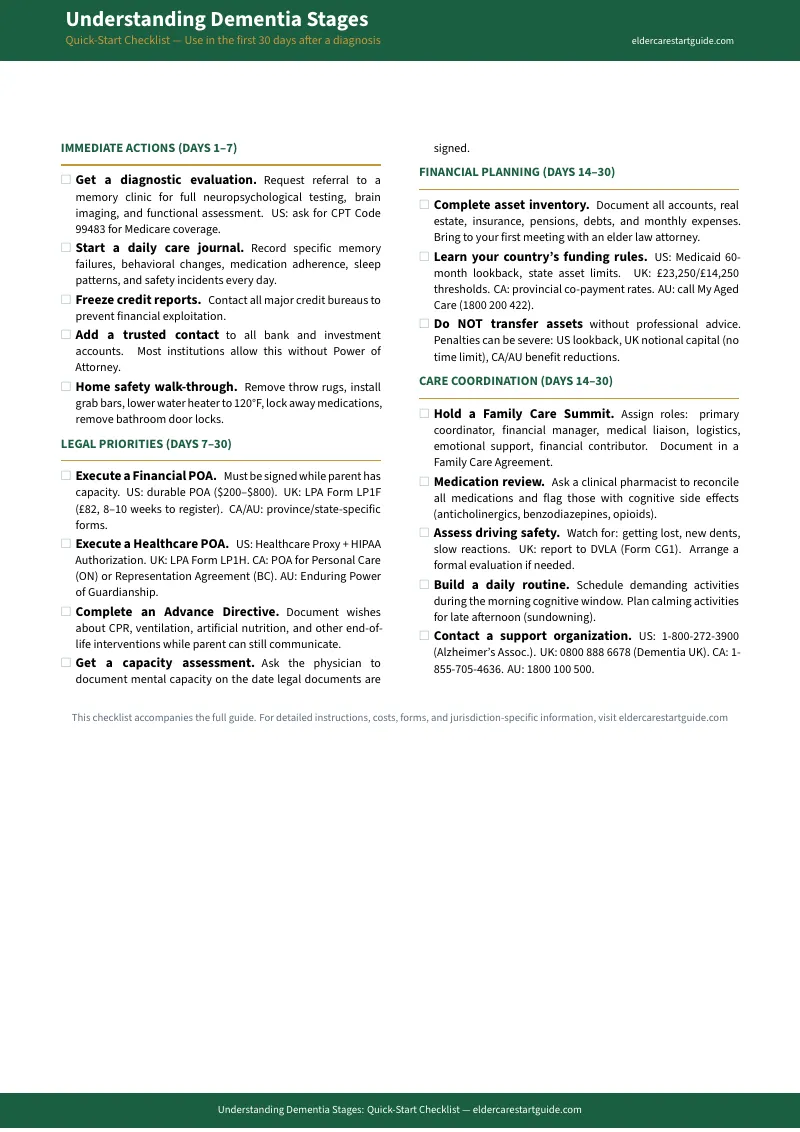
At its core is the First 30 Days Action Plan: the five non-negotiable steps every family should complete in the first month — diagnostic evaluation, care journal setup, financial account lockdown, legal paperwork, and home safety walk-through — each with a timeline, a checklist, and the exact calls to make. No paralysis. No guesswork. Just the next right step.
What's Inside
- The First 30 Days After Diagnosis — Five time-boxed steps: get a comprehensive diagnostic evaluation (days 1–14), start a care journal that documents everything for doctors and attorneys, lock down bank accounts and set up trusted contact alerts (days 1–14), start the legal paperwork clock (days 7–30), and conduct a home safety walk-through (days 7–14). Each step tells you exactly who to call, what to bring, and what to sign.
- The Practical Staging Map — A plain-language breakdown of early, middle, and late stages mapped to the functional changes that matter: when complex financial tasks start failing, when driving becomes unsafe, when bathing and toileting require hands-on help, when 24-hour supervision begins. Cuts through clinical jargon so you can plan around what your parent can and cannot do right now.
- Legal Authority — The Window That Closes — The two documents every family needs signed while their parent still has capacity (Durable Power of Attorney and Healthcare Proxy), with jurisdiction-specific requirements for the US (state-by-state POA and HIPAA rules), the UK (Lasting Power of Attorney registration through the Office of the Public Guardian), Canada (provincial Representation Agreements and Mandates), and Australia (Enduring Power of Attorney and Guardianship Tribunal pathways). Plus what to do when the window has already closed — the guardianship and deputyship process, costs, and realistic timelines.
- Paying for Care — Country by Country — The financial realities nobody explains until the bills arrive. US: Medicaid long-term care, the 60-month lookback, penalty period calculations, Qualified Income Trusts for income-cap states, and a printable asset inventory worksheet. UK: the means-test capital thresholds (£23,250 / £14,250), tariff income, Deferred Payment Agreements, deprivation of assets rules, and NHS Continuing Healthcare screening prep. Canada: provincial co-payments, Line 23600 income assessments, and the Involuntary Separation application (Form ISP3040) that can dramatically increase pension income when a couple is forced apart. Australia: My Aged Care ACAT assessments, Home Care Package levels, and residential care means-tested fees.
- Home Safety Modifications by Stage — Room-by-room audits that evolve as the disease progresses. Early stage: key lockbox, simplified remotes, medication management stations. Middle stage: stove auto-shutoff valves, bathroom grab bars, door alarms, wandering prevention sensors, hiding car keys. Late stage: hospital bed setup, fall mats, skin-safe positioning aids. Each modification listed with cost range and installation notes.
- Daily Care Management — How to build a daily routine around your parent's peak cognitive window (almost always morning). Medication management strategies for when a parent refuses pills. Behavioral scripts for sundowning, repetitive questioning, aggression, and bathing resistance — written as practical, word-for-word approaches, not clinical abstractions you can't use in the moment.
- When Professional Care Is Needed — The warning signs that home care is no longer safe: wandering episodes, physical aggression, caregiver injury, round-the-clock supervision needs. A side-by-side comparison of assisted living, locked memory care, and skilled nursing. The facility evaluation checklist with pointed questions on staff-to-resident ratios, dementia-specific training, incident protocols, and family communication practices.
- Caregiver Survival — The clinical signs of burnout that most families dismiss as "just being tired." Where to find respite: adult day programs, in-home relief, and government-funded caregiver support by country. The sibling alignment framework — a fill-in template that turns "you're overreacting" into a documented, concrete task-and-cost division so caregiving stops falling on one person.
- End-of-Life Care — Hospice eligibility criteria specific to dementia (not cancer-model hospice, which is what most families know), the difference between palliative and hospice care, advance directive and POLST completion, and comfort-care techniques for the final stage: positioning, skin integrity, non-verbal connection, and managing the family's grief while care continues.
- Nine Standalone Printable Worksheets — Care Journal Log, Financial Asset Inventory, Legal Document Tracker, Home Safety Audit, Medication Log, Family Roles Agreement, Facility Evaluation Checklist, Questions for the Doctor, and Benefits Eligibility Tracker. Each is its own PDF — print only the ones you need right now and bring them to appointments, family meetings, and attorney consultations.
Who This Is For
- The adult child who just got the diagnosis and needs to know what's urgent versus what can wait — before another week slips by without the legal paperwork signed
- Long-distance caregivers managing a parent's decline by phone, who need documentation tools that make remote coordination concrete instead of guesswork
- The primary caregiver doing it all alone, who needs the sibling-alignment framework to get help — and the burnout checklist to recognize they're already past their limit
- Families about to spend thousands on an elder-law attorney, who want to walk in organized instead of paying $300–$500 an hour to sort loose papers
- UK, Canadian, and Australian families navigating care systems that most dementia guides ignore entirely
- Caregivers in the middle or late stages who skipped the early planning and need to catch up — the guide meets you where you are
Why the Free Resources Leave You Stuck
The Alzheimer's Association and NIA are authoritative and clinically accurate — but they explain the disease, not the process. They'll tell you what sundowning is. They won't give you a fill-in worksheet to track it, a behavioral script to manage it, and a medication log to bring to the neurologist next Tuesday. Their articles are topic-sorted, not stage-sorted, so you end up reading about hospice and early-stage driving safety in the same afternoon with no idea what applies now.
Then there are the lead-referral portals — A Place for Mom, AgingCare — where the "free advice" is structured to move your parent into a facility that pays the site a referral commission. Their incentive is to push you toward placement, not to help you make the home-safety changes and legal decisions that might keep your parent at home longer.
And the professionals who would connect these dots charge accordingly. Geriatric care managers bill $150–$350 an hour. Elder-law estate plans start at $3,000 and climb from there. This roadmap does the organizing work before you hire anyone: walk in with your parent's assets inventoried, care needs documented, and legal questions sharp, and you cut billable hours from five to one — or handle most of it yourself for less than a single hour of professional time.
Satisfaction Guarantee
If this roadmap doesn't show you at least one legal deadline, financial strategy, safety fix, or care technique you didn't already know, email us for a full refund. No forms, no waiting period. The only risk is leaving things where they are.
Get the Plan Your Parent's Doctor Should Have Given You
Download the free Quick-Start Checklist for the one-page post-diagnosis priority list — or get the complete Understanding Dementia Stages: A Family Roadmap for and have every worksheet, legal track, safety audit, and care template you need to navigate the entire journey — from diagnosis day through end-of-life — in one connected system.