
You're one missed ride away from a crisis
Your parent can't drive anymore. Maybe the doctor said so. Maybe the DMV did. Maybe nobody has said it yet, but you watched them clip the mailbox last Tuesday and you can't stop thinking about what happens next time it's a person instead of a post.
Now every medical appointment, every pharmacy pickup, every Sunday lunch with friends — it's all on you. And you're cobbling it together week by week: borrowing favors from siblings who live three states away, white-knuckling through Uber tutorials with someone who thinks "the app" is a virus, and spending your lunch breaks on hold with an agency that covers rides to the hospital but not to the grocery store.
The information you need exists — scattered across forty government websites, each covering one program in one state, each written in a dialect of bureaucratic English that assumes you already know what NEMT stands for and which form to file.
The Mobility Transition System
The Transportation Solutions for Non-Driving Parents toolkit replaces the scattered browser tabs with a single operational plan. It's not a list of "transportation options for seniors." It's a step-by-step system for building a ride network that works without you personally driving every trip — covering the legal groundwork, the benefit applications, the family scheduling, and the difficult conversation that makes the whole thing possible.
This is the preparation layer that saves families thousands by organizing eligibility, filing applications, and documenting care agreements before paying a geriatric care manager $90–$300 per hour to do it for them.
What's inside
- The 4-Country Benefit Navigator — because your parent's rides may already be paid for and nobody told you. US Medicaid NEMT is a federally mandated benefit in all 50 states, but families miss it because each state uses a different broker and a different application process. Medicare Advantage plans cover 12–48 rides per year that most members never claim. OAA Title III-B provides free community rides with no income test. The guide walks through every program — US, Canadian, UK, and Australian — with eligibility criteria, documentation checklists, and the exact call scripts to use when you phone the agency.
- The ADA Paratransit Filing Kit — paratransit is curb-to-curb public transit for people with functional limitations, and eligibility is based on disability, not age. The application requires medical verification that most families get wrong on the first try. The guide includes the complete filing process, what the doctor's letter needs to say, and how to handle the 21-day response window.
- The Driving Retirement Conversation Kit — the hardest part isn't finding rides; it's having the conversation that makes them necessary. This kit includes a 30-day observation log that turns "I think Dad shouldn't drive" into documented evidence, sibling alignment scripts that get everyone on the same page before engaging the parent, and a physician liaison letter that lets the doctor deliver the news instead of the family.
- DMV Reporting Protocols by State — if conversation fails, most states allow you to file an unsafe-driver report that triggers a mandatory reexamination. The guide maps every state's reporting form (California DS 699, Wisconsin MV3141, Texas "Katie's Law"), whether your name stays confidential, and what happens after you file — including the reexamination process and what to expect if the license is revoked.
- The Liability Firewall Checklist — if your name is on a parent's car title or insurance policy, you may be personally liable for accident damages under negligent entrustment. The guide covers how to detach your assets, audit existing POA documents for transportation authority, and set up a Medicaid-compliant caregiver transport contract that protects family savings during the five-year look-back period.
- The Weekly Dispatch System — a shared calendar template with standardized event tags, sibling shift assignments with backup drivers, and the weekend setup checklist that locks in next week's coverage every Sunday. This is what replaces the group text chain that drops rides every other week.
- Rideshare for Non-Smartphone Seniors — GoGoGrandparent setup (phone-based Uber/Lyft booking without an app), Uber Family Profiles for remote booking and tracking, and a side-by-side comparison of concierge ride services. Plus safety notes on vehicle height, driver patience, and where to instruct drivers to meet a mobility-impaired rider.
- Wheelchair and Stretcher Transport Audit — verification checklist for WAV carriers, the 3-step bed-to-wheelchair transfer protocol, wheelchair maintenance checklist, and a long-distance medical transport planning guide for state-to-state relocations.
Who this is for
- The crisis coordinator — your parent is being discharged from the hospital in 48 hours and you need a verified transportation plan before they'll release them
- The long-distance caregiver — you live hours away and need systems that work without you physically being there to drive every trip
- The sibling caught in the middle — one sibling wants the keys taken immediately, another says you're stealing Mom's independence, and you need an objective framework that takes the "bad guy" role off the family
- The dementia caregiver — your parent has been diagnosed with cognitive decline, still insists on driving, and you need to know when and how to intervene before something irreversible happens
- The recurring-ride manager — dialysis three times a week, oncology every two weeks, cardiac rehab — and you need a sustainable schedule, not a last-minute scramble every time
Why free resources aren't solving this
AARP covers conversation tips but not Medicaid NEMT filing. The NIH explains cognitive decline but not legal liability. AgingCare has forums but funnels you toward residential care referrals. Your Area Agency on Aging has a phone number but a three-week callback window and a website that hasn't been updated since 2019.
The problem isn't that the information doesn't exist — it's that it exists in fragments, each one covering a slice of the problem and ignoring the rest. You end up doing the integration work yourself: cross-referencing eligibility rules, guessing at application processes, and hoping you haven't missed a program that would have solved this weeks ago.
This toolkit does the integration. Every program, every eligibility rule, every application step, every legal safeguard — organized in the order you actually need them, not the order government agencies happen to present them.
Satisfaction guarantee
Full refund, no time limit. If the toolkit doesn't give you a clear, actionable transportation plan for your parent, email [email protected] and you'll get your money back. No forms, no justification needed.
What you get today
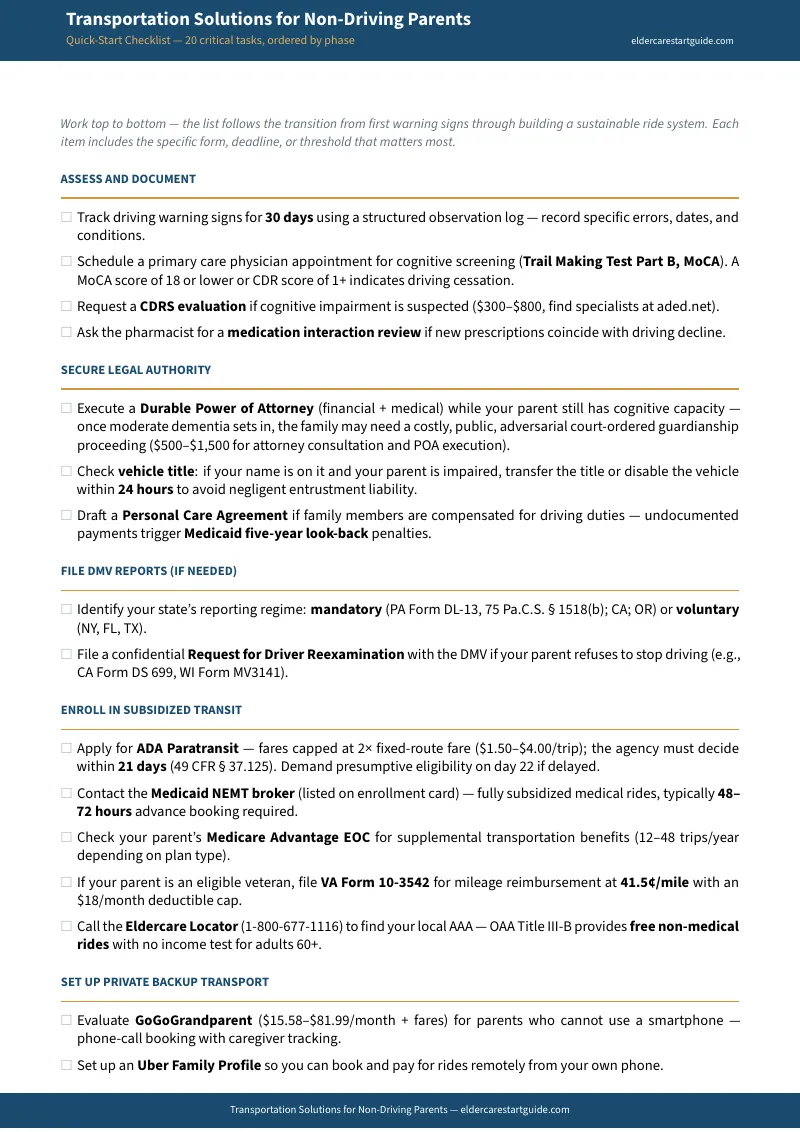
For , you get the complete toolkit: the 45-page guide covering legal preparation, benefit navigation, conversation protocols, scheduling systems, and physical safety — plus the 21-item quick-start checklist and 10 fillable printables (the Driving Behavior Observation Log, Transit Benefit Enrollment Tracker, Weekly Ride Schedule Template, Wheelchair Transport Safety Checklist, Caregiver Handoff Log, Legal Authority Audit Worksheet, Physician Liaison Letter, Sibling Alignment Scripts, Agency Call Scripts, and Caregiver Transport Contract). One purchase, lifetime access, instant PDF download.
Or start with the free checklist — a two-page, 21-item quick-start version that covers the essential first steps. Download it now and see if the approach works for your family before deciding on the full toolkit.