
Stop Splitting Care Costs by Guesswork
Your mother needs care three days a week. One sibling lives nearby and handles every emergency. Another lives two states away and earns three times the salary. A third hasn't returned a call in six months. Somebody Venmos $200 and calls it "fair."
It's not fair. Everyone knows it. Nobody knows how to fix it without a fight that lasts longer than Thanksgiving dinner.
Free articles say "communicate openly." Elder-law attorneys will draft a custom agreement — for a $3,000 retainer and four weeks of meetings. Nothing in between gives you the actual formula, the actual conversation framework, and the actual Medicaid-compliant paperwork to make the split defensible and the relationships survivable.
The Sibling Care Ledger System
This toolkit replaces the awkward "can everyone chip in more?" text chain with a structured system that turns emotion-driven arguments into arithmetic-driven agreements. It works whether all siblings cooperate or you're the only one at the table.
At the core is an income-proportional cost formula with caregiving labor credits — the same methodology professional geriatric care managers use, packaged as a print-and-write worksheet. The sibling who earns more pays a proportionally larger share. The sibling who provides physical care gets credited at local home health aide rates. The math does the arguing so you don't have to.
What's Inside
- Sibling Cost-Splitting Worksheet — income-proportional formulas plus caregiving labor credits at local home health aide rates ($25–$35/hour nationally), so sweat equity shows up in the ledger the same way cash does
- Daily Care Log and Monthly Expense Tracker — print-and-write logs for hours, receipts, and a running care-account balance (Medicaid audit trail and time-credit evidence)
- Medicaid-Compliant Personal Care Agreement — a prospective contract template that protects family caregiver payments from being reclassified as gifts under the 60-month look-back rule, with rate-setting guidance and POA conflict shields
- Sibling Cost-Sharing Contract — an editable agreement covering split percentages, payment schedules, emergency-cost thresholds, care-transition triggers, and a dispute-resolution clause
- Parent Financial Audit — a 15-day document-and-numbers sheet so sibling contributions start after the parent's own income and assets, not before
- Family Meeting Agenda and Communication Scripts — a 60-minute meeting framework with a fill-in invitation, ground rules, the "Big Three" role-assignment system (Hands-On Care, Financial and Legal, Logistics and Research), and verbatim sentences for missed deposits and refusals
- IRS Household Employer Tax Guide — employee vs. contractor classification, FICA thresholds, W-2 filing steps, and the family-member exemptions that determine whether you owe payroll taxes at all (in the 51-page guide)
- Escalation and Mediation Playbook — when to call a geriatric care manager ($100–$300/hour), how elder mediation works (70–80% success rate at $700–$1,400), and why it beats guardianship litigation ($5,000–$15,000+) in almost every scenario
Who It's For
- The local caregiver sibling who handles the daily emergencies and needs an objective, third-party framework to ask for fair financial recognition — without looking greedy or manipulative
- The distant sibling who writes checks but wants transparency and tracking so their contributions actually go toward care, not into a black hole of unreceipted spending
- The family organizer who sees the resentment building and wants to get everyone aligned before a hospital crisis forces decisions nobody is prepared to make
- Families approaching Medicaid eligibility who need to restructure informal caregiver payments into compliant contracts before the 60-month look-back window creates catastrophic penalty periods
Why Free Resources Don't Solve This
AARP's caregiving articles explain that you should "discuss finances openly." Government sites list Medicaid eligibility rules. SibSplit's free calculator runs the income-proportional math. Each one solves 10% of the problem.
None of them gives you the meeting agenda to get siblings into the same room, the contract language that satisfies a Medicaid caseworker, the tax compliance checklist for paying a family caregiver, and the escalation playbook for when one sibling refuses to participate — all integrated into a single executable sequence.
That's what makes the Sibling Care Ledger System different. It doesn't explain what to do in the abstract. It gives you the cost-splitting worksheet, the contracts, the conversation scripts, and the household-employer tax steps — connected in the order you actually need them.
The Guarantee
Full refund, no time limit. If the toolkit doesn't give you a clearer, fairer framework for splitting costs, email [email protected] and we'll refund every cent. No forms, no time pressure.
Get Started
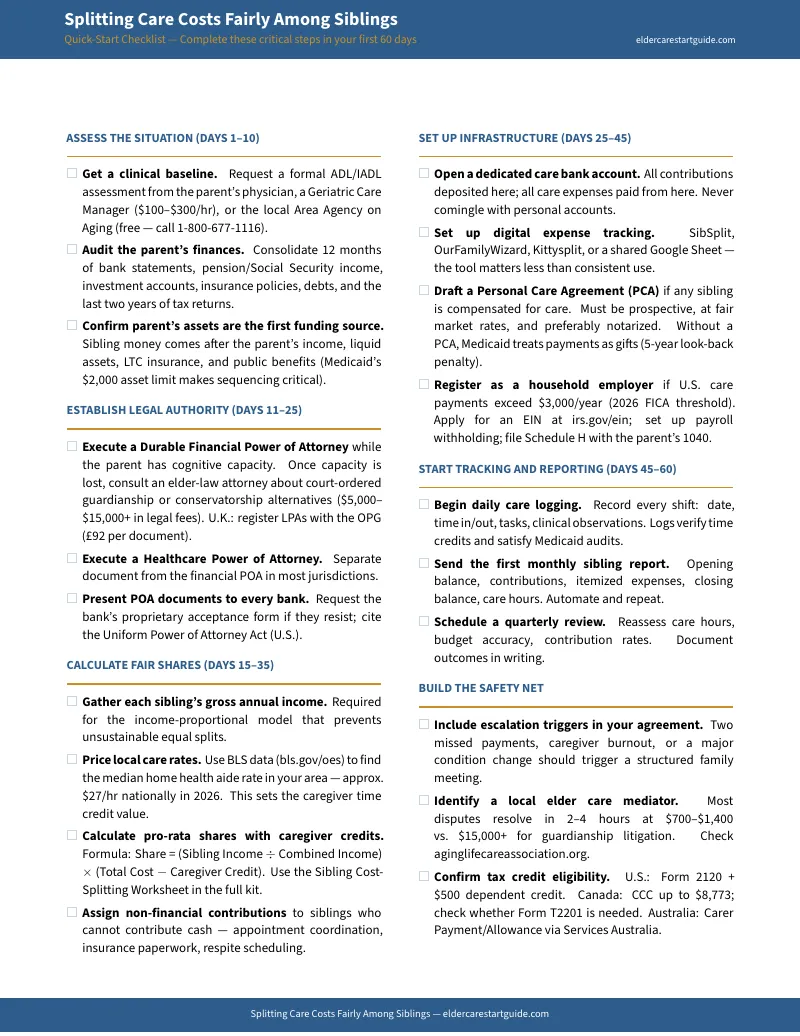
Download the free Quick-Start Checklist to see the priority action items. When you're ready for the full system — worksheets, contracts, tax guide, and escalation playbook — get the complete toolkit for .