
Your Parent Is Disappearing — And Nobody's Talking About It
It starts slowly. They stop going to church. They let the garden go. The phone calls get longer and needier — or they stop picking up altogether. You tell yourself it's just aging, just a phase, just what happens.
But you know what's actually happening. Your parent is becoming isolated. And the research is clear: chronic social isolation increases the risk of dementia by 50%, heart disease by 29%, and premature death at the same rate as smoking 15 cigarettes a day.
You've tried the obvious things. More phone calls. Suggesting the senior center. Sending links to local programs. Nothing sticks — because your parent doesn't think they need help, and every conversation about it turns into a fight or a guilt trip.
The Connection Triage System
The Social Isolation and Loneliness Prevention Plan is not another list of "tips to stay connected." It's a structured, week-by-week triage system that rebuilds social contact around your parent — without requiring their cooperation, without confrontation, and without you becoming their only lifeline.
The difference between this plan and the scattered advice on AARP or AgingCare is simple: sequence. Those sites tell you isolation is dangerous and suggest you "encourage activities." This plan tells you what to do on Day 1, what to do on Day 7, and exactly how to handle it when your parent says "I don't need anyone."
What's Inside
- Three clinical screening tools (printable standalone) — the UCLA Loneliness Scale, Lubben Social Network Scale, and GDS-15 depression screen — so you can objectively measure where your parent stands and bring real numbers to the doctor
- Stealth socialization scripts (printable standalone) — six conversation starters to introduce social contact through housekeepers, gardeners, and companion visitors, so your parent never feels "managed" or pitied
- A 7-day social calendar template (printable standalone) — map daily touchpoints across five connection channels (in-person, phone, digital, structured activities, passive contact) matched to your parent's mobility and cognitive level
- Boundary-setting scripts (printable standalone) — handle guilt-trip calls with preset end times, break the cycle of over-dependence, and stop the pattern where you're the only person your parent talks to all week
- Transportation and mobility solutions — find Area Agency on Aging ride programs, volunteer driver networks, and medical transport options when your parent can no longer drive safely
- Technology setup guides — configure GrandPad-style tablets, voice-activated speakers, and automated daily check-in calls for parents who resist screens and smartphones
- Community program scorecard (printable standalone) — vet senior centers, friendly visitor programs, faith-based outreach, and adult day programs with a structured scoring rubric instead of guessing
- Warning signs decision tree (printable standalone) — distinguish normal aging from clinical depression, recognize when isolation has crossed into a medical emergency, and know exactly when to escalate to a geriatric specialist
- Caregiver handoff worksheet (printable standalone) — daily shift worksheet for paid aides covering companionship goals, sensory checks, and clinical observations
- Medicare and insurance navigation — understand which isolation-related services Medicare covers (Annual Wellness Visits, chronic care management, social determinants screening) and how to trigger coverage
Who This Is For
- The distant child who lives hours away and can't physically check in every day — you need a system that works when you're not there
- The sole local caregiver who has become their parent's only social outlet and is burning out from the emotional weight of it
- The sibling coordinator who needs an objective framework to divide responsibilities fairly and stop the arguments about who's doing enough
- Families after a spouse's death — the widowhood effect is real (surviving spouses face a 27–70% higher mortality risk in the first year), and this plan addresses the sudden social void head-on
Why Free Resources Fall Short
Government directories list hundreds of local programs. AARP publishes articles about the isolation epidemic. Your parent's doctor might mention "staying active." None of that helps when you're staring at your phone on a Tuesday night, dreading the call because you know it'll be 45 minutes of guilt and complaints.
Free resources give you awareness. This plan gives you action steps:
- Government sites list programs — this plan shows you how to get a resistant parent to actually attend one
- Articles explain that isolation is dangerous — this plan gives you a clinical screening tool to measure how dangerous, so you can show a doctor real numbers instead of "I'm worried about my mom"
- Geriatric care managers charge $75–$250 per hour to coordinate what this plan teaches you to do yourself
- Elder law attorneys charge $300–$500 per hour for the legal triage section alone
100% Satisfaction Guarantee
If the plan doesn't give you a clear path forward within the first week, email us for a full refund. No forms, no questions, no hoops. The plan works or you don't pay.
Start Tonight — Not Next Month
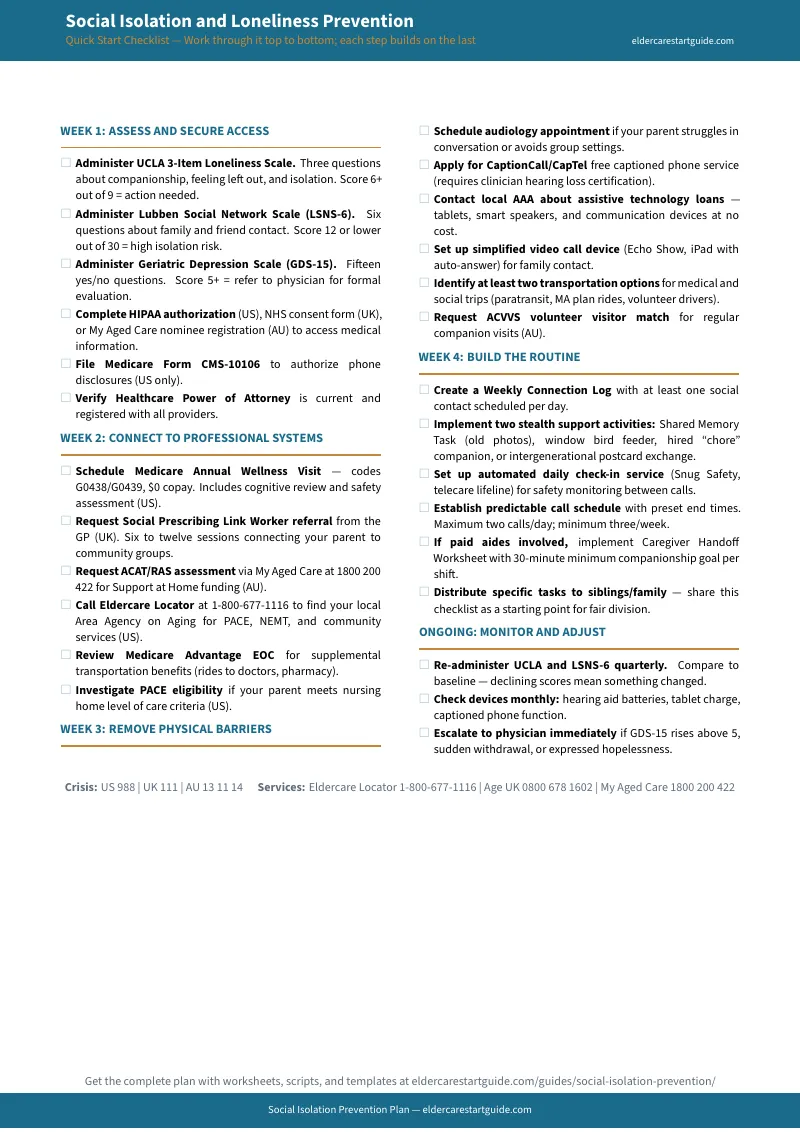
Download the free Quick-Start Checklist to get the 20-item weekly isolation prevention checklist right now. It covers the essentials — daily check-in structure, boundary scripts, and the first three steps to introducing social contact.
When you're ready for the full system — 9 PDFs including the clinical assessments, the 7-day calendar template, the stealth socialization scripts, the community program scorecard, and the complete caregiver handoff worksheet — the full plan is . Less than one hour with a geriatric care manager. A fraction of one attorney consultation.