
The Hospital Says "Ready for Discharge." You Know They're Not.
Your parent had a fall. A surgery. A stroke. And now the case manager is pushing discharge — tomorrow — while your parent still can't get to the bathroom alone.
You're scrambling to figure out who orders the hospital bed, whether Medicare covers a home health aide, how to change a surgical dressing without making things worse, and what happens when your siblings in other states insist "Dad will be fine" while you're the one sleeping on a cot in the living room.
The internet has answers — scattered across Medicare.gov PDFs, AARP articles, Reddit threads, and home care agency marketing pages that all want to sell you a $4,000-per-month placement. None of them connect the clinical piece to the legal piece to the family coordination piece. None of them work at 11pm when your father's wound looks different than it did this morning.
The Home Recovery Command Center
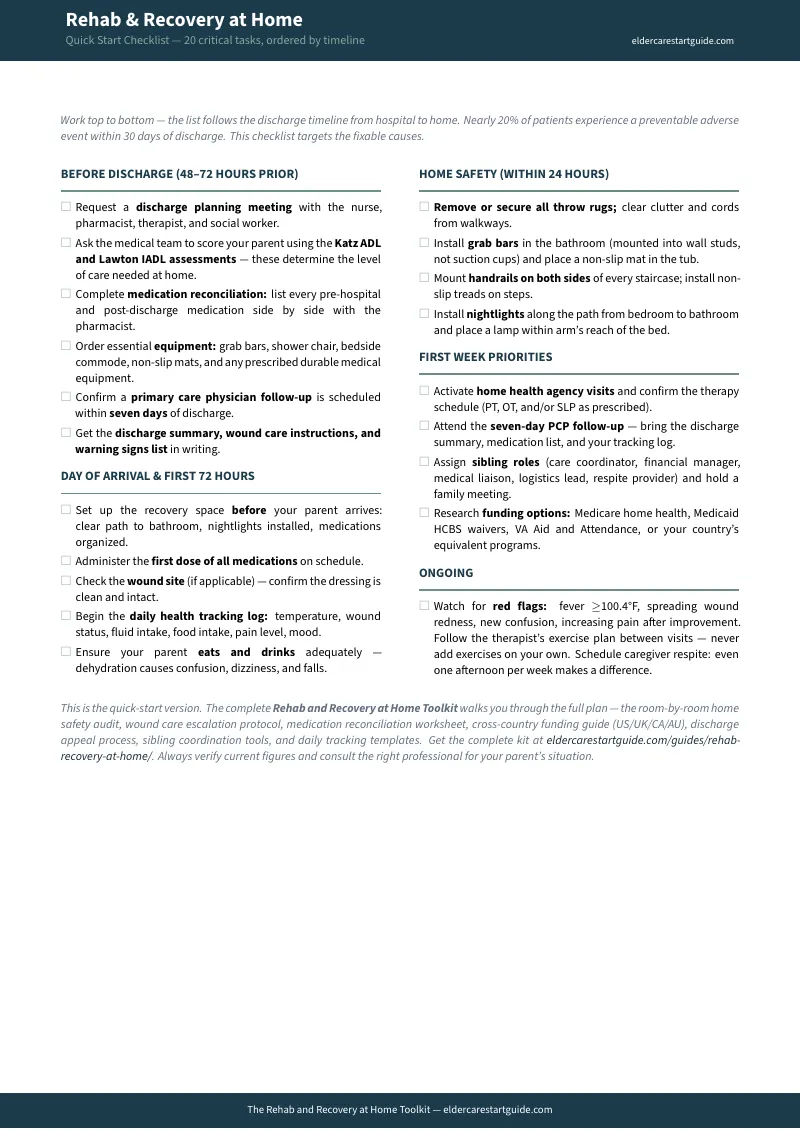
The Rehab & Recovery at Home Toolkit is the single reference that ties discharge planning, home safety, therapy coordination, funding navigation, and family logistics into one connected system.
Instead of piecing together fragments from six different websites, you get a structured playbook that moves with you — from the hospital discharge meeting through the first month of recovery at home.
It's built for the adult child who just became a caregiver overnight and doesn't have time to become a medical expert, an elder-law paralegal, and a family mediator all at once.
What's Inside
- The 72-Hour Transition Protocol — hour-by-hour workflow covering discharge day through the first three nights: medication pickup, bed setup, first meal, mobility checks, and the exact questions to ask the discharge nurse before you leave the hospital
- Home Safety Audit Checklist — room-by-room inspection with specific fixes (not just "remove hazards" — exactly which grab bars, where to install them, and how to secure throw rugs without ripping out carpet)
- Wound Care & Daily Vitals Tracker — printable daily log for temperature, fluid intake, wound appearance, and pain levels, plus a standalone four-tier escalation guide: what's normal healing, what needs a nurse call within 24 hours, and what's an ER trip
- Home Therapy Coordination Guide — how Medicare's homebound rule actually works, what PT, OT, and speech therapists do differently, and the 12 interview questions to ask before signing with a home health agency
- Setback Prevention Playbook — exercise adherence strategies for parents who refuse to do their PT, hydration protocols that prevent UTI-related readmissions, and the clinical warning signs of post-hospital delirium
- Cross-Country Funding Navigator — US state Medicaid waiver programs, UK NHS Continuing Healthcare, Canada's provincial home care, and Australia's Home Care Packages — eligibility rules, application steps, and appeal processes in one reference
- Discharge Appeal Scripts — word-for-word phrases to halt an unsafe discharge, plus the exact QIO fast-appeal timeline and contact process that buys up to 72 hours of additional covered hospital care at zero cost
- Sibling Coordination Kit — printable roles worksheet, task allocation matrix, expense-splitting log, and a structured family meeting agenda that keeps the conversation productive instead of accusatory
Who This Is For
- Adult children bringing a parent home after surgery, a fall, a stroke, or an extended hospital stay
- Families facing a discharge deadline they don't feel ready for — and nobody's explaining the options
- First-time caregivers coordinating physical therapy, wound care, or medication management at home
- Long-distance siblings who need a fair system for splitting responsibilities without destroying the family
- Anyone spending hours on Medicare.gov, AARP, and AgingCare forums trying to assemble a plan from contradictory advice
Why Not Just Use the Free Resources?
Medicare.gov's discharge checklist is six bullet points. AARP's caregiving guide is 400 pages of general advice. Reddit threads are helpful but anonymous and impossible to verify. Home health agency blogs exist to sell you their services.
None of them tell you what to do when the wound looks worse on day three, your sibling thinks you're overreacting, and the home health agency hasn't shown up for the first visit.
The toolkit connects the pieces: clinical monitoring feeds into escalation decisions, which connect to your legal authority documents, which connect to your funding options. Each section tells you what to do, why it matters, and exactly when to do it.
An elder-law attorney charges $400–$800 per hour. A private geriatric care manager runs $100–$250 per hour. This toolkit gives you the organized starting point so that when you do hire a professional, you pay for strategy — not for someone to help you list your parent's medications.
Your Purchase Is Risk-Free
If the toolkit doesn't help you navigate your parent's recovery, email us and we'll refund you — no questions, no forms, no waiting period.
— Less Than One Hour of the Professional Fee
A geriatric care manager's initial assessment alone costs $150–$2,000. The toolkit gives you the preparation system that makes every hour of professional advice more effective — and handles the daily coordination that no professional covers.
Instant PDF download. Start using the 72-Hour Transition Protocol tonight.