
Your Parent Stopped Eating. You Started Panicking. Here's What Comes Next.
You noticed it three weeks ago. The plate came back barely touched. The refrigerator had expired yogurt and a half-eaten can of soup. When you asked, your parent said they "just weren't hungry." When you pushed, they got defensive.
Now you're up at midnight searching "why won't my elderly parent eat" and drowning in contradictory advice — eat more protein, but not too much; try supplements, but watch the sugar; check for dysphagia, but what even is that?
The problem isn't information. There's plenty of that. The problem is that none of it tells you what to do first, what to do next, or how to tell the difference between normal aging and something that needs a doctor right now.
The Daily Nutrition Command System
The Nutrition and Meal Planning for Aging Parents toolkit is a structured, sequential care system — not another collection of tips. It works because it does what free articles and generic planners never do: it tells you exactly what to screen, in what order, with what tools, and gives you the fillable worksheets to track every meal, every symptom, and every change over time.
This is the system that turns "I think Mom isn't eating enough" into "Mom's Self-MNA score is 9, her EAT-10 flagged possible dysphagia, she's averaging 38 grams of protein per day against a target of 72, and here is the completed worksheet for her geriatrician."
That conversation gets results. Vague worry doesn't.
What's Inside the Full Toolkit
- Three Clinical Screening Tools You Can Run at Home — the Self-MNA (nutritional status), SNAQ (appetite risk), and EAT-10 (swallowing risk). Validated instruments, simplified into worksheets. Complete them in 15 minutes and walk into the doctor's office with clinical data, not a list of anxieties.
- The Post-Discharge Nutrition Protocol — your parent just came home from the hospital and the discharge instructions say "soft diet." This protocol tells you exactly what that means: which foods qualify, how to test texture safety using the IDDSI fork and spoon tests, what positioning prevents aspiration, and the 72-hour monitoring checklist that catches readmission risks early.
- Protein Targets Calibrated to Your Parent's Body — not "eat more protein," but 1.0–1.2 grams per kilogram per day, split into 25–30 gram portions across three meals. You get a soft-food protein swap table (tough steak becomes shredded slow-cooker chicken; raw nuts become almond butter stirred into oatmeal), so every meal hits the target without a fight.
- The Complete IDDSI Swallowing Safety Framework — the same international standard that hospitals use to classify safe food and drink textures (levels 0 through 7), translated into plain language with home testing procedures. Because "puréed" and "minced and moist" are not the same thing, and the difference matters.
- Dementia Mealtime Strategies That Actually Work — your parent isn't refusing food out of stubbornness. Their brain is losing the ability to recognize hunger, interpret utensils, or coordinate chewing and swallowing. This chapter covers sensory adjustments (high-contrast plates, reduced visual clutter), simplified single-item plating, the UTI-confusion connection that mimics appetite loss, and a behavior tracking sheet to identify patterns you can bring to the care team.
- The Batch-and-Freeze Meal Prep System — designed for the caregiver who has 45 minutes on a Sunday afternoon, not a professional kitchen. Single-pan recipes that hit protein and micronutrient targets. Freeze-and-reheat protocols with large-font heating instructions for parents living alone. Microwave-safe portioning that eliminates stovetop risk.
- Hydration Tracking That Goes Beyond "Drink More Water" — a daily fluid target calculated from your parent's body weight (30 mL/kg), a table of high-water-content foods (cucumber at 96%, watermelon at 92%, broths and gelatin), and practical strategies for parents who limit fluids to avoid bathroom trips.
- Government Benefits You May Not Know About — Meals on Wheels eligibility and how to apply, Medicaid waiver meal delivery programs by state, Medicare Part B Medical Nutrition Therapy (100% covered for diabetes, kidney disease, and post-transplant), VA Aid and Attendance for veterans, plus equivalent programs in Canada, the UK, and Australia. This chapter alone can save hundreds of dollars per month.
- The Meal Delivery Evaluation Checklist — not a recommendation list, but a scoring rubric. Rate any senior meal service on the criteria that actually matter: no-subscription flexibility (protecting seniors with cognitive decline from confusing recurring charges), sodium limits under 800mg per serving, dietary accommodation, insurance integration, and fresh-chilled vs. frozen form factor.
- The Caregiver Handoff Template — a single-page shift log that goes on the refrigerator. Any paid aide, family member, or neighbor can record meals given, fluids taken, medication timing, and mood changes. Designed for the remote caregiver who needs eyes on the ground without miscommunication.
Who This Toolkit Is For
- The crisis-driven working daughter who just discovered her mother has lost 12 pounds and has been living on toast and tea
- The remote sibling who coordinates care from three states away and needs a structured handoff system that eliminates "she seemed fine when I called"
- The exhausted co-resident caregiver who is doing all the cooking, all the cleaning, and all the worrying while other family members second-guess from the sidelines
- The primary caregiver managing dementia who has watched mealtimes go from difficult to frightening and does not know whether the food refusal is behavioral or neurological
Why Free Resources Won't Get You There
You can find nutrition advice for seniors on AARP, the NIH, and a dozen state health department websites. That is not the problem. The problem is that free resources give you the what without the when or the how.
They will tell you "older adults need more protein." They will not tell you that your 150-pound mother needs 68–82 grams per day, split into 25-gram portions, and that a single egg only provides 6 grams — so she needs to eat the equivalent of eleven eggs worth of protein every day, which means you need a plan that goes far beyond scrambled eggs for breakfast.
They will tell you "watch for swallowing problems." They will not give you the IDDSI fork drip test to check whether your parent's food texture is actually safe, or the positioning protocol (90 degrees upright, chin slightly tucked) that reduces aspiration risk during every meal.
They will tell you "look into meal delivery." They will not tell you which programs your parent's Medicaid waiver actually covers, or how to evaluate whether a service's sodium levels are safe for someone with hypertension.
This toolkit organizes the 40+ hours of research you would otherwise do at 2 AM into a single, sequential system with fillable worksheets you can print tonight.
The Cost of Waiting
Every week without a tracking system is another week of guessing. Malnutrition in older adults increases fall risk, delays wound healing, and quadruples the chance of hospital readmission. A single fall leading to a hip fracture can mean $50,000 in medical costs and the end of independent living.
A Geriatric Care Manager assessment costs $500–$1,500. An elder-law attorney consultation runs $300–$600 per hour. The worksheets in this toolkit help you organize your parent's medical, nutritional, and care data before those appointments — so you pay for answers, not for a professional to sort through your shoebox of notes.
Your Purchase Is Protected
Download the complete toolkit. Print the worksheets. Use the screening tools. Fill in the meal tracking logs. If you don't feel more organized and less overwhelmed, email us for a full refund. There is no time limit.
Start With the Free Checklist — or Get the Complete System
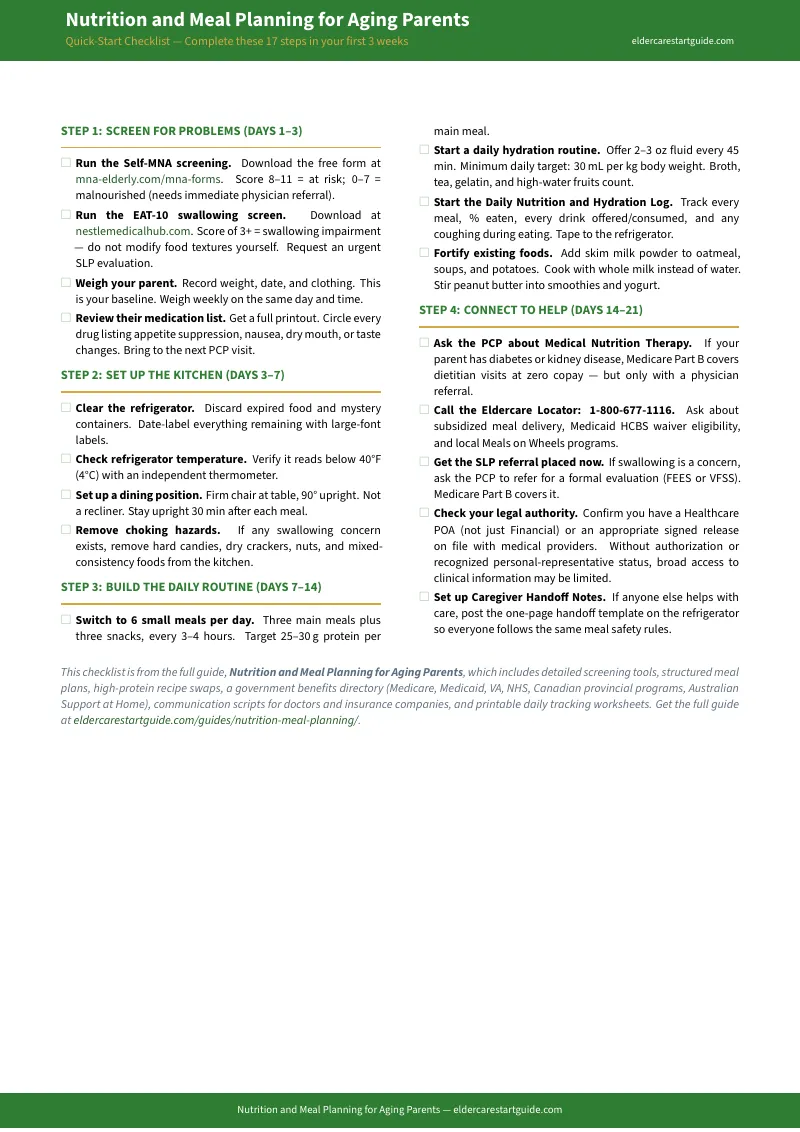
The free quick-start checklist gives you the essential first steps: what to assess, what to watch for, and what to bring to the doctor. It is a solid starting point for anyone who needs to act tonight.
The full toolkit goes the rest of the way — a 15-chapter guide, 10 standalone printable worksheets and reference cards, screening protocols, meal plans, government benefit breakdowns, and the daily tracking system that turns scattered worry into structured care. For less than the cost of one hour with a nutritionist, you get a system designed to last months.