You're attending every appointment. You're still losing the thread.
You drove your mother to the doctor. You sat in the room. The doctor spoke for six minutes, adjusted a medication, mentioned a referral, and moved on. Now you're in the parking lot trying to remember what the new pill is for, which specialist you're supposed to call, and whether that blood test was ordered or just discussed. You meant to bring up the tremor, the bruise from last week's stumble, and the fact that she's been sleeping fourteen hours a day — but the visit was over before you got through your mental list.
This isn't a memory problem. It's a systems problem. You are walking into a high-stakes clinical encounter — where a single missed drug interaction or an unreported fall can set off a chain of expensive, dangerous consequences — with no preparation framework, no structured way to capture what happens, and no follow-up process to make sure things actually get done afterward.
The doctor isn't being negligent. They have twelve minutes per patient and no context beyond what's in the chart. Your parent isn't being difficult. They're instinctively performing competence in front of an authority figure — a well-documented clinical phenomenon called "showtiming" — because admitting decline feels like losing independence. And you're stuck in the middle, doing the hardest coordination job in the room with nothing but a scrap of paper and a growing sense of dread.
The Clinical Coordination System — everything a geriatric care manager does, in a printable toolkit you own
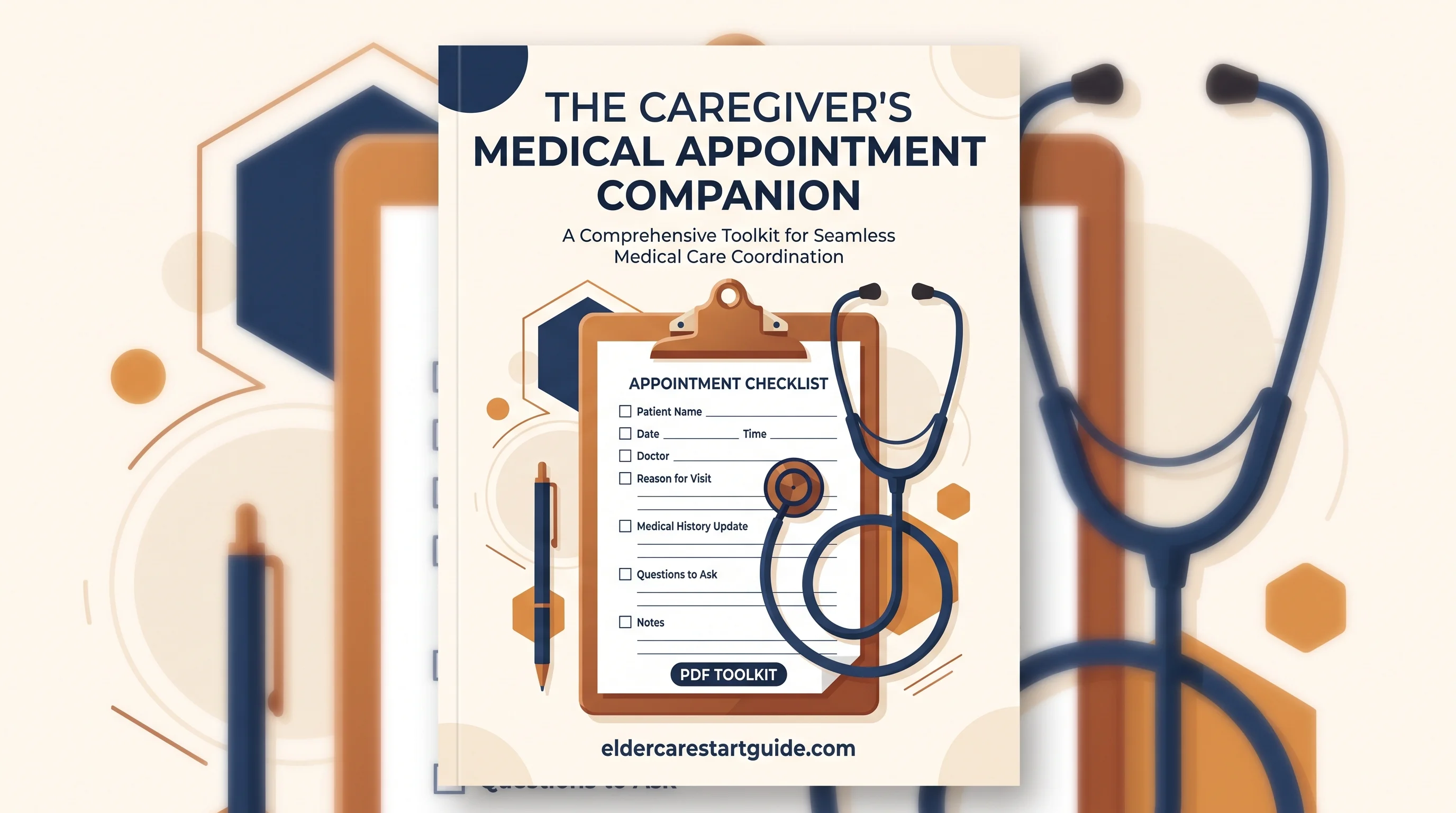
The Caregiver's Medical Appointment Companion is not another checklist. It's a complete clinical coordination system — the same structured approach a $150-per-hour geriatric care manager uses — packaged as a printable, fill-in toolkit for . Pre-visit preparation worksheets. A clinician memo that gets the real picture to the doctor before showtiming hides it. Structured note templates that capture diagnoses, medication changes, and follow-ups in real time. A medication audit protocol. A care team directory. Patient portal setup. Medicare preventive benefits. Post-visit follow-through. Cognitive and physical tracking logs. And a sibling coordination framework that keeps every family member aligned without the arguments.
Sixteen chapters. Forty-seven pages. Every worksheet designed to be printed, filled in, and reused at every appointment — not read once and filed away.
What's inside
Legal Authority Audit — know your standing before you walk in
Being someone's adult child does not give you the right to view their chart, talk to their doctor privately, or sign a form. The guide walks you through the four documents every caregiving family needs — HIPAA authorization, healthcare proxy, durable power of attorney, advance directive — and includes the legal authority audit checklist so you know exactly where the gaps are before the next visit.
The Brown Bag Medication Audit — catch the errors before the doctor does
Gather every bottle, blister pack, supplement, and OTC product in the house and run a structured review. The guide covers the Beers Criteria list of high-risk medications for older adults, teaches you to spot dangerous interactions and duplicate prescriptions, and gives you the medication tracking worksheet you bring to every appointment so the entire care team is working from one accurate, current list.
Fall Risk Screening — the CDC protocol you can run at home
A home-based screening using the STEADI protocol — three simple balance and gait tests your parent can do in the living room — plus the home fall-prevention checklist and a pre-appointment sensory check. Falls are the leading cause of injury death in adults over 65. A documented screen gives the doctor actionable data instead of "she seems a bit unsteady."
Pre-Visit Preparation Worksheet — walk in with your agenda, not theirs
Build a prioritized three-concern agenda, organize the medication list, document recent changes in function, and prepare for showtiming. Includes the pre-appointment clinician memo — a one-page structured letter you send to the doctor before the visit that documents what's really happening at home, so the medical team has the facts regardless of how your parent performs in the exam room.
Structured Note-Taking Template — stop trying to remember what the doctor said
A fill-in template that captures diagnoses, medication changes, referrals, lab orders, and follow-up instructions in real time. You walk out of the appointment with a written record, not a vague recollection. Includes advocacy scripts for the moments when the doctor dismisses your concerns or your parent contradicts you in the room.
Care Team Directory — one page, every provider, every number
Primary care, specialists, pharmacy, home health, therapists — every provider your parent sees, with direct lines, after-hours numbers, and portal access. Because when something goes wrong at 9 PM on a Saturday, you need the number in front of you, not buried in a patient portal you can't log into.
Patient Portal Setup — the single most underused tool in elder care
Step-by-step walkthrough for getting proxy access to your parent's patient portal. Covers the common obstacles — no email address, clinic won't grant proxy, different login systems — and the workarounds. Once set up, you can check lab results, review medication lists, and schedule appointments between visits without calling anyone.
Medicare Preventive Benefits — the free screenings your parent isn't getting
The Annual Wellness Visit, cognitive assessment, and the full directory of preventive screenings covered at no cost — and how to make sure the doctor actually orders them. Includes the list of screenings most commonly skipped for older adults and exactly how to request them so they're coded correctly.
Post-Visit Follow-Through Protocol — nothing falls through the cracks
The 48-hour protocol: processing notes into action items, scheduling follow-ups, filling new prescriptions, relaying changes to the rest of the care team, and the follow-up tracking worksheet. Because the most dangerous moment in your parent's care isn't the appointment — it's the two weeks after, when the referral sits unscheduled and the new medication sits unfilled.
Cognitive and Physical Tracking Logs — evidence, not anecdotes
Structured observation logs for documenting memory, orientation, language, judgment, mobility, balance, appetite, and sleep changes over weeks and months. The kind of longitudinal data that gives a doctor real diagnostic evidence instead of "I think she's getting worse." Includes a trend summary sheet you bring to each visit.
Telehealth Management — make video visits actually work
Setup, troubleshooting, and optimization for a parent with hearing loss, limited tech skills, or mild cognitive impairment. Covers lighting, camera angle, audio testing, and how to position yourself in the room without taking over the conversation.
Sibling Coordination System — alignment without the blowup
A shared update log, a task delegation worksheet that assigns responsibilities based on each sibling's strengths, location, and budget (not a forced 50/50 split), and a family meeting framework that replaces "you're not helping enough" with a documented plan everyone can see.
Emergency Recognition Reference — know when to call 911
Rapid-recognition guidance for stroke (BE-FAST), heart attack, falls with head injury, severe infection, and acute confusion — including the critical difference between delirium (sudden, reversible, often caused by medications) and dementia (gradual, progressive). What to say to dispatch and what to grab on the way out.
Care Binder Assembly Guide — one binder, everything in it
The tab-by-tab guide for assembling the single physical binder that holds legal documents, medication list, care team directory, insurance cards, appointment history, and emergency contacts — so any family member, aide, or first responder can pick it up and act.
Who this is for
- The adult child who keeps leaving appointments confused — you sit in the room, hear the doctor talk, and can't reconstruct what happened or what to do next. The structured note template and post-visit protocol fix that.
- The caregiver whose parent "showtimes" for the doctor — your father can't find his keys, but in the exam room he's charming and articulate. The clinician memo gets the real picture to the medical team without undermining his dignity.
- The family juggling five specialists and zero coordination — cardiology doesn't know what neurology prescribed. The care team directory and medication worksheet put you at the center of a system that otherwise has no center.
- The long-distance sibling — you're three states away and depend on secondhand summaries. The sibling coordination system, shared logs, and patient portal walkthrough keep you in the loop with facts.
- The new caregiver who inherited this role overnight — a fall, a stroke, a diagnosis — and suddenly you're in charge. The toolkit gives you the system from day one instead of building it from scratch during a crisis.
Why this works where free tools don't
Free checklists from AARP, the NIA, and hospital discharge packets give you a list of things to think about. They don't give you a system — a set of interlocking templates that carry information from one appointment to the next, from one provider to another, and from one family member to the rest.
The difference is the difference between a packing list and an itinerary. One reminds you what exists. The other tells you what to do, in what order, with a place to write it down and a way to hand it off.
Geriatric care managers charge $90 to $250 an hour for exactly this kind of structured coordination. An elder law consultation to sort out legal authority runs $200 to $500 for the first meeting. This toolkit gives you the same operational framework — the preparation worksheets, the tracking logs, the coordination templates — for , in a format you can print tonight and use at the appointment tomorrow.
Satisfaction guarantee
If the toolkit doesn't change how you walk into your parent's next appointment, email us and we'll refund you — no questions, no forms, no time limit.
Get started now
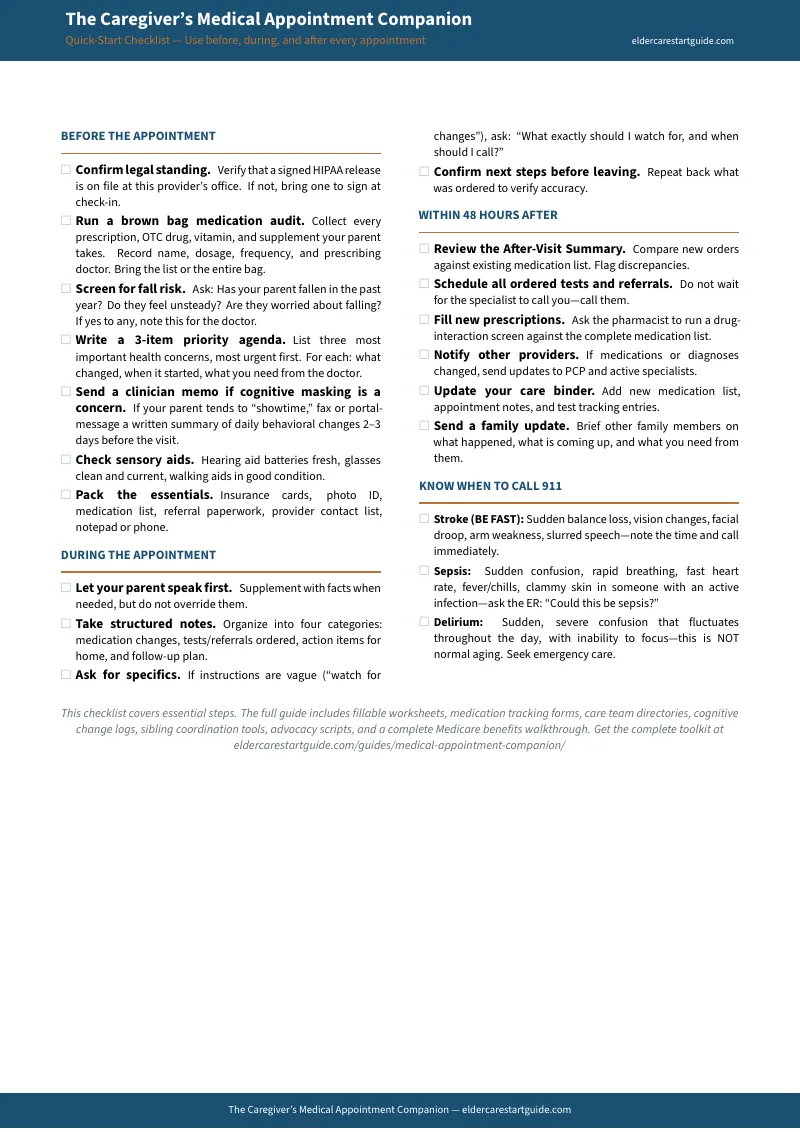
Download the free Quick-Start Checklist — the 20 most critical actions on a single printable page — and see the system in action before you buy. Or get the full Caregiver's Medical Appointment Companion and walk into the next appointment with every worksheet, template, and tool ready to go.