
Your parent turns into a different person every evening — and every article says the same five things that don't work.
"Keep the lights on. Play soft music. Stay calm." You've read that advice a hundred times. It didn't stop last night's three-hour pacing episode, the accusation that you stole their wallet, or the attempt to leave the house at midnight. The standard sundowning advice describes the problem without actually solving it — because managing sundowning requires a system, not a tip sheet.
The Sundowning Response System is a structured caregiver toolkit built around one biological fact: sundowning is predictable. It follows the same 3 PM–midnight window every day because it's driven by measurable neurodegeneration of the brain's circadian clock. That predictability is what makes it manageable — if you have the right framework to get ahead of it instead of reacting after it starts.
What's Inside the Toolkit
Hour-by-Hour Evening Routine Framework — because preparation starts at 1 PM, not at dusk. A fill-in schedule template that maps transition management, meal timing, activity sequences, lighting shifts, and the bedtime protocol to your parent's specific patterns. The routine starts hours before the trouble window opens so the environment is already calm when the agitation cycle would normally begin.
De-Escalation Scripts for Real Scenarios — because "stay calm" is not a strategy. Worked verbal scripts for the situations you actually face: "I want to go home" loops, refusal to sit down, accusations of theft, attempts to leave, and aggressive outbursts. Each script explains the cognitive mechanism driving the behavior, gives you the exact words to use, and — just as importantly — tells you what not to say and why certain common responses make the agitation worse.
ABC Behavior Tracking System — because you can't fix what you can't see. A structured Antecedent–Behavior–Consequence log that turns chaotic evenings into actionable data. After two weeks of entries, patterns surface: the agitation always spikes after a specific TV show, or after a late visitor, or on days the afternoon nap was skipped. Includes a worked example showing exactly how one family identified and eliminated a specific trigger that had been invisible for months.
The Delirium Emergency Guide — because sometimes it's not sundowning at all. A sudden overnight escalation in confusion can be a treatable urinary tract infection, medication toxicity, or dehydration masquerading as worsening dementia. The guide includes a side-by-side diagnostic comparison and a physician script you can use to request the right tests immediately — before panic drives a premature facility placement over a fully reversible condition.
Home Environment Audit Checklist — because your living room may be manufacturing triggers. A room-by-room walkthrough targeting the environmental factors that compound sundowning: reflective surfaces creating moving shadows, uneven lighting transitions at dusk, cluttered pathways, and hidden trip hazards. Includes smart lighting recommendations, visual barrier techniques for exit doors, and a bathroom safety protocol.
Medication Safety and Doctor Discussion Guide — because common medications can make sundowning worse. A tracking worksheet for every current prescription, its timing, and its anticholinergic risk profile. Certain antihistamines, bladder drugs, and antidepressants directly worsen evening agitation — and the person prescribing them may not be the same specialist managing the dementia. The printable question list ensures nothing gets missed in a rushed appointment.
Legal Authority Templates — US, UK, and Canada — because the documents that protect your parent must be signed while they can still sign them. Durable Power of Attorney, Healthcare Proxy, and Advance Directive templates with jurisdiction-specific requirements. Includes a capacity assessment prep guide so you know what the attorney or solicitor will evaluate.
Wandering Prevention and Nighttime Safety Protocols — because the highest-risk moment is a parent leaving the house at 3 AM. Door alarm placement, visual threshold barriers, GPS tracking options, and a pre-formatted emergency handoff sheet with the information police need if your parent goes missing.
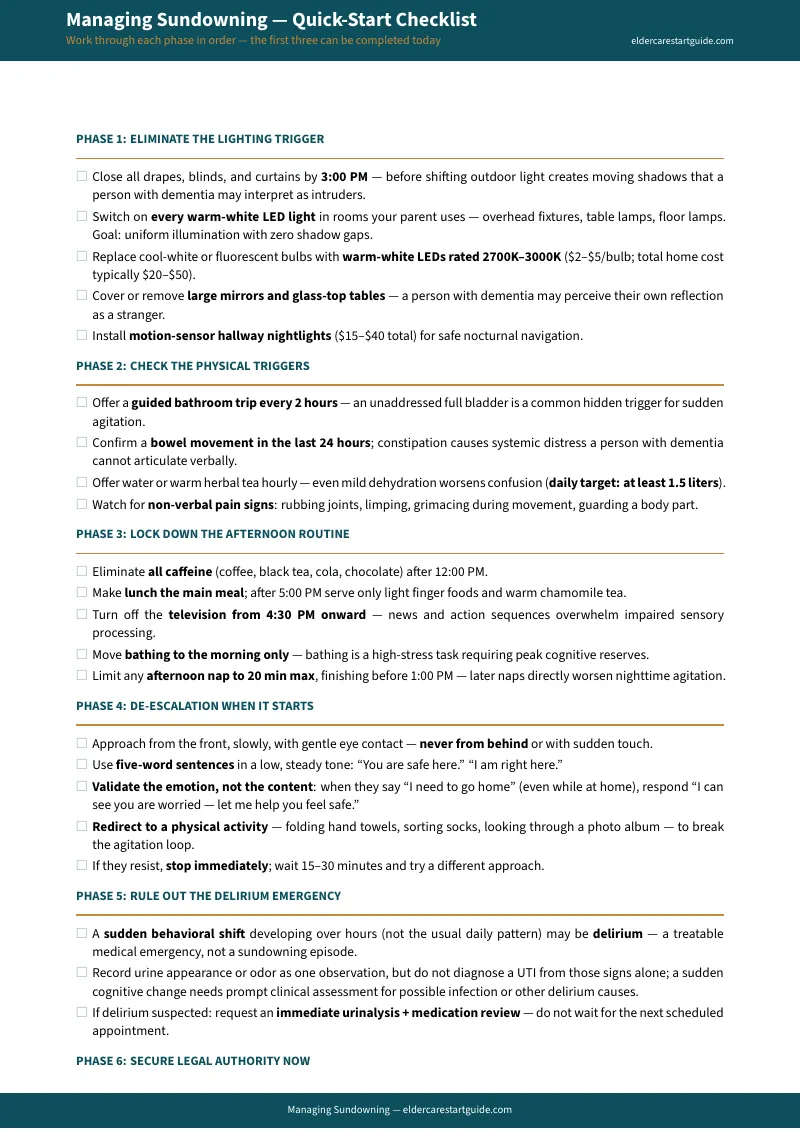
Quick-Start Checklist — 25 prioritized action items distilled from the full toolkit. Print it, stick it on the fridge, work through it this week.
Who This Toolkit Is For
- Caregivers whose evenings have become a nightly crisis — you've moved past occasional restlessness into daily multi-hour agitation, and general advice isn't cutting it anymore.
- Families unsure whether a sudden change is sundowning or a medical emergency — the delirium comparison guide and physician script help you get the right tests fast.
- Long-distance family members coordinating care remotely — the ABC tracking log gives the on-site caregiver a protocol that produces data you can review and discuss with the medical team.
- Primary caregivers losing sleep — the nighttime safety protocols and wandering prevention setup address what happens between midnight and 6 AM, the window every daytime-focused resource ignores.
Why the Free Tools Aren't Enough
The Alzheimer's Association and NIA publish solid clinical overviews of what sundowning is. They explain the symptoms, the stages, and the general categories of intervention. What they don't give you is an evening routine template you can fill in for your parent's specific schedule, a behavior tracking system that reveals which particular triggers are causing your parent's episodes, de-escalation scripts written for the actual verbal loops you're dealing with at 8 PM, or a delirium-vs-sundowning comparison you can bring to the ER when you suspect something medical is being missed.
Etsy printables offer attractive care binders and daily trackers. They're designed by graphic artists, not by people who understand the clinical mechanisms behind sundowning behavior. A generic "daily mood tracker" doesn't capture the Antecedent–Behavior–Consequence pattern that makes behavior data actually useful to a medical team. A "calming tips" card doesn't explain why certain responses escalate paranoia in a person with damaged frontal lobes.
This toolkit bridges that gap: clinical understanding translated into printable, fill-in tools that work in a living room at dusk, not just in a research abstract.
Your Purchase Is Protected
If the toolkit doesn't help you build a more manageable evening routine within 30 days, email us and we'll refund your purchase — no forms, no hassle. We'd rather you try it risk-free than spend another week white-knuckling through evenings without a system.
Get the free Quick-Start Checklist
Not ready for the full toolkit? Download the free 25-item checklist — the prioritized action items you can start tonight. When you're ready for the complete system, the full toolkit is waiting.
Get the Complete Toolkit
The full Managing Sundowning and Nighttime Agitation toolkit — 49-page guide plus 10 standalone printable worksheets, behavior tracking system, de-escalation scripts, home audit checklist, medication worksheets, legal templates, and the quick-start checklist — for less than one hour of a geriatric care manager's time.