One missed pill. One doubled dose. One phone call you never wanted to get.
Your parent is taking five, eight, twelve medications a day — and right now, the only "system" keeping them safe is memory, a half-labeled pillbox, and hope. You lie awake wondering: did Dad take his blood thinner this morning, or did he take it twice? You're not being paranoid. Up to two-thirds of older adults leave the hospital with at least one unintended medication error baked into their prescriptions — and most families never catch it.
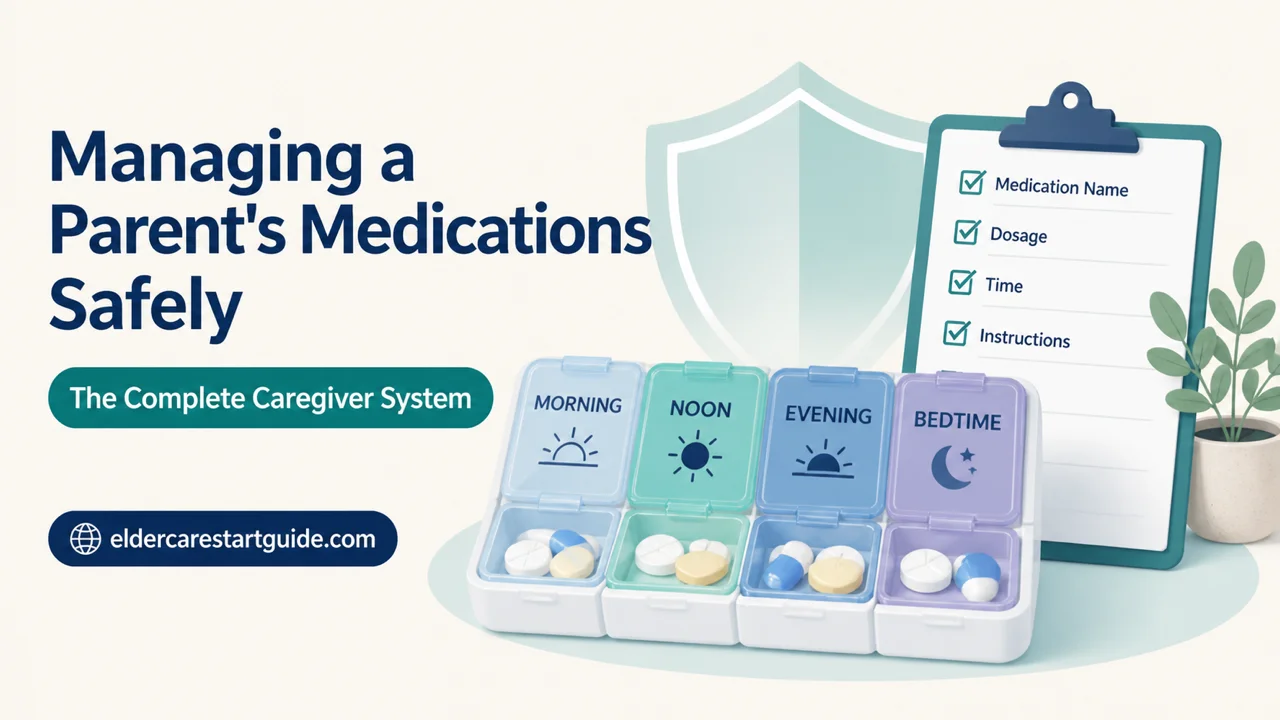
Managing a Parent's Medications Safely replaces the guesswork with a complete Medication Command Center: one master list, one daily log, one set of scripts and forms that puts you in control of every pill, refill, doctor, and dollar — even from three time zones away.
The problem nobody warns you about
Aging bodies process drugs differently. The liver and kidneys slow down, so medications that were safe at 55 accumulate to dangerous levels at 80. Common prescriptions — sleep aids, antihistamines, anti-anxiety drugs — can mimic dementia, trigger falls, and land a parent in the ER. And when siblings, pharmacists, and three different specialists each hold a piece of the puzzle, the caregiver becomes the unpaid project manager of a small pharmacy.
Free printables from the internet won't save you. They're pretty layouts with no clinical logic: no column for the prescribing doctor, no physical pill description to catch look-alike generics, no missed-dose protocol, no legal access forms. They track doses — they don't prevent errors.
What's inside
- The Master Medication Log — the "one source of truth" every guide tells you to build and none actually hands you. Brand and generic names, doses, pill appearance, prescribing doctors, and pharmacy contacts in one sheet you can hand to any ER nurse or new specialist in seconds.
- The Discharge-Day Reconciliation Worksheet (Best Possible Medication History) — because the 72 hours after a hospital stay are when the most dangerous errors happen. Compare pre-admission meds against new discharge orders line by line and catch brand-generic duplicates before the first home dose.
- Daily Medication Logs with sign-off lines — color-coded Morning / Noon / Evening / Bedtime grids with checkboxes, so you, your sibling, and the hired aide never have to wonder "did anyone give Mom her 2 o'clock?" Double-dosing becomes structurally impossible.
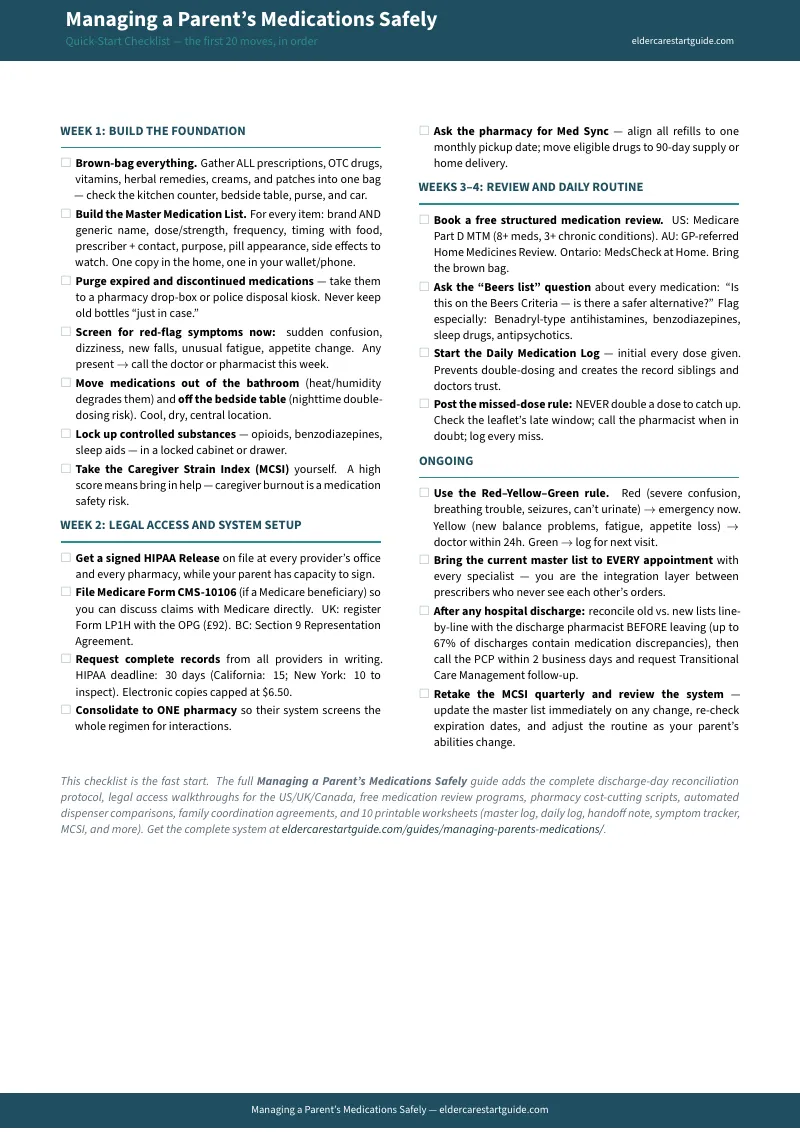
- The Symptom & Side-Effect Tracker with a Red–Yellow–Green escalation framework — know instantly whether Dad's dizziness means "mention it at the next visit" or "call 911 now," and walk into every appointment with documented evidence instead of vague worry.
- Legal access templates that actually work — HIPAA caregiver authorization forms, the Medicare disclosure form (10106) walkthrough, and plain-English guidance on healthcare proxies, so you can legally speak with doctors, pharmacists, and insurers before a capacity crisis — not after.
- The Pharmacy Logistics Playbook — how to consolidate to one pharmacy, set up Medication Synchronization so every refill lands on one predictable day, request easy-open caps and blister packs, and use copay cards and patient assistance programs to cut costs.
- Scripts for every hard conversation — the exact questions to ask the pharmacist about Beers List high-risk drugs, the words that get a free professional medication review scheduled (it's covered — if you know what to ask for), and respectful dialogue for the parent who insists "I can manage my own pills."
- Family coordination tools — the Care Handoff Note, Safety Event Log, and Family Care-Coordination Agreement that turn sibling arguments into documented facts and divide the workload transparently.
- The quarterly Caregiver Strain self-check — because your burnout is a patient-safety risk factor too.
Every worksheet ships twice: inside the guide, and as its own separate print-ready PDF — so you print only the sheet you need, as many times as you need it. (That's 12 PDFs in total: the guide, the checklist, and 10 standalone worksheets and forms.)
Who this is for
- Adult children who just took over a parent's medications after a fall, hospital stay, or scary discovery (loose pills on the counter, expired bottles in the pantry)
- Long-distance caregivers who need visibility into daily dosing without being there
- Families splitting care between siblings or home aides who need one shared record everyone trusts
- Anyone whose parent takes five or more daily medications and sees more than one doctor
Why not just hire help — or Google it?
A geriatric care manager runs $100–$300 an hour, and an elder-law attorney $300–$600. They have their place — and this guide tells you exactly when that place is. But neither of them sits at your parent's kitchen table at 8 a.m. confirming the morning dose. Government sites hand you fragments scattered across a dozen agencies; this guide is the unified workflow that connects the medication list to the legal forms to the pharmacy setup, in the order you actually need them.
Walk into your next appointment with the Master Log filled in and you'll save more in professional billable hours than this guide costs — every single visit.
Start tonight
The first worksheet takes one evening: gather every bottle, tube, and blister pack in the house and build the Master List. Most families find at least one surprise — a duplicate, an expired prescription, a drug nobody remembers prescribing. That one evening is the difference between hoping your parent is safe and knowing it.
— less than one missed refill costs
Instant download. Print the worksheets, put them in a binder at your parent's home, and the system runs itself. Not sure yet? The free Quick-Start Checklist gives you the 20 highest-priority safety actions — grab it above and start there.
Get the complete Medication Command Center and take the 3 a.m. worry off your plate.