
Nobody Trained You for This
The first time you changed your parent's soiled clothing, you had no idea what you were doing. You improvised with baby wipes that burned inflamed skin. You used a towel that made the rash worse. You tried to preserve some shred of normalcy while your parent stared at the wall, mortified.
Since then, you've been learning by crisis — each accident revealing another gap in your knowledge. The mattress protector that leaked. The skin breakdown you didn't notice until it was raw. The overnight routine that leaves both of you exhausted. The supply costs that keep climbing because you're buying the wrong products for your parent's actual needs.
Incontinence affects over 30% of adults aged 65 and older, yet the practical knowledge for managing it at home is scattered across clinical papers, product marketing, and forum posts from other exhausted caregivers. You need the same structured protocols that continence nurses and home health aides follow — adapted for a family caregiver who's doing this without any clinical training.
The Home Continence Care System
The Incontinence Care and Dignity Toolkit is a structured clinical-care system for family caregivers — the same skin protection routines, prompted voiding schedules, and supply management protocols that trained continence nurses use, reorganized into printable checklists and fill-in templates you can start using tonight.
Where free resources give you tips to read, this toolkit gives you protocols to follow. Each template has a specific clinical purpose: prevent skin breakdown, establish a toileting routine, select the right absorbency product, track symptoms for your parent's doctor. Complete one template and you've addressed a real care gap — even on a day when you only have ten minutes.
What's Inside
- Skin Integrity Protection Protocol — the three-step cleanse-dry-barrier routine used in clinical continence care. pH-balanced perineal cleansing, proper pat-dry technique, and dimethicone or zinc-oxide barrier application — with an inspection schedule that catches incontinence-associated dermatitis before it becomes a wound.
- Prompted Voiding Schedule Builder — 1.5-hour, 2-hour, and 3-hour interval templates modeled on clinical protocols for cognitively impaired adults. Track behavioral cues (fidgeting, pulling at clothing, pacing), use environmental prompts, and establish a predictable routine that reduces accidents by working with your parent's remaining capacity.
- Supply Selection Matrix — stop guessing which products to buy. This comparison framework matches product types (liners, pull-ups, tabbed briefs) to your parent's mobility level, leak volume, and overnight needs. Includes absorbency ratings, cost-per-use calculations, and the sizing measurements that actually matter — because the wrong product leaks regardless of brand.
- Overnight Routine Builder — fluid timing protocols, bed layering systems (mattress encasement + washable pad + disposable liner), low-light check schedules, and bedside supply staging. Designed to protect sleep for both of you, because a caregiver running on four hours of broken sleep is a caregiver approaching burnout.
- UTI Recognition Reference — the atypical elder symptoms that most families miss. When an older adult develops sudden confusion, agitation, or behavioral changes, the cause is often a urinary tract infection — not "just getting worse." This reference teaches you the warning signs that trigger an urgent doctor call versus the symptoms you can monitor at home.
- Home Environment Setup Checklists — room-by-room waterproofing guides, grab-bar placement for safe transfers, odor control protocols (enzymatic cleaners, ventilation, laundry techniques), and supply staging for bedroom, bathroom, and living areas. Turn your home into a functional care environment without making it feel like a facility.
- Dignity Communication Scripts — specific language substitutions and conversation frameworks from continence nursing practice. Replace "diaper" with "comfort wear." Replace "I need to change you" with "let's get you freshened up." These aren't generic tips — they're the exact verbal techniques that reduce shame, resistance, and conflict during personal care.
- Fecal Incontinence Management — the issue no one wants to discuss but many families face. Bowel tracking sheets, dietary fiber and fluid protocols, scheduled toilet trials, and specific cleanup procedures. Addresses the care gap that most free resources completely ignore.
- Benefits Navigation Worksheets — Medicaid incontinence supply coverage (state-specific documentation requirements), NHS continence services through Integrated Care Boards, Canadian provincial supply programs, and Australian Continence Foundation support. Each worksheet includes the clinical vocabulary and documentation steps that trigger approval — because knowing the system exists and knowing how to get approved are two different things.
- 7-Day Bladder and Bowel Diary — a structured tracking sheet designed to hand directly to your parent's physician or continence nurse. Fluid intake, voiding intervals, accident timing, stool consistency. Clinicians can make treatment decisions in minutes when they see documented patterns instead of vague descriptions.
- Care Coordination Binder Templates — daily handoff logs, symptom tracking sheets, and medication schedules for sharing care across family members and paid aides. Everyone follows the same documented protocol. You review the logs remotely and catch problems early instead of hearing about them after something goes wrong.
- Caregiver Wellbeing Resources — because managing a parent's incontinence is one of the leading drivers of caregiver burnout and premature facility placement. Boundary-setting frameworks, respite scheduling templates, and the clinical indicators that signal when you need professional support — not as a failure, but as a strategic care decision.
Who This Toolkit Is For
- Adult children managing a parent's incontinence at home who are learning everything through trial and error
- Sandwich generation caregivers who need structured routines that don't consume every waking hour
- Long-distance care coordinators who need printable protocols to standardize what local helpers and paid aides do
- Aging spouses managing a partner's physical decline while dealing with their own physical limitations
- Families trying to keep a parent at home instead of moving them into a facility — 27% of caregivers cite incontinence as the specific reason they had to make that transition
Why Free Resources Aren't Solving This
Sites like DailyCaring and the National Institute on Aging publish useful articles — scattered across hundreds of pages with no unified protocol. You can spend two hours reading about skin care best practices and still not have a printable routine to tape to the bathroom wall.
A Place for Mom and Caring.com are designed to funnel you toward facility placement, not to help you manage care at home. Continence product manufacturers publish guides that always conclude with buying more of their specific products. Geriatric care managers charge $150–$750 for an initial assessment that produces the same kind of structured care plan this toolkit gives you.
The gap isn't information — it's organization. Not tips to read — protocols to follow. Not awareness of skin care — a printable daily inspection checklist you can actually use at the bedside.
The Professional Preparation Layer
Continence nurses charge $75–$200 per visit. Geriatric care managers run $150–$750 for intake. Elder-law attorneys bill $195–$500 per hour for legal-authority consultations. Every minute they spend gathering basic information — "How often does he void? What products are you using? Is the POA current?" — is money you could save by arriving with documented answers.
This toolkit is the preparation layer that makes every professional interaction faster and more productive. Show up to a continence appointment with a completed 3-day bladder diary and the clinician starts recommending treatments immediately. Arrive at the elder-law attorney with your legal-authority checklist completed and they focus on strategy from minute one.
100% Satisfaction Guarantee
If the toolkit doesn't help you feel more organized and in control of your parent's continence care, email us at any time for a full refund. No forms, no hassle. You're navigating one of the most physically and emotionally demanding aspects of caregiving — the last thing you need is purchase anxiety added to everything else.
— Less Than One Professional Visit
One continence nurse visit costs $75–$200. One geriatric care manager intake runs $150–$750. This toolkit gives you the structured protocols, tracking tools, and care coordination templates that these professionals would build for you — ready to use tonight.
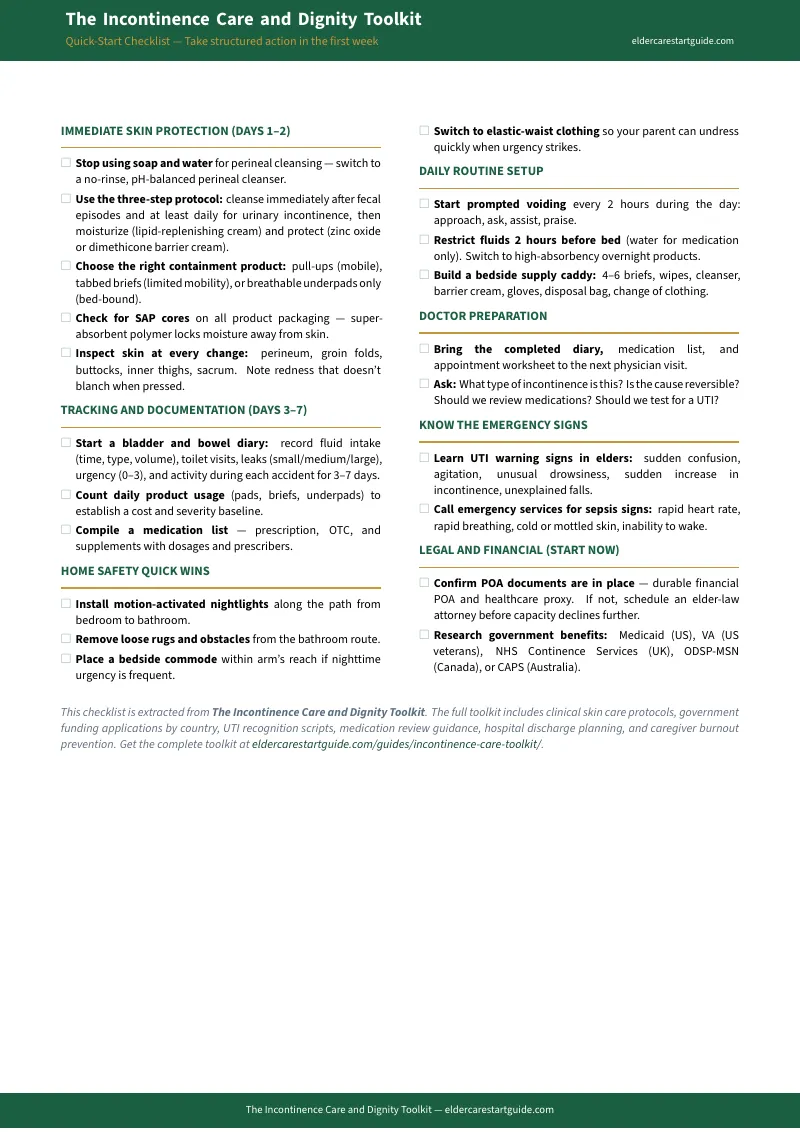
Get the free Quick-Start Checklist to see the system in action, or get the full Incontinence Care and Dignity Toolkit and start bringing order to your parent's care today.