
Your Parent Is in the Hospital — And the System Is Not on Your Side
It happens fast. A fall at home. A sudden infection. A call from the ER that starts with "Don't panic, but..." And suddenly you're standing in a hospital hallway, trying to follow a conversation full of acronyms you don't know, while a social worker slides discharge paperwork across the table and asks you to sign.
Nobody tells you that your parent might be classified as "observation" instead of "inpatient" — a distinction that can cost your family tens of thousands of dollars in rehab care that Medicare won't cover. Nobody explains that the case manager pressuring you to take your parent home works for the hospital, not for you. And nobody mentions that you have the legal right to halt an unsafe discharge with six specific words.
You don't need more articles about "being an advocate." You need the exact scripts, the exact legal frameworks, and the exact sequence of actions that protect your parent from a system designed to move them out as fast as possible.
The Bedside Defense System
The Hospital Stay Survival Guide for Families is not a book to read later. It's a crisis-grade toolkit built for the waiting room, the bedside, and the hallway conversation where someone tells you "there's nothing more we can do here."
The difference between this guide and what you'll find on Medicare.gov or AARP is the difference between knowing the rules and knowing how to use them. Government sites will define "observation status." This guide gives you the script to demand reclassification and the step-by-step appeal process when they refuse. Nonprofit articles will tell you that discharge planning matters. This guide gives you the legally mandated phrases that force the hospital to document that the discharge is unsafe — triggering a mandatory safety review.
What's Inside
- Admission status verification scripts — the precise questions and follow-ups to determine whether your parent is a formal inpatient or under outpatient observation status, and how to request written confirmation via the Medicare Outpatient Observation Notice (MOON) form
- "Unsafe discharge" defense protocol — step-by-step instructions using the exact language that triggers a mandatory safety review under federal guidelines, including how to document your objection in the medical chart and when to contact your state's BFCC-QIO for a fast-track appeal
- HIPAA bedside communication scripts — word-for-word scripts based on 45 CFR 164.510(b) that legally establish your right to access medical updates, even without a notarized Power of Attorney — covering both scenarios where your parent can consent verbally and where they lack capacity
- SBAR clinical communication scripts — three ready-to-use scripts (reporting a condition change, requesting a medication review, objecting to discharge) using the Situation-Background-Assessment-Recommendation format that hospital staff actually respond to
- Medicare cost breakdowns and appeal timelines — 2026 Part A and Part B rates, the observation status financial trap explained in real dollars, the three-midnight rule, and the complete QIO expedited appeal process that legally buys 1–2 extra days of covered inpatient care during review
- Delirium prevention checklist — evidence-based interventions from the Hospital Elder Life Program (HELP) that reduce hospital-induced confusion by up to 40% and falls by 42%, translated into a daily caregiver action list
- Daily bedside advocacy log — structured templates for tracking vital signs, medications, cognitive status, pain levels, nutrition, and care team conversations, designed for multi-caregiver handoffs so nothing gets lost between shifts
- CARE Act compliance worksheet — a point-by-point checklist ensuring the hospital has met its legal obligations to identify you as caregiver, notify you of discharge timing, and provide hands-on training for every medical task you'll need to perform at home
- Caregiver capacity self-assessment — an honest, structured evaluation of your physical strength, work schedule, financial resources, and emotional readiness, designed to be shared with the discharge planner as objective evidence before anyone signs paperwork
- Post-discharge 72-hour protocol — day-by-day action plan covering medication setup, home safety sweeps, warning signs that require an ER return, and follow-up appointment coordination to prevent the readmission cycle
Who This Is For
- The bedside advocate who needs to know what to ask the hospitalist before rounds end in 15 minutes — not next week, right now
- The long-distance child coordinating care through phone calls and patient portal updates, trying to protect a parent from 500 miles away
- The only child making every decision alone — medical, financial, emotional — with no sibling to share the weight or validate the choices
- The spousal caregiver whose own blood pressure is spiking while the hospital expects them to learn wound care, injection schedules, and catheter management before discharge tomorrow
- The burned-out sandwich generation adult managing a toddler's schedule, a full-time job, and a parent's sudden hospitalization simultaneously
Why Free Resources Fall Short
Government portals will tell you the rules of Medicare. They will not tell you how to write the appeal letter that forces a hospital to keep your parent safe for another 48 hours. AARP will publish an article about the importance of discharge planning. They will not give you the specific legal phrases that halt a premature discharge in its tracks.
Free resources give you awareness. This guide gives you weapons:
- Medicare.gov defines observation status — this guide gives you the script to demand reclassification and the appeal timeline when they refuse
- AARP explains the CARE Act — this guide gives you the compliance worksheet that forces the hospital to actually follow it
- Hospital websites describe the discharge process — this guide shows you how to halt it when your parent isn't ready to go home safely
- Private patient advocates charge $100–$500 per hour — this guide arms you with the same regulatory knowledge they use, so your first paid consultation isn't wasted on orientation
100% Satisfaction Guarantee
If the guide doesn't give you a clear, actionable plan within the first day your parent is hospitalized, email us for a full refund. No forms, no questions, no waiting period. It works or you don't pay.
Stop Guessing — Start Defending
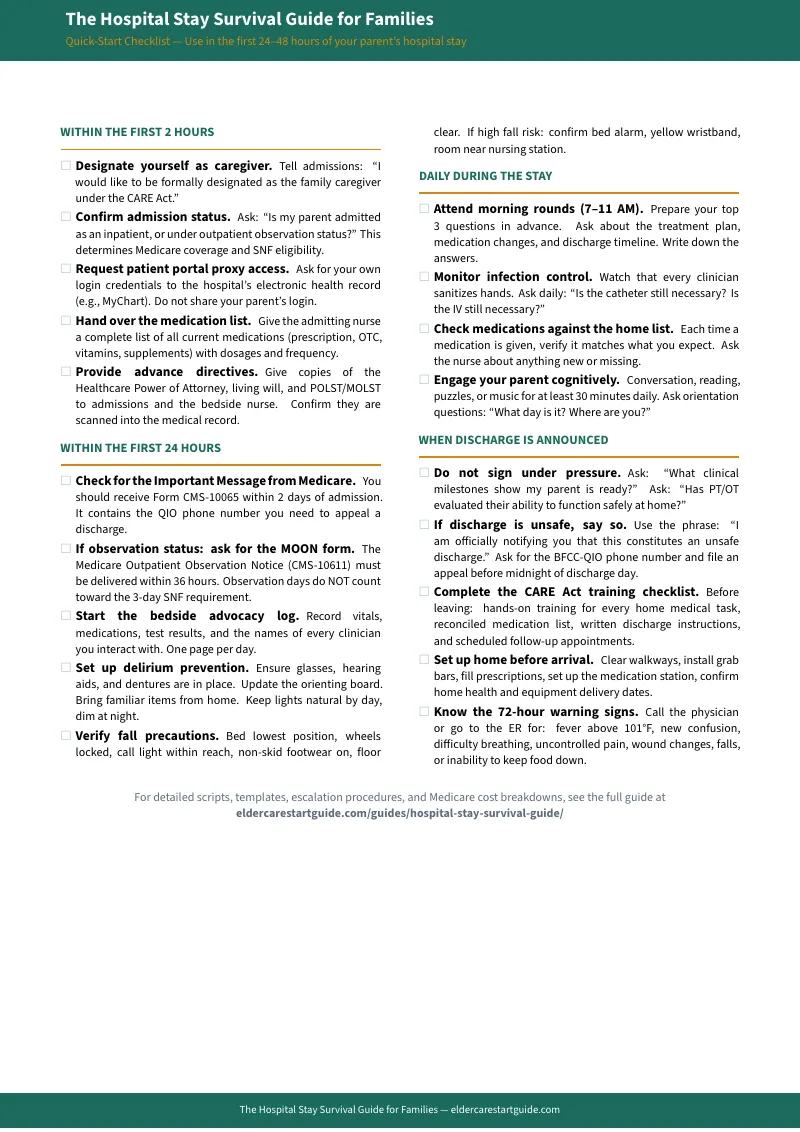
Download the free Quick-Start Checklist to get the 19-item hospital stay triage checklist right now — covering admission verification, HIPAA scripts, essential packing, delirium prevention basics, and your discharge rights.
When you're ready for the full system — 12 printable PDFs including the 11-chapter guide, SBAR scripts, HIPAA scripts, the bedside advocacy log, the discharge defense protocol, the CARE Act worksheet, the caregiver capacity assessment, the Medicare cost reference, and the complete post-discharge protocol — the full toolkit is . Less than one hour with a patient advocate. A fraction of what one medication error or premature readmission costs.