Your parent fell. The ER said "make the home safer." Nobody told you how.
You're standing in your parent's bathroom looking at a towel bar that isn't load-bearing, a bathtub with no grip surface, and a night-light plugged into the only outlet — and you have no idea which problem to fix first, what hardware actually meets safety standards, or whether any of it is covered by insurance.
The CDC has a clinical brochure. It tells you to "add grab bars" without telling you what length, what height, what weight rating, or where the studs need to be. A Place for Mom has a checklist that steers you toward a facility referral worth thousands in commission. The Etsy printables look helpful until you realize they're just lists with no technical specifications, no medication review, no funding guidance, and no way to know if what you're buying at the hardware store will actually hold your parent's weight.
Meanwhile, a professional Occupational Therapy home assessment costs $150 to $500 out of pocket — and that's only if a doctor orders it. A geriatric care manager charges $800 to $2,000 just for the initial evaluation. And your parent doesn't think anything needs to change.
The Clinical-Grade Home Audit System — built for family caregivers, not billing departments
The Home Safety and Fall Prevention Audit is the structured assessment framework that sits between a generic free checklist and a $500 professional evaluation. Every recommendation is tied to ADA, NFPA, or CDC STEADI standards — translated into plain language with exact specifications so you know what to buy, where to install it, and how to pay for it.
It starts with the same clinical screening protocol used in hospitals — the CDC STEADI "Stay Independent" questionnaire and three physical performance tests you can administer at home — so you know whether your parent needs environmental modifications, a physical therapy referral, or both. Then it walks you room by room through every fall hazard in the house, with the precise technical specs that turn vague advice into concrete action.
What's inside
The CDC STEADI Clinical Screening — because guessing your parent's fall risk wastes time and money on the wrong modifications. The 12-question screening tool plus the 30-Second Chair Stand, 4-Stage Balance Test, and Timed Up and Go physical tests — adapted for safe home administration with scoring thresholds that tell you exactly what level of intervention the results call for.
Room-by-Room Technical Audit — Bathrooms, Bedrooms, Kitchen, Stairs, Outdoors — because "add grab bars" is not a plan. Vertical entry grab bars: minimum 24 inches long, lower end 36–39 inches above finished floor. Bathroom turning diameter: 59 inches minimum. Bed height: calibrated so feet rest flat on the floor before standing. Water heater: 120°F maximum. Kitchen shelves: waist-to-eye height. Stair handrails: 34–38 inches, continuous, both sides, full weight-bearing. Every specification sourced from ADA and NFPA standards, translated into what you need to buy and where to install it.
Medication Fall-Risk Scorecard — because 53% of older adults take at least one Fall-Risk-Increasing Drug, and nobody flags it until after the fall. The Beers Criteria and STOPPFall drug classes mapped into a printable scorecard: benzodiazepines, opioids, antidepressants, antihistamines, blood pressure medications that cause orthostatic hypotension, muscle relaxants. Fill it in before the next doctor visit with the deprescribing conversation script so you can raise the issue without antagonizing the physician.
Funding Walkthrough — Medicare, VA, and Medicaid Pathways — because most families pay out of pocket for modifications they could have funded through programs they didn't know existed. Medicare Part B coverage for in-home OT assessments (physician order required). VA Specially Adapted Housing and HISA grants for veterans with service-connected disabilities. Medicaid HCBS waivers. Older Americans Act Title III-B services through your local Area Agency on Aging. Each pathway with eligibility criteria, application steps, and the questions to ask.
Emergency Response and Safe-Rise Protocol — because the single highest-impact intervention after a fall is preventing the "long lie." How to set up a Personal Emergency Response System, register with the NFPA Steps to Safety program, and teach your parent the safe-rise technique for getting off the floor independently when they're not injured. Plus the fall documentation log that builds the clinical record driving better care at the next physician visit.
Parental Resistance Scripts — because the hardest part of fall prevention isn't the hardware, it's the conversation. Word-for-word scripts that reframe grab bars as "premium bathroom hardware," present the audit as a way to stay independent rather than an admission of decline, and give you clinical evidence to back up the conversation without turning it into a power struggle. Plus the sibling alignment framework for splitting costs and tasks without family arguments.
Contractor Vetting Checklist — because the wrong handyman can make a bathroom more dangerous, not less. How to verify the CAPS (Certified Aging-in-Place Specialist) credential, interview templates, insurance verification steps, and the three-tier cost breakdown: low-cost high-impact changes under $400, mid-range structural work from $300 to $6,000, and major renovations above $5,000.
The "When Home Is No Longer Enough" Decision Framework — because the honest answer isn't always "one more modification." The objective clinical thresholds for recognizing when home-based safety has been exhausted — recurring falls despite modifications, cognitive decline affecting safety judgment, severe caregiver burnout — and the transition pathway from companion care to assisted living to skilled nursing.
Seven Standalone Printable Tools — Room-by-Room Hazard Audit, Medication Fall-Risk Scorecard, Fall Incident Log, Modification Cost and Task Tracker, Agency Communication Log, Parental Resistance Scripts, and Contractor Vetting Checklist. Each is a separate PDF designed for on-site use — print what you need for each visit, doctor appointment, or contractor meeting.
Who this is for
- The family scrambling after a hospital discharge — your parent fell and the ER wants them home in 48 hours. You need the highest-risk hazards identified and addressed before they walk back through the door.
- The long-distance caregiver with one weekend to work with — you're flying in Friday and leaving Sunday. The audit is structured for a single-day assessment that produces a documented action list for local siblings or contractors to execute after you leave.
- The sandwich-generation planner who sees early warning signs — your parent is grabbing furniture for balance, recovering slowly from minor trips, wearing slippers on hardwood. Nothing has happened yet. You'd rather act now than react later.
- The caregiver whose parent won't accept changes — the throw rugs stay, the grab bars look "clinical," and your mother insists she's fine. The resistance scripts give you the clinical framing and the exact words to shift the conversation from "you're getting old" to "this lets you stay home."
- The sibling mediator caught between denial and overreaction — one brother thinks everything's fine, the other wants to move Mom into assisted living immediately. The objective hazard scoring replaces opinions with data so the family can align on priorities.
- The family that can't afford a $500 OT assessment — this toolkit gives you the same structured framework at a fraction of the cost, so you can resolve obvious hazards yourself and save professional consultations for complex structural or clinical needs.
Why not the free checklists?
Free checklists tell you what to look for. They don't tell you what the fix actually looks like — the grab bar length, the load rating, the mounting height, the distance from the toilet, the stud-finding technique. They don't review your parent's medications for fall-risk drugs. They don't tell you whether Medicare, the VA, or Medicaid will pay for the modifications. They don't give you the words to use when your parent says "I don't need that." They don't help you coordinate with siblings who disagree about what needs to happen. And they don't tell you what to do when the modifications aren't enough and it's time to consider a different living arrangement.
The CDC STEADI brochure is a clinical screening tool — not a home modification plan. A Place for Mom's checklist is a lead-generation funnel — it exists to sell you a facility placement. The Etsy printables are aesthetically pleasing — and technically unverified. This toolkit is the structured middle ground: clinical-grade specifications translated for family use, with the funding, communication, and planning tools that turn a list of hazards into actual changes.
100% satisfaction guarantee
If the toolkit doesn't give you a clear, actionable plan for making your parent's home safer, email us and we'll refund your purchase. No forms, no hassle. The audit works — but if it doesn't work for your situation, you don't pay.
Start the audit this weekend
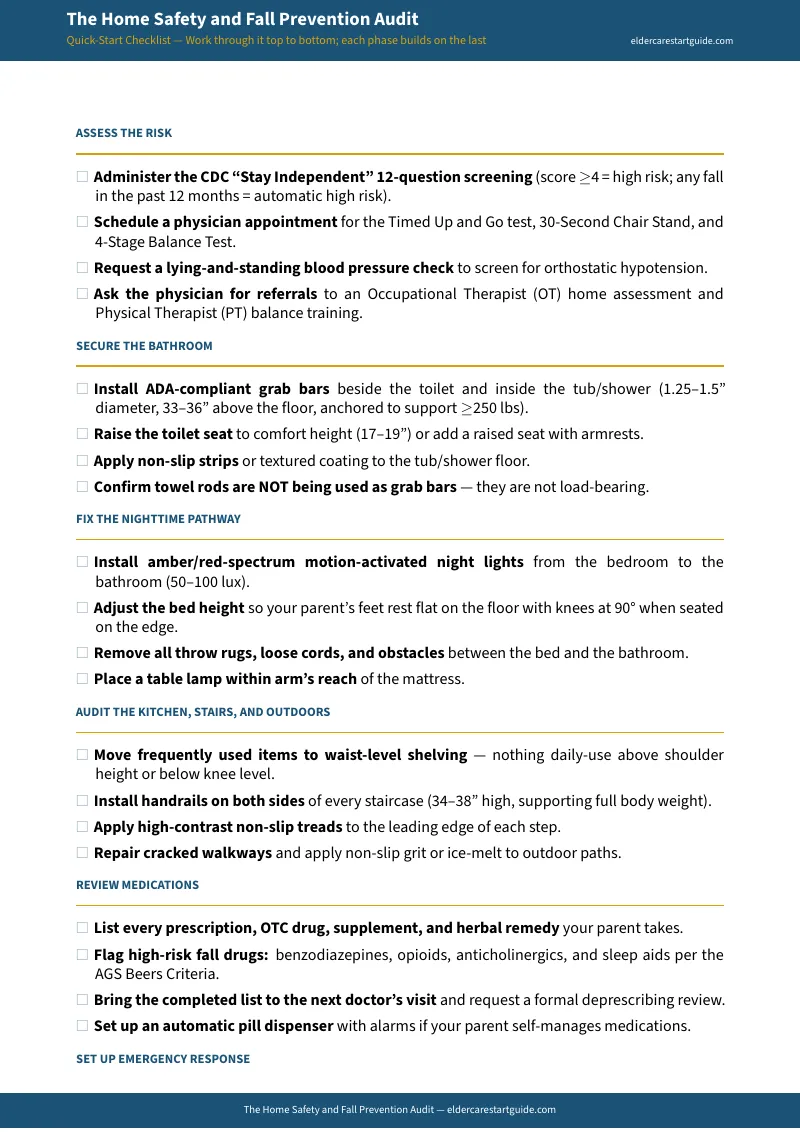
Download the free Quick-Start Checklist to address the most urgent hazards tonight — 24 critical actions across six categories on a single printable page. When you're ready for the complete system — clinical screening, room-by-room technical audit, medication review, funding walkthroughs, contractor vetting, resistance scripts, and all seven standalone printable tools — get the full toolkit.
For less than the copay on a single doctor visit, you get the assessment framework that professional occupational therapists charge $150 to $500 to deliver — structured so you can execute it yourself, this weekend, without waiting for a physician referral.