You're Not Being Difficult. You're Being Dismissed.
You drove forty minutes to the appointment. You wrote out every symptom, every medication change, every question you needed answered. And then the doctor spent eleven minutes in the room, talked mostly to your parent, and left before you could ask about the new prescription that's been causing falls.
That's not a communication problem. That's a system problem — and it has a system-level fix.
The Clinical Advocacy System
The Caregiver's Guide to Doctor Communication is built around the SBAR framework — Situation, Background, Assessment, Recommendation — the same structured communication protocol nurses and hospitalists use when they need a physician to act on incomplete information under time pressure.
You're not learning to "be more assertive." You're learning to present clinical information in the exact format doctors are trained to process. When you hand a physician a structured SBAR summary instead of a list of worries, the dynamic in the room shifts. You stop being a concerned family member asking for time. You become a prepared care partner delivering organized clinical data.
What's Inside the Full Toolkit
- Legal Authority Setup (legal-authority-setup.pdf) — A fillable tracker for HIPAA authorization, Directed Right to Access requests, DPOA/proxy papers, and portal proxy enrollment at every provider. Each office uses its own forms; this sheet tells you what to file and records the result.
- Pre-appointment printables — The Symptom and Behavior Log (symptom-behavior-log.pdf) for 72-hour observations, plus the Pre-Visit Agenda (pre-visit-agenda.pdf): a three-item ranked agenda, 4Ms snapshot (What Matters, Medication, Mentation, Mobility), and the appointment go-bag. You hand the doctor a one-page clinical summary they can scan in seconds.
- SBAR Script Cards (sbar-script-cards.pdf) — Eight fillable Situation-Background-Assessment-Recommendation cards for the scenarios caregivers face most: dismissed symptoms, a new medication, a second opinion, a premature discharge, and more. Fill in your parent's details and bring the card into the room.
- Master Medication Log (master-medication-log.pdf) — One source of truth across every specialist: drug name, dose, frequency, prescriber, purpose, start date, side effects, and status. The guide also covers the AGS Beers Criteria for spotting potentially inappropriate medications and a four-step deprescribing conversation you can have in the exam room.
- Specialist Coordination Workbook (specialist-coordination-workbook.pdf) — Care team directory, named clinic point of contact, referral tracker, and records-transfer log so your family isn't opening three duplicate threads at the same clinic.
- Hospital and discharge printables — ER Handoff Sheet (er-handoff-sheet.pdf) for triage, CARE Act Worksheet (care-act-worksheet.pdf) with a rapid-discharge appeal block, Discharge Medication Reconciliation (discharge-medication-reconciliation.pdf), and the 30-Day Post-Discharge Tracker (post-discharge-30-day-tracker.pdf) for TCM contact windows.
- Second opinion navigation (Chapter 9) — When to pursue one, how to frame the request without burning the relationship with the current provider, and the specific Medicare Part B rules that cover the cost.
- Professional referral guide (Chapter 10) — When self-advocacy reaches its limits: geriatric care managers, patient advocates, elder-law attorneys, and the Medicare programs that actually pay for caregiver involvement — Transitional Care Management, the Annual Wellness Visit, Medication Therapy Management, Caregiver Training Services, and Principal Illness Navigation.
Who This Is For
You're an adult child — probably the primary caregiver, possibly the only one who shows up — managing your parent's healthcare alongside everything else in your life. You've felt the frustration of being talked past, the guilt of missing something important, and the low-grade dread that accompanies every new specialist referral.
You don't need a medical degree. You don't need to become a professional patient advocate. You need a system that makes every appointment count and every clinical interaction productive — starting with the next one on the calendar.
Why Free Resources Fall Short
The free advice from AARP and the National Institute on Aging is well-intentioned. "Be prepared." "Write down your questions." "Bring a list of medications." That's not wrong — it's just not enough to change the clinical dynamic when you're sitting in a room with a physician who has eleven minutes and six other patients waiting.
Etsy templates look organized, but they're designed by graphic creators, not healthcare advocates. They track daily care tasks — water intake, bowel movements, blood pressure readings — but they don't prepare you for a medical crisis, a hospital discharge at 10 PM, or a pharmacy call about a drug interaction the prescribing doctor never mentioned.
This guide bridges the gap between generic reassurance and professional-grade care management. It gives you the clinical frameworks, the legal tools, and the exact words to use — without the $100-to-$300-an-hour cost of hiring an Aging Life Care Manager or the $300-to-$500-an-hour fee of an elder-law attorney.
Satisfaction Guarantee
If the guide doesn't change how your next appointment goes, email us. We'll make it right.
Start With the Free Checklist — or Get the Full System
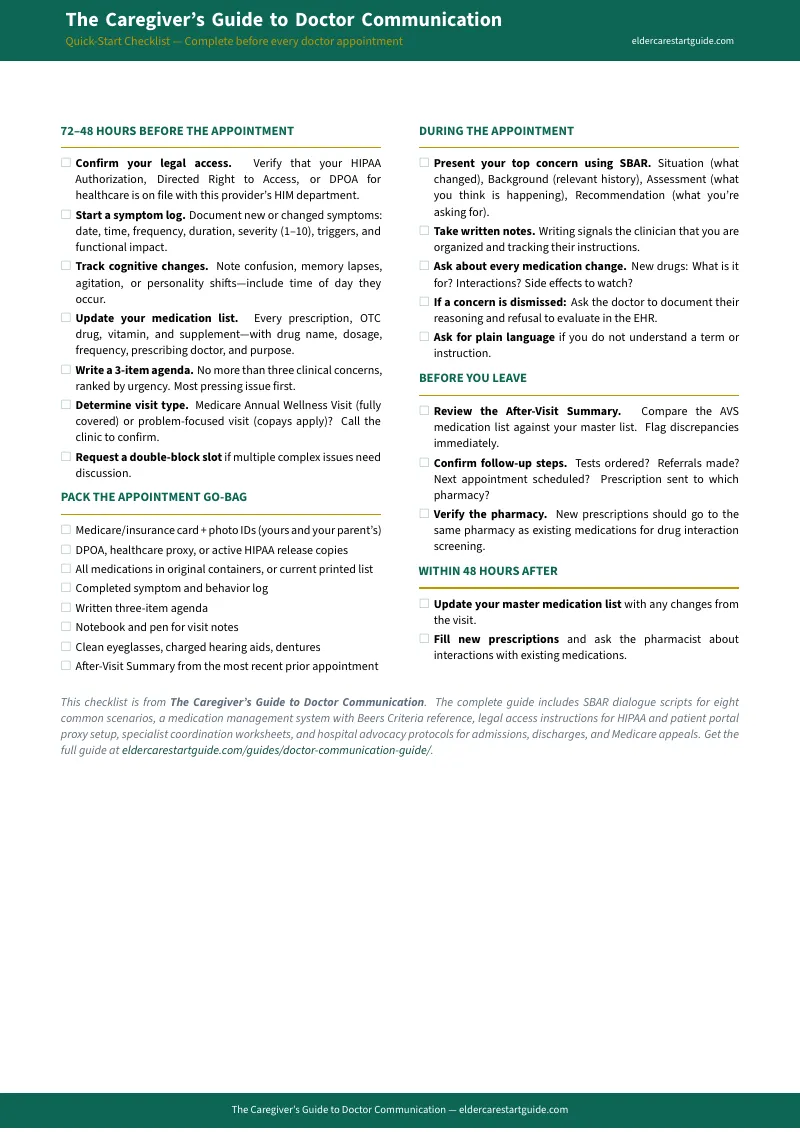
The free quick-start checklist covers the essential steps in a single printable page. It's a solid starting point if you want to see the structure before you commit.
The full Caregiver's Guide to Doctor Communication gives you the guide, the 20-item checklist, and ten fillable printables — legal setup, symptom log, pre-visit agenda, SBAR cards, medication log, specialist workbook, ER handoff, CARE Act sheet, discharge reconciliation, and the 30-day tracker. One purchase, no subscription, use it at every appointment from here on.
Your parent's next appointment is already on the calendar. Walk in ready.