
You already know what needs to happen. You just don't have the words.
Your parent left the stove on again. Or they came home with a dented fender and no memory of hitting anything. Or the pile of unopened mail is growing because they can't keep track of what's due. You can see where this is heading — and every week you don't say something, the risk gets worse.
But the last time you tried, it didn't go well. Maybe they shut down completely. Maybe they got angry and accused you of trying to control their life. Maybe a sibling jumped in to defend them, and the whole thing collapsed into an argument about who's overreacting. So now you're stuck — doing more and more behind the scenes, watching the situation deteriorate, and dreading the conversation you know you'll eventually be forced to have under worse circumstances.
The problem isn't your parent. It's that nobody taught you how to have these conversations. The generic advice — "pick a good time," "be empathetic," "listen actively" — assumes your parent will respond rationally. Real conversations about driving, money, hygiene, and independence don't work that way. They trigger fear, denial, and defensiveness that no amount of empathy can override without a structure to contain them.
The Conversation Blueprint: a structured system for the talks nobody wants to have
The Difficult Conversation Scripts toolkit gives you a complete communication framework for the six conversations that derail families most: driving, finances, home safety, personal care, medications, and legal planning. Each conversation gets its own chapter with word-for-word scripts, the parent's most likely defensive responses, and exact de-escalation follow-ups — so you're not improvising when emotions run high.
This isn't a list of tips. It's a sequenced system: observe first, prepare alternatives, open with a specific script, handle the pushback, and follow through with a written plan. The framework is built on clinically validated de-escalation techniques — the same approaches geriatric care managers and elder mediators use, adapted into language a family member can deliver without sounding clinical or condescending.
What's inside
- Word-for-word scripts for six high-conflict conversations — driving cessation, financial oversight, home safety modifications, hygiene and bathing resistance, medication management, and legal planning (Power of Attorney, advance directives). Each script shows the exact opening phrase, the parent's most common defensive reaction, and the de-escalation response that prevents the conversation from shutting down.
- Side-by-side phrase comparisons — because the difference between "We need to talk about your driving" (triggers immediate defensiveness) and "Your doctor mentioned something about a driving evaluation — can I help you schedule one?" (externalizes the authority) is the difference between a productive conversation and a fight that sets you back months.
- Three clinical assessment tools you can use at home — the Mini-Cog (3-minute cognitive screen), the Katz ADL Index (functional independence measurement), and the Timed Up-and-Go test (mobility assessment). These give you objective data points so you're not arguing from "I think Dad is getting worse" — you're saying "Dad scored a 2 on the Mini-Cog, which is the clinical threshold for further evaluation."
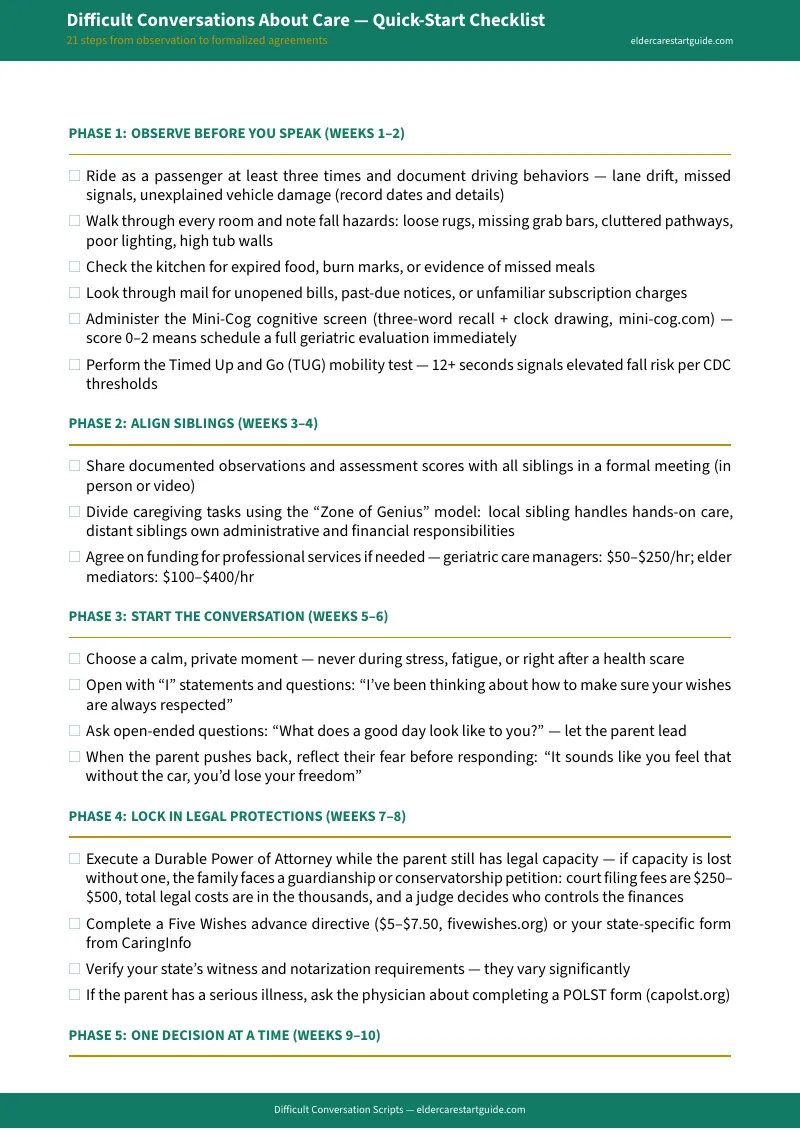
- A 90-day transition plan — six phases that sequence changes gradually over 12 weeks so your parent doesn't feel ambushed. Week 1 starts with observation and documentation. By week 12, you have formal agreements in place and a care team operating. Each phase includes the conversation scripts you need for that stage.
- Sibling alignment tools — the "Zone of Genius" model for dividing caregiving responsibilities by actual skills and availability instead of demanding equal time. Includes meeting agenda templates, a care-share tracker, and specific scripts for the long-distance sibling who criticizes without contributing.
- Legal planning conversation guides — scripts that frame Power of Attorney as protecting your parent's choices, not taking them away. Includes the capacity timeline showing exactly what happens if nobody signs documents before cognitive decline crosses the legal threshold — guardianship proceedings that cost thousands, take months, and may assign a court-appointed stranger.
- Escalation boundaries — clear criteria for when DIY family conversations aren't enough and you need a geriatric care manager, elder mediator, elder-law attorney, or Adult Protective Services. Knowing when to stop trying on your own is as important as knowing what to say.
- Eight fillable worksheets — observation log, home safety assessment, emergency medication card, care-share tracker, sibling meeting agenda, pre-consultation prep sheet, legal authority tracker, and driving transition agreement. These are the documents that elder-law attorneys and geriatric care managers ask families to bring — having them ready saves hundreds in professional consultation fees.
Who this is for
- Adult children who've been avoiding "the talk" — you can see the decline, but every time you try to bring it up, the conversation ends in anger, tears, or a wall of silence. You need a script that doesn't start a fight.
- Primary caregivers doing everything alone — you're quietly paying bills, sorting medications, checking the stove, and driving your parent to appointments while they insist they don't need help. You need a way to formalize what's already happening so you don't collapse from burnout.
- Families where siblings disagree — one child sees daily decline; the out-of-town sibling says "Mom seemed fine at Thanksgiving." You need clinical assessment data that moves the conversation from opinions to evidence.
- Long-distance caregivers — you suspect your parent is "showtiming" during visits and covering up problems during phone calls. You need an observation framework and a structured plan for the next time you're there in person.
- Anyone who's tried and failed — you've already had the conversation and it went badly. The damage from a botched attempt often makes the next try harder. These scripts include repair language specifically designed for reopening a conversation after a previous attempt caused a rift.
Why free guides don't solve this
AARP, the Alzheimer's Association, and government health portals all publish caregiver resources — and some of them are genuinely good at explaining what cognitive decline looks like or how Power of Attorney works.
What none of them provide is the exact conversation. They'll tell you to "discuss your parent's preferences" but won't give you the opening sentence that avoids triggering immediate defensiveness. They'll explain that a Durable Power of Attorney should be signed while a parent still has capacity but won't give you the script for bringing it up without your parent hearing "I think you're losing your mind."
Senior placement platforms (A Place for Mom, Caring.com) offer free advisor calls — but their business model is referral fees from assisted living communities, so their advice consistently steers toward facility placement even when aging in place with modifications is viable. DIY legal publishers (Nolo, Quicken WillMaker) provide the forms but nothing about how to get a resistant parent to sign them.
This toolkit sits in the gap: it gives you the relational communication framework that connects clinical observation to legal preparation to daily care — the part that nobody else covers because it's messy, emotional, and doesn't fit into a FAQ page.
Satisfaction guarantee
If the toolkit doesn't give you a clearer path into the conversations you've been avoiding, email [email protected] for a full refund. No time limit, no forms, no questions.
Start the conversation you've been putting off
The free checklist gives you the conversation topics in order — what to discuss and when. It's a good starting point if you want to see the structure before committing.
The full Difficult Conversation Scripts toolkit — — gives you the word-for-word scripts, the de-escalation responses, the clinical assessments, and the worksheets to actually have the conversations and follow through on them.
Every week you wait is another week of managing everything yourself, hoping nothing goes wrong. The conversations don't get easier with time — but they do get more urgent.