You Are Not Losing Your Patience. You Are Missing the Scripts.
Your parent is standing in the bathroom doorway, arms crossed, refusing to shower. You have tried gentle encouragement. You have tried matter-of-fact scheduling. You have tried walking away and coming back later. Nothing works. Tomorrow you will try again and get the same result, because the approach that works with a healthy brain does not work with a brain that has been physically rewired by dementia.
The issue is not willpower. It is neurology. Dementia destroys the pathways responsible for logic, short-term memory, and emotional regulation — which means every tool in your normal communication repertoire (reasoning, reminding, explaining) now triggers exactly the opposite of what you intend. You explain that it is time for a shower, and your parent hears a stranger giving orders. You remind them they already asked that question, and their brain processes it as an attack.
The Validate-Bridge-Redirect Communication System replaces guesswork with a clinically grounded sequence you can follow in real time. Built on Naomi Feil's Validation Therapy and Teepa Snow's Positive Approach to Care, every script in this toolkit follows the same three-step structure: validate the emotional truth behind what your parent is saying, bridge their attention with a sensory or social cue, and redirect toward a cooperative outcome. You do not need clinical training. You need the right words at the right moment.
What's Inside the Toolkit
- Nine Scenario-Specific Script Cards — each built on the Validate-Bridge-Redirect sequence and covering the situations that exhaust caregivers most: bathing refusal, theft accusations, wanting to go home, repetitive questions, meal refusal, aggression and hitting, sundowning agitation, medication refusal, and exit-seeking. Open to the right page and follow the steps — no interpretation needed
- The Six-Step Clinical Workflow — the master framework behind every script: Identify the trigger, Validate the emotion, Simplify your language, Redirect to a cooperative activity, Document what happened, and Escalate when the situation exceeds home care. Once you internalize this workflow, you can handle situations the script cards do not cover
- PAINAD Pain Assessment Scale — a five-category observation tool (breathing, vocalization, facial expression, body language, consolability) for parents who can no longer report their own pain. Undetected pain is one of the most common drivers of agitation and aggression in dementia — and it is invisible without a structured assessment
- ABC Behavior Tracking Log — Antecedent, Behavior, Consequence tracking sheets that turn daily chaos into data. Log what happened before the behavior, what the behavior looked like, and what resolved it. Within two weeks, you will see patterns your memory alone would never catch — same trigger, same time of day, same caregiver
- Family Communication Guide — scripts for explaining the diagnosis to siblings who have not seen it firsthand, managing "showtiming" (the social mask that makes long-distance family members think everything is fine), preparing visitors so holiday gatherings do not become crises, and structuring a family care meeting that produces decisions instead of arguments
- Clinical Care Planning Worksheets — medication tracker, provider contact sheet, and a structured template for presenting behavioral data at a physician appointment so your concerns are documented and taken seriously
- Financial and Legal Planning Checklists — power of attorney documentation, Medicaid planning timeline, and a cost comparison framework for home care vs. assisted living vs. memory care. These decisions need to happen before a crisis forces them
- Home Safety and Wandering Assessment — room-by-room audit covering fall hazards, exit security, kitchen safety, bathroom modifications, and wandering prevention measures
Who This Is For
This toolkit is built for family caregivers who are past the diagnosis stage and deep into the daily reality of dementia care — the part where good intentions are not enough and you need tools that work in the moment.
- Primary caregivers providing daily hands-on care who need scripts they can follow during a bathing refusal or a sundowning episode — not a chapter to read afterward
- Long-distance family members coordinating a care team who need a shared communication protocol that every aide, sibling, and visiting nurse follows consistently
- Siblings in disagreement about the severity of decline who need objective, documented evidence of behaviors rather than competing anecdotes
- Families evaluating care transitions who need structured tools for comparing home care, assisted living, and memory care options
Why Not Just Use Free Resources?
The Alzheimer's Association provides excellent clinical education on disease stages and research breakthroughs. AARP offers tips like "be patient" and "speak slowly." The NIH explains the neuroscience of cognitive decline in clinical language. None of them give you a printed card you can grab from the kitchen counter at 7 PM when your parent is pacing toward the front door.
The gap in the market is not information — it is format and timing. Caregivers do not fail because they lack knowledge about dementia. They fail because the moment they need that knowledge is the exact moment they have no capacity to recall a paragraph from a website. This toolkit puts the right response in your hands at the right moment — printed, posted, and designed for scanning during a crisis, not studying before one.
What You Get
Your download includes the complete guide (10 chapters covering the clinical workflow, all 9 scenario scripts, behavior tracking, family coordination, clinical planning, financial and legal planning, and home safety) plus 10 standalone printable PDFs — ready to post on the fridge, carry through the house, or hand to a visiting nurse.
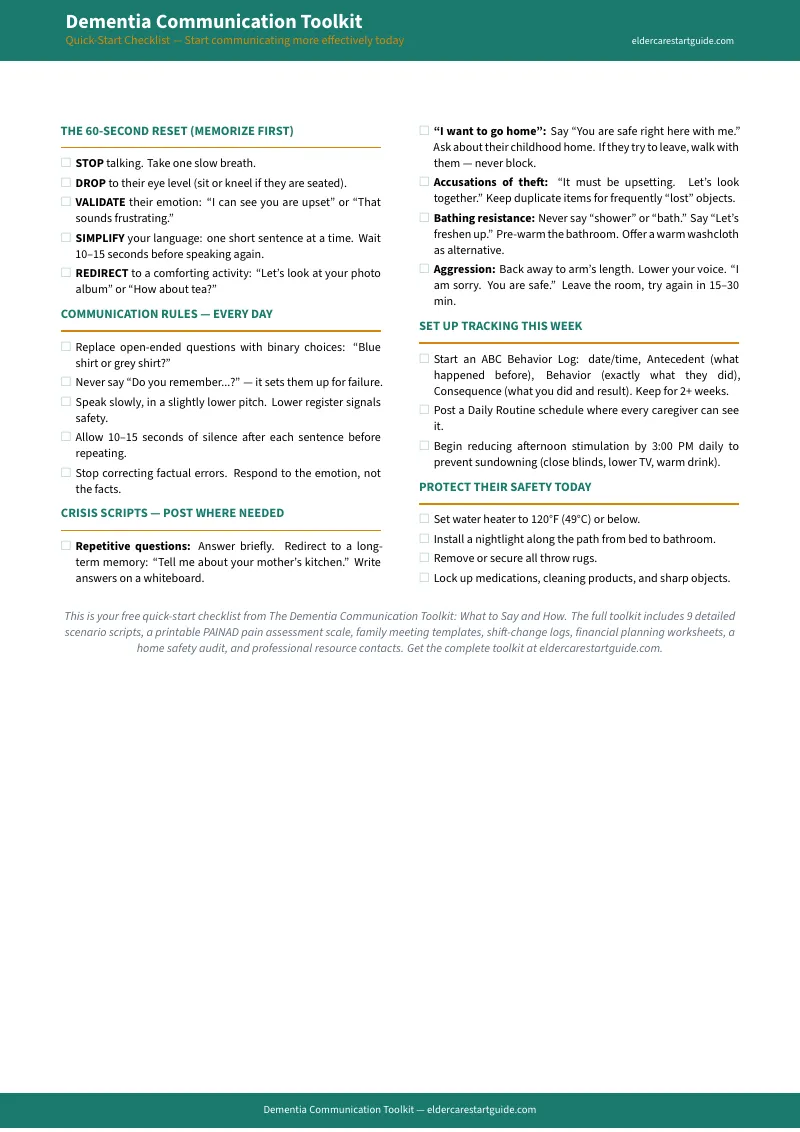
Free version: Download the Quick-Start Checklist — 20 high-impact communication techniques you can start using immediately, including the core Validate-Bridge-Redirect sequence and the five most common mistakes family caregivers make.
Full toolkit (11 PDFs): The complete guide, the quick-start checklist, six quick-reference script cards, the Six-Step Clinical Workflow card, the ABC Behavior Tracking Log, the PAINAD Pain Assessment Scale, a daily routine template, a shift-change communication log, a home safety and wandering assessment, a legal documents checklist, and a family care meeting agenda.
— Less Than Thirty Minutes of a Geriatric Care Manager
A geriatric care manager charges $100–$200 per hour. An elder law attorney charges $300–$500. A single emergency room visit triggered by an avoidable escalation costs far more than either. This toolkit costs less than half an hour of professional consultation — and it stays on your kitchen counter every day, available the moment you need it.
Every purchase is a one-time payment. No subscriptions. No recurring fees. If this toolkit does not change how you communicate with your parent, reach out and we will make it right.