Your Parent's Care Costs Are Climbing. Your Plan Isn't.
Home care runs $35 an hour. Assisted living averages $6,200 a month. A private nursing home room costs $10,798 a month. And those are national medians — your local rates may be higher.
Most families don't discover these numbers until they're already in crisis: a hospital discharge, a dementia diagnosis, a parent who can no longer live alone. By the time you start searching for answers, you're making financial decisions under pressure — the kind that drain savings accounts, trigger Medicaid penalties, and turn sibling relationships toxic.
The Caregiver's Budget and Cost-of-Care Planner is a financial command center for families managing an aging parent's care. It replaces the scattered spreadsheets, the frantic Google searches, and the "we'll figure it out later" conversations with a structured system that calculates your parent's financial runway, maps every available funding source, and gives you worksheets to track what's actually being spent.
What's Inside the Planner
Care Cost Estimation Worksheets
Calculate costs across all ten care categories — home care, adult day care, assisted living, memory care, nursing facilities, medications, durable medical equipment, transportation, home modifications, and respite care — using current national medians and space for your local quotes. Includes the three-tier comparison model so you can see what 15, 30, or 44 hours of weekly home care actually costs per year.
The Financial Runway Calculator
Your parent's savings and income are finite. This worksheet takes their total available resources and divides by their monthly care burn rate to show exactly how many months they can sustain each level of care. When you can see the runway in black and white, you stop guessing and start planning.
8 Funding Source Breakdowns
Medicare, Medicaid, VA Aid and Attendance, long-term care insurance, state home and community-based programs, reverse mortgages, life insurance conversions, and structured family contributions — each one explained with eligibility criteria, what it covers, what it doesn't, and how to apply. Most families leave money on the table because they don't know these programs exist.
Tax Strategy Worksheets
Track deductible medical expenses against the 7.5% AGI threshold. Calculate whether claiming your parent as a dependent qualifies you for additional deductions. Document medical mileage at current IRS rates. If a family member is being paid to provide care, the FICA threshold and reporting requirements are pre-formatted so your accountant doesn't have to start from scratch.
Spousal Asset Protection Framework
When one spouse needs nursing home care and the other doesn't, Medicaid's Community Spouse Resource Allowance rules determine how much the healthy spouse gets to keep. These worksheets walk through the calculation — minimum and maximum resource allowances, income protections, and home equity exemptions — so you understand the math before you sit down with an attorney.
Family Caregiver Compliance Kit
Paying a family member for caregiving without a formal Personal Care Agreement is one of the most common Medicaid planning mistakes. The 60-month look-back treats undocumented payments as gifts, which can trigger penalty periods that delay eligibility by months or years. This section includes a Personal Care Agreement framework, fair market rate guidance, and IRS reporting checklists.
Sibling Cost-Splitting Worksheets
Money destroys families faster than caregiving itself. These worksheets create transparency: who's contributing what (time, money, or both), how costs are divided based on income and proximity, and a shared tracking format that keeps everyone honest without turning every family call into an audit.
Cost-Stretching Strategies
Medication optimization (generics save up to 70%), household consolidation analysis (eliminate duplicate housing costs), senior discount audits, utility rate reductions, and subscription clean-up. Structural changes, not coupons.
Who This Planner Is Built For
- The crisis transitioner — Your parent just left the hospital and you're realizing Medicare won't cover what comes next. You need a funding map and a cost timeline, not another article about "the importance of planning."
- The sandwich generation caregiver — You're paying for your kid's braces and your parent's home aide out of the same paycheck. You need to know exactly how long your parent's money will last and where the gaps are.
- The sibling administrator — You hold power of attorney and manage your parent's finances while your siblings second-guess every expense. You need documentation that proves where every dollar went.
- The long-distance planner — You can't be there every day, but you can make sure the money side is handled. You need a system your local sibling can update without calling you for every decision.
Why Free Resources Aren't Solving This
AARP publishes helpful articles. Your state's Department of Aging has printable checklists. The Alzheimer's Association runs a solid helpline. None of them do the math for you.
Free resources tell you that care is expensive and that you should "explore funding options." They don't calculate your parent's financial runway at three different care levels. They don't walk you through whether claiming your parent as a dependent actually helps your tax situation. They don't give you a Personal Care Agreement framework that protects family caregiver payments from Medicaid's look-back period.
A professional care manager charges $150-$200 an hour. An elder law attorney runs $400-$800 an hour. This planner doesn't replace those professionals — it makes sure you walk in with organized data instead of a box of loose receipts, cutting your billable hours in half.
What You Get
- The complete guide — 12 chapters covering care costs, funding sources, tax strategies, Medicaid planning, family compliance, and cost optimization
- 10 standalone worksheets — Print-ready PDFs you can use independently: care needs assessment, cost comparison, financial runway calculator, funding eligibility checklist, personal care agreement, daily care log, tax documentation tracker, sibling cost-share agreement, Medicaid spend-down ledger, and monthly expense tracker
- Budget review calendar — Monthly and quarterly review prompts so nothing falls through the cracks
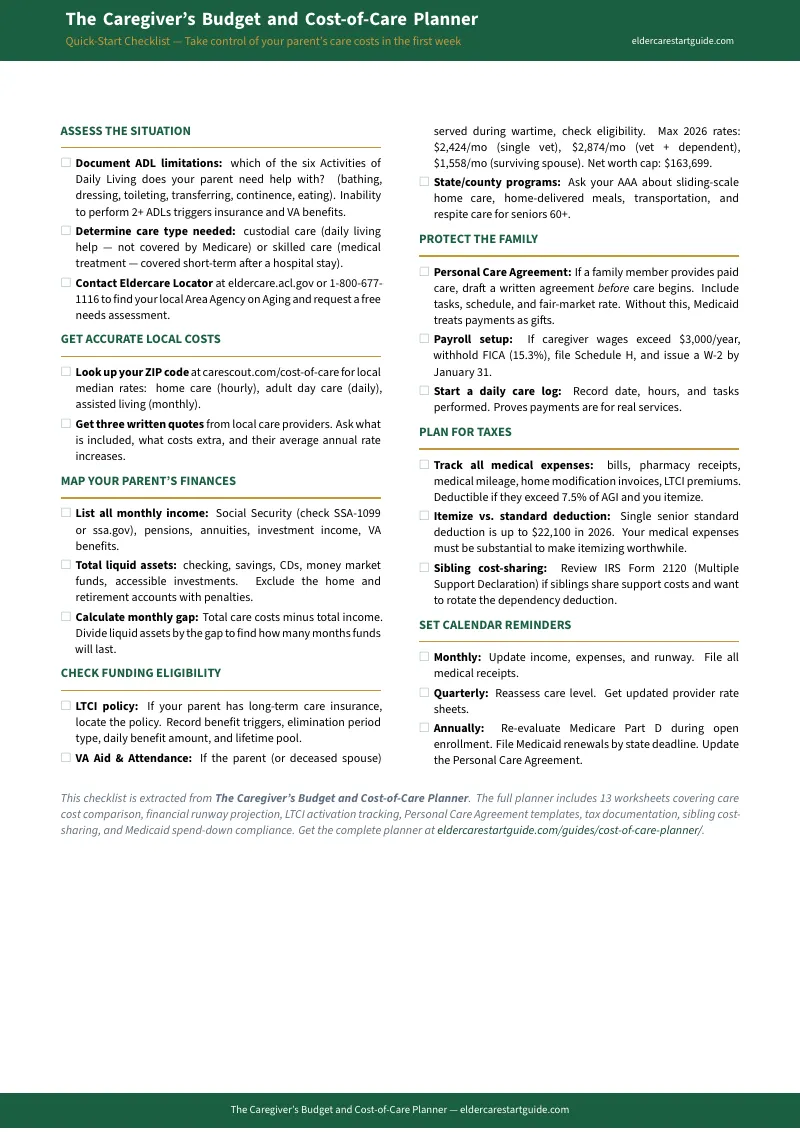
- Quick-start checklist — 20 action items across 6 priority sections so you know exactly where to begin
The Free Quick-Start Checklist
Not ready for the full planner? Download the free quick-start checklist — a 20-item action list that walks you through the most urgent financial steps for families managing elder care costs. It covers what to gather, who to call, and which deadlines matter most.
If you need the complete system — the funding source breakdowns, the financial runway calculator, the tax worksheets, the sibling cost-splitting tools, and the Medicaid planning frameworks — the full planner picks up where the checklist leaves off.
— Less Than One Hour of Home Care
At $35 an hour for home care, this planner costs less than a single hour of the service you're trying to budget for. One caregiving tax deduction you would otherwise have missed can cover it.
Satisfaction guarantee: If the planner doesn't help you build a clearer financial picture for your parent's care, email us for a full refund. No forms, no hassle.