You're Not a Bad Person. You're an Unsupported One.
You snapped at your mother last Tuesday. You counted the hours until you could leave. You fantasized about what your life would look like if you weren't doing this. And then the guilt hit — a wave so heavy it made you feel worse than the anger ever did.
You've Googled "caregiver guilt" at 2 AM. You've read the articles that say "be kind to yourself" and "you're doing your best." And you've closed the tab feeling exactly the same. Because generic reassurance doesn't fix the structural problem: you were never trained for this role, you never fully consented to it, and the emotional weight compounds every single day.
The Guilt-Resentment Cycle System
This isn't another self-care guide telling you to take a bath. It's a clinical-grade workbook system that treats guilt and resentment as structural problems — problems with identifiable causes, measurable patterns, and specific interventions that actually work.
The toolkit uses the same evidence-based CBT frameworks that therapists use with caregivers, distilled into fill-in worksheets and scripts you can use tonight. It identifies the exact type of guilt you're carrying (there are four distinct types, and they require different solutions), then gives you the precise tools to interrupt the cycle before it destroys your health and your relationship with your parent.
What's Inside
- The Four-Type Guilt Diagnostic — because guilt over setting a boundary requires a fundamentally different response than guilt over losing your temper. Most resources treat all guilt the same. Yours has a specific cause and a specific fix.
- CBT Reframing Worksheets — the exact cognitive exercises therapists assign between sessions, adapted for caregiving scenarios. Dismantle the "Impossible Good Carer" schema that's making you believe you should do more when you're already at capacity.
- Boundary Scripts with Exposure Schedules — word-for-word scripts for saying no to your parent, your siblings, and yourself. Includes a gradual separation protocol if your parent has dementia-related shadowing or separation anxiety.
- The Sibling Mediation Kit — a structured family meeting framework with workload inventories and task-delegation templates. Turns "you never help" into an objective, non-defensive audit that siblings can't dismiss.
- Anger De-escalation Protocols — immediate physiological interventions for the moments when you're about to say something you'll regret. Based on clinical caregiver stress research, not generic mindfulness advice.
- Anticipatory Grief Processing — structured exercises for the particular grief of watching a parent disappear while their body remains. Validates the mourning no one tells you is allowed.
- The Codependency Circuit-Breaker — identifies the reassurance traps and shadowing cycles that keep you chained to constant vigilance. Teaches separation without the guilt spiral that usually follows.
- 60-Day Action Plan — a sequenced recovery roadmap. Week 1 focuses on immediate stabilization. By Week 8, you'll have boundaries, support structures, and a care model that doesn't require your complete self-destruction.
Who This Is For
- The default caregiver who accumulated responsibilities without ever being asked — and now feels trapped under an unsustainable load
- The adult child losing their career, marriage, or friendships to caregiving and resenting every hour of it
- The primary caregiver dealing with siblings who don't help, are in denial, or criticize every decision
- Anyone who has lost their temper with a parent and then spent the next week punishing themselves for it
- Caregivers considering facility placement and drowning in guilt about "giving up"
Why Generic Free Resources Don't Work
AARP tells you to "take breaks." The Alzheimer's Association gives you disease education. Reddit gives you validation but no structure. And none of them address the specific, clinical mechanisms that turn normal frustration into corrosive resentment.
Free resources treat caregiver guilt as one feeling. It's actually four distinct types — Performance Guilt, Feeling Guilt, Boundary Guilt, and Outcome Guilt — and each requires a completely different intervention. Using the wrong approach makes the guilt worse, not better.
This toolkit closes the gap between the free information scattered across dozens of websites and the $100–$300/hour geriatric care managers or therapists who specialize in caregiver dynamics. It gives you the structured system you'd build if you had a month to research this full-time — ready to use tonight.
Satisfaction Guarantee
If the toolkit doesn't help you identify your guilt patterns and give you practical tools to interrupt them, email us for a full refund. No time limit, no questions.
Start With the Free Checklist — or Get the Full System
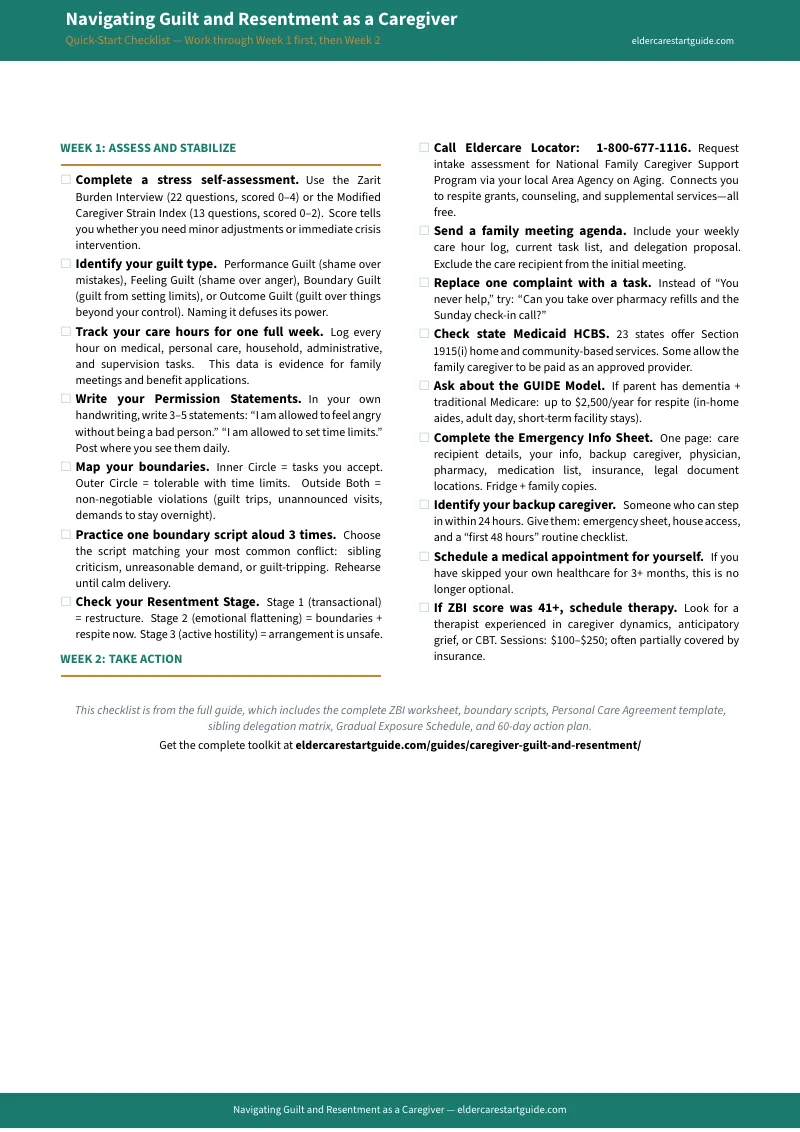
The free Quick-Start Checklist gives you 16 items to assess your current state tonight. It's the diagnostic. The full Navigating Guilt and Resentment as a Caregiver toolkit is the treatment — 12 PDFs: the complete 13-chapter guide plus 10 standalone printable worksheets (boundary scripts, anger protocol, family meeting agenda, task delegation matrix, care hour log, expense tracker, boundary map, emergency info sheet, crisis checklist, and the 60-day action plan).
For , you get the complete system. That's less than 15 minutes of a therapist's billable time — and you'll use these tools for months.