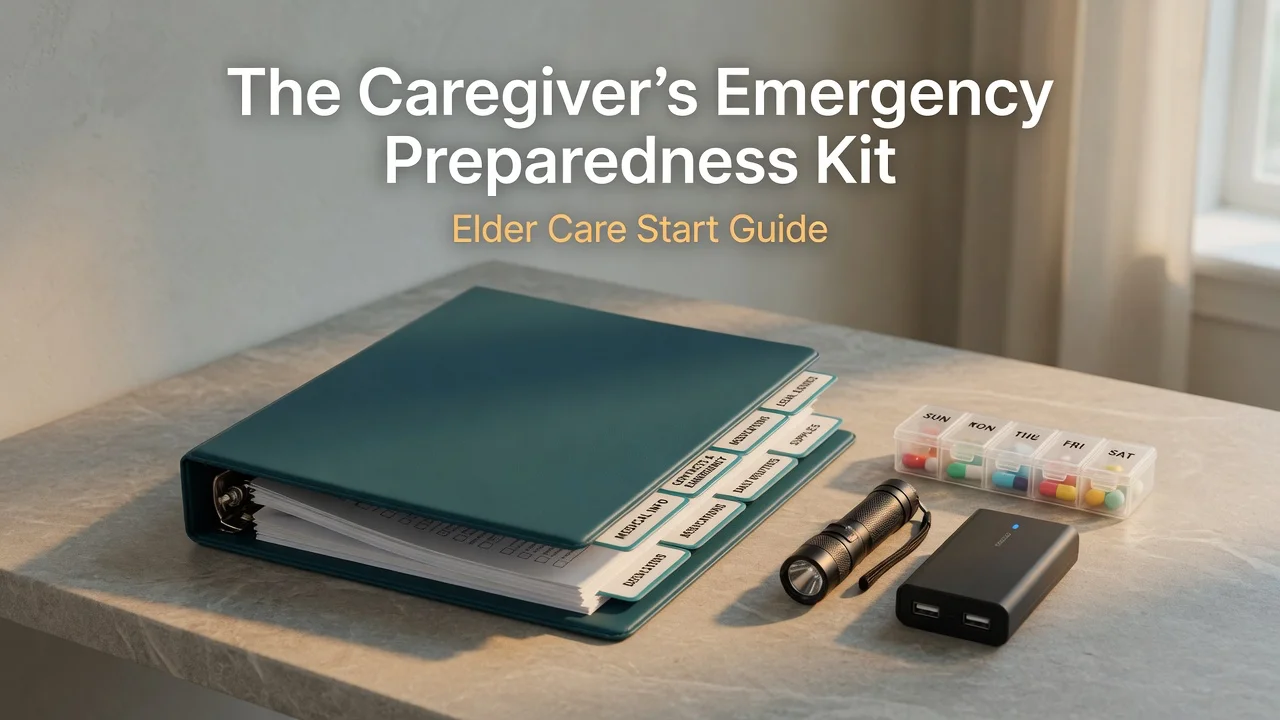
Your Parent's Next Emergency Won't Wait for You to Get Organized
The power goes out and your mother's oxygen concentrator stops. The hospital calls and the ER needs her medication list, her allergies, her advance directive — now. Your neighbor agrees to stay with your father while you travel for work, but doesn't know his insulin schedule, his evening anxiety triggers, or which bedroom door to leave open so he doesn't panic at 3 a.m.
You've meant to build an emergency plan. But the government checklists tell you to stockpile flashlights and canned food — nothing about medication cold chains, backup power calculations for medical devices, or what to do when your parent with dementia refuses to evacuate. The free resources weren't designed for the kind of emergency you're actually going to face.
The Caregiver Crisis Operating System
This isn't another emergency checklist. It's a complete operational system that covers what actually goes wrong when a family caregiver faces a real emergency — not a theoretical one. Where free government checklists stop at "have supplies ready," this kit starts with the clinical, logistical, and interpersonal reality of protecting a medically complex parent.
Every protocol in the kit was built around the emergencies caregivers actually report: the 2 a.m. power outage with a ventilator-dependent parent, the unexpected hospitalization where nobody can find the advance directive, the hurricane evacuation with a parent who uses a wheelchair and won't leave without the cat. The result is a planning system that works when you're panicking, not just when you're calm.
What's Inside
- Legal Authority Checklist — because the ER doesn't care that your power of attorney "is somewhere in the filing cabinet." This printable inventory puts every document a hospital actually asks for — HIPAA authorization, MPOA, financial POA, POLST/MOLST — with execution dates and storage locations.
- Medical Device Power Sizing Worksheet — because "have a backup battery" is useless if the battery dies in four hours and your parent's concentrator needs six. The watt-hour calculation shows exactly how much backup power you need and when to stop waiting and relocate.
- Medication Management Worksheet — because open insulin left above 86°F (30°C) loses potency, controlled substances can't be refilled early without specific disaster provisions, and the generic "grab your meds" advice causes dangerous dosing errors. Includes cold-chain fields, the 7-day go-bag supply, and a 60-to-90-day rotation log.
- Condition-Specific Action Protocol — because a power outage for a parent on oxygen is a fundamentally different emergency than a power outage for a parent with dementia. Separate fill-in rows for oxygen dependency, wandering, dialysis, diabetes, and mobility limitations, so the plan matches your parent's actual medical situation.
- Backup Caregiver Handoff Template — because your neighbor said "sure, I'll check in" and now needs to know which medications go at 8 a.m. versus 8 p.m., what your father's sundowning looks like, and why the back door alarm is set. A two-page hour-by-hour reference that lets someone else provide competent care without calling you every twenty minutes.
- Go-Bag Inventory Checklist — because telling a parent with a walker to "proceed to the nearest exit" is not a plan. The packing list for a medically complex elder: waterproof legal folder, 7-day labeled medications, equipment adapters, and comfort items, plus Tier 1 and Tier 2 destination fields.
- Emergency Contact Directory — because the sibling group text during an emergency produces more confusion than coordination. A landscape directory for the out-of-state relay, physicians, pharmacy, DME supplier, utility medical-baseline line, and backup caregivers. Print three copies: home kit, go-bag, wallet.
- Environmental Hazard Response Plan — because generator carbon monoxide poisoning kills more people than the storms that caused the power outage. Fill-in triggers for heat, cold, flood, and 72-hour outages, plus generator placement and cooling-center fields.
Who This Is For
- Primary caregivers who know their current "plan" is a collection of mental notes that only work if they're the one present during the emergency
- Long-distance caregivers who need a backup system comprehensive enough that a local aide, sibling, or neighbor can handle a crisis independently
- Caregivers of parents with medical equipment — oxygen concentrators, CPAP machines, home dialysis, powered wheelchairs — who need actual power math, not generic "have a flashlight" advice
- Families dealing with dementia or Alzheimer's where any disruption to routine risks wandering, agitation, or a behavioral emergency on top of the original crisis
- Anyone who just had a near-miss — a brief outage, a minor fall, a storm warning that exposed how fragile the current setup really is
Why Free Checklists Don't Work for Caregiver Emergencies
Ready.gov tells you to store three days of water and keep a flashlight handy. The Red Cross has a supply list. AARP has a generic preparedness article. These resources are designed for healthy, mobile adults preparing for their own emergencies.
None of them address medication cold chains for insulin-dependent parents. None of them include power-consumption calculations for home medical equipment. None of them have a backup caregiver handoff protocol or a dementia wandering response plan. And none of them solve the problem that actually makes caregiver emergencies dangerous: the critical information is scattered across kitchen drawers, phone contacts, and one person's memory — and that person might not be available when the emergency happens.
A professional geriatric care manager charges $150–$300 an hour to help organize this. An elder law attorney charges $195–$500 an hour — and neither one gives you a printable system you can hand to a neighbor at midnight. This kit bridges the gap between free checklists that don't fit your situation and professional consultations that cost thousands.
Your Purchase Is Risk-Free
Full refund, no time limit. If the kit doesn't fit your caregiving situation, email [email protected] and you'll get your money back — no forms, no expiration, no questions.
Get Started Now
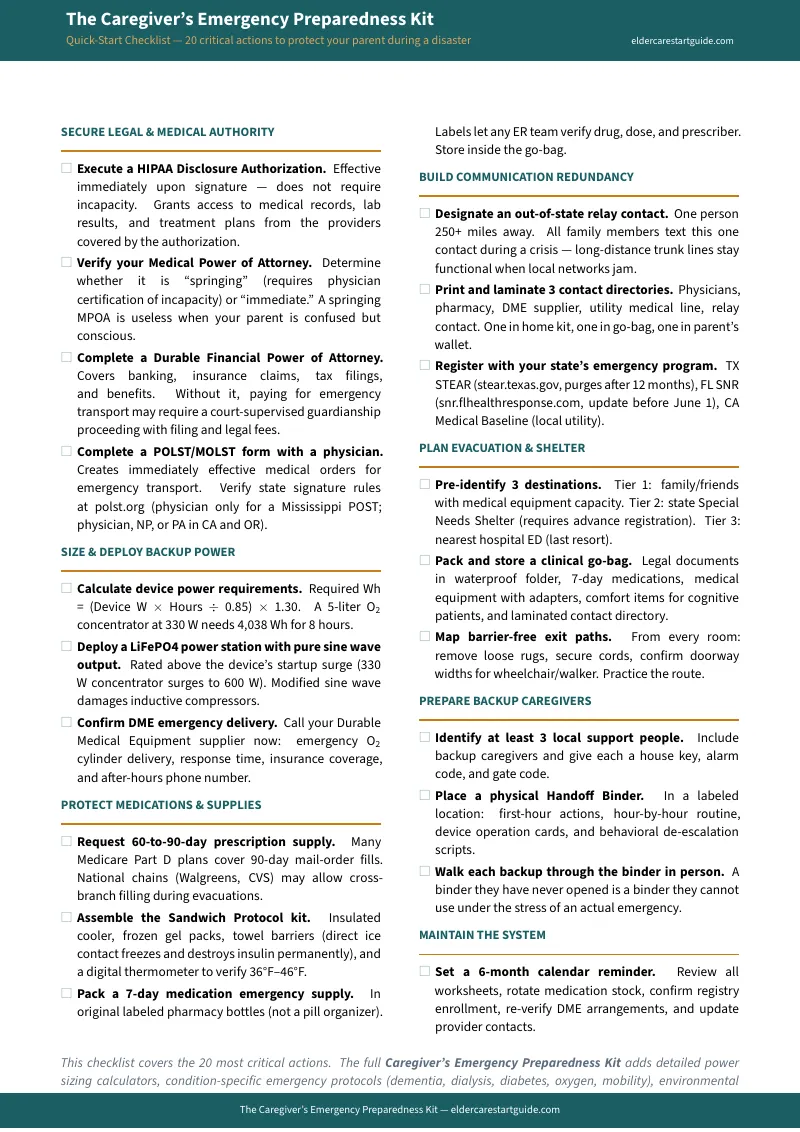
Download the free quick-start checklist to handle the most critical items today. When you're ready for the complete system — the Medical Device Power Sizing Worksheet, the Medication Management Worksheet, the Backup Caregiver Handoff Template, the Condition-Specific Action Protocol — the full Caregiver's Emergency Preparedness Kit is available for less than the cost of a single lunch. For , you replace twenty hours of scattered research with an operational plan ready for immediate use.