Your Parent Is in Whitehorse General Hospital. The Continuing Care Worker Said the Fee Is $40 a Day — Unless Your Parent Fails the Residency Check, in Which Case It Jumps to $509 a Day. Nobody Gave You a Checklist for Proving Residency.
Your parent had a fall, a stroke, or a cognitive episode that put them in hospital. The medical team has stabilized them, but the discharge planner says they are Alternate Level of Care — the signal that returning home is no longer clinically safe. A Continuing Care social worker is already scheduling a clinical assessment for placement at Whistle Bend Place, Copper Ridge Place, or the Thomson Centre. The Continuing Care Referral Form has been started.
The fee sounds manageable: $40 per day, roughly $1,217 per month, governed by the Financial Administration Act. That covers room, meals, housekeeping, and 24-hour nursing care. But buried in the intake conversation is a warning: if the territory determines your parent has not been physically resident in the Yukon for 12 consecutive months — or 10 years cumulatively — the non-eligible rate of $509 per day kicks in. That is more than $15,500 a month. And you have no clear instructions on what documents prove residency or how to challenge a denial.
The Yukon Long-Term Care Costs & Subsidies Guide is a Territorial Care Cost Navigator — a step-by-step manual that walks you from the first hospital discharge conversation through residency verification, fee calculation, income stacking, spousal protection, rural transfer logistics, and legal document preparation. Not a national Canadian elder-care overview that gives Yukon a single paragraph. Not a $400-per-hour Whitehorse estate lawyer consultation for a process you can coordinate yourself. A Yukon-specific manual built on the Financial Administration Act, the Enduring Power of Attorney Act, and the Care Consent Act — covering every fee, every residency rule, every rural-transfer step, and every First Nations legal exception in the order you actually encounter them.
What's Inside the Territorial Care Cost Navigator
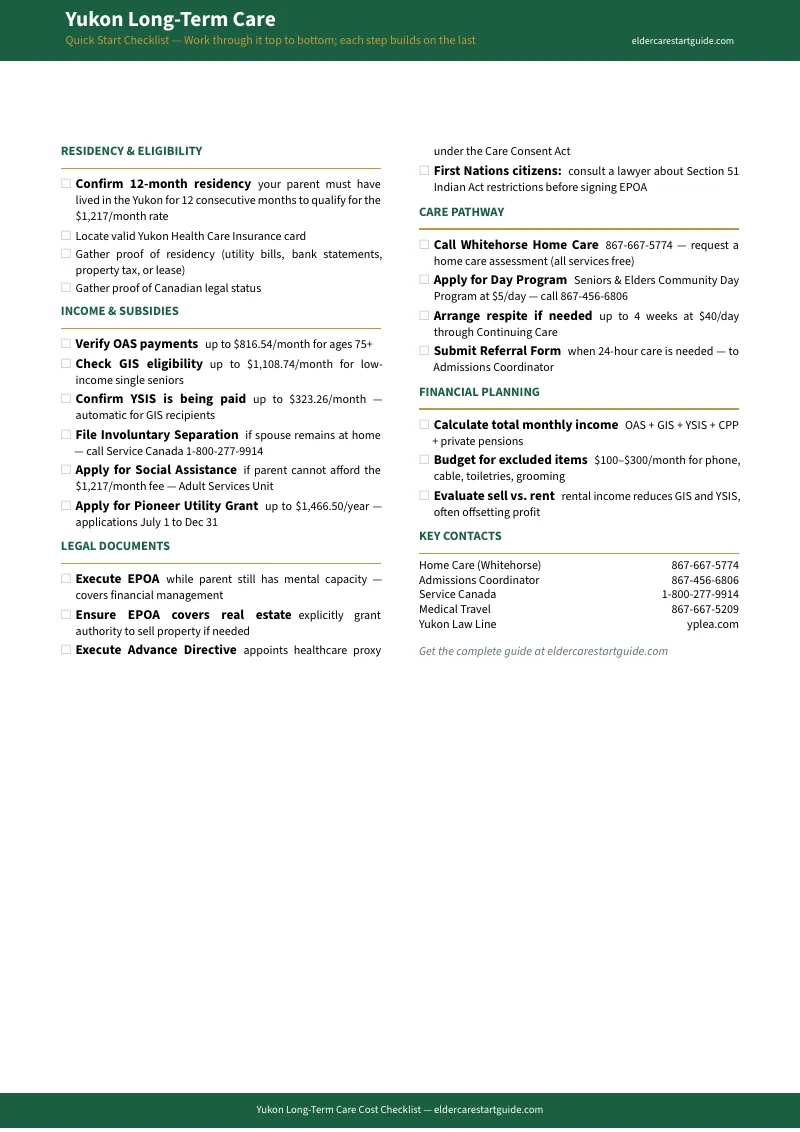
An 18-chapter guide, a 20-item quick-start checklist, and standalone printable worksheets — covering every phase of paying for long-term care in Yukon from the first Continuing Care referral through placement, budgeting, and legal preparation:
The Yukon Continuing Care System — Who Runs What and What It Actually Costs
The Yukon's long-term care system is centrally managed by the Department of Health and Social Services through a single Continuing Care branch — no regional health authorities, no LHIN-style gatekeepers, no competing administrative layers. The guide maps the current system: one branch, one referral pathway, three primary Whitehorse facilities (Whistle Bend Place with 150 beds, Copper Ridge Place, and the Thomson Centre). It explains exactly what the territory pays for (all clinical and nursing care) and what your family pays for (room and board only at $40/day), so the financial conversation starts on solid ground.
The Residency Rule — The $469-Per-Day Difference That Nobody Explains Clearly
This is the single most consequential financial rule in Yukon continuing care. Eligible residents pay $40 per day — about $1,217 per month. Non-eligible residents pay $509 per day — more than $15,500 per month. The qualification: 12 consecutive months of physical presence in the territory, or 10 cumulative years. The guide details exactly which documents satisfy the residency check, how "snowbird" absences to southern provinces are handled, what happens if your parent recently relocated from Alberta or BC, and the process for challenging a non-eligible determination. Families who do not understand this rule before intake risk a monthly bill twelve times higher than expected.
No Asset Testing — What the Yukon Does Not Touch
Search "Yukon long-term care costs" and most top results are about Yukon, Oklahoma — US elder-law firms explaining Medicaid five-year lookback rules, asset seizure, and nursing home rates exceeding $6,000 per month. None of that applies in the Canadian territory. The Yukon public care system does not asset-test. The government does not place liens on primary residences, require property sales, or drain savings to fund residential care. The $1,217 monthly fee is flat and applies to every eligible resident regardless of income or wealth. The guide explains exactly what is protected and corrects the American search-result confusion that panics Canadian families into unnecessary legal spending.
Free Public Home Care — What It Covers and Where It Ends
Before residential placement, the Yukon Health Care Insurance Plan covers all public home care at zero cost: homemaking, personal care, respite, and nursing visits. No income test. No asset test. A Continuing Care Coordinator assesses your parent's needs and develops a care plan. The guide explains the assessment process, the threshold where home support hours are no longer enough, and how the $5/day Seniors and Elders Community Day Program at Whistle Bend Place can bridge the gap. When home care limits are exceeded and private agencies charge $35 or more per hour, the flat $1,217/month facility fee — with 24-hour nursing included — often becomes the more affordable option.
Income Stacking — Using OAS, GIS, CPP, and YSIS to Cover the Monthly Fee
The guide maps every federal and territorial income program available to Yukon seniors: Old Age Security (OAS), Guaranteed Income Supplement (GIS), Canada Pension Plan (CPP), and the Yukon Seniors Income Supplement (YSIS). It shows how to stack these programs so pension income covers most or all of the $1,217 monthly fee — and where supplementary income from private pensions or personal savings fills the gap. For families managing a parent with minimal pension history, the guide covers social assistance pathways and hardship provisions within the Continuing Care system.
Spousal and Family Financial Protection
When one spouse enters care and the other remains at home, household income that covered two people must now fund a $1,217 monthly care fee and a household. The guide walks through joint income planning: how to structure pension splitting so the community spouse is not left short, what comfort allowance your parent retains for personal expenses, and how to use GIS recalculation for involuntary separation. It includes a sibling cost-sharing framework for out-of-pocket expenses — cable, phone, toiletries, clothing, non-formulary medications — that the flat fee does not cover.
Rural Elders — The Forced Relocation Nobody Prepares You For
If your parent lives in Dawson City, Watson Lake, Mayo, Haines Junction, or any other Yukon community outside Whitehorse, local residential care options are extremely limited. McDonald Lodge in Dawson City has a handful of beds; most communities have none. When care needs exceed what local home support can provide, the Continuing Care branch arranges a transfer to Whitehorse — often to Whistle Bend Place. The guide covers the transfer logistics, medical travel subsidies from the territory, how to coordinate with regional Continuing Care offices, and the emotional and practical impact of moving an elder hundreds of kilometres from their community, land, and family.
Palliative Care and End-of-Life Options
For families facing end-of-life situations, the guide covers Wind River Hospice House (accommodation at $40/day), the territory's rural end-of-life support program (up to $10,000 in direct funding to hire local caregivers so an elder can remain in their community), and how palliative options interact with the regular continuing care system. It explains eligibility, application steps, and the role of advance healthcare directives under the Care Consent Act in ensuring your parent's wishes are respected.
Legal Protections — EPA, Advance Directives, and the First Nations Exception
The guide walks through executing a valid Enduring Power of Attorney (EPA) under the Yukon Enduring Power of Attorney Act with step-by-step instructions and template references. It covers advance healthcare directives under the Care Consent Act and explains when court-ordered adult guardianship is the only option. Critical for many Yukon families: citizens of First Nations that have not completed their land claims — including the Liard First Nation, White River First Nation, and Ross River First Nation — face restrictions under Section 51 of the federal Indian Act that may prevent a standard EPA from being executed. The guide explains the exception, the legal alternatives, and how to coordinate with First Nations health directors during the placement process.
Who This Guide Is For
- The adult child who just got the ALC call from Whitehorse General — whose parent is flagged for discharge, a Continuing Care social worker is scheduling assessments, and the family needs to prove residency before intake paperwork is finalized — or risk paying $509 a day instead of $40
- The family terrified the government will take the house — who searched "Yukon long-term care costs" and found American results about Oklahoma Medicaid, five-year lookback periods, and nursing home bills exceeding $6,000/month — none of which applies in the Canadian territory
- The spouse trying to keep the household running on reduced income — who needs to understand how pension splitting, GIS recalculation, and the comfort allowance work when only one partner enters care and the other must maintain a home in Whitehorse or a rural community
- The rural family watching local care options run out — whose parent has been in Dawson City or Watson Lake their entire life, and the local beds are full or the care needs have exceeded what home support can provide, forcing a transfer to Whitehorse that nobody has prepared them for
- The First Nations family navigating a legal exception nobody warned them about — whose parent is a citizen of a nation that has not completed land claims, making the standard EPA process unavailable under Section 51 of the Indian Act, and who needs to know the alternatives before the Continuing Care assessment is complete
Why Free Resources Will Not Get You Through This
The information exists. It is scattered across Yukon.ca program pages, Continuing Care referral forms, the Financial Administration Act, the Enduring Power of Attorney Act, Service Canada pension guides, and CRA tax instructions. Here is what you actually encounter when you try to navigate the financial side of Yukon long-term care using free sources:
- Yukon.ca publishes program descriptions, not action plans. You can find the $40/day rate and a description of the Continuing Care branch. You will not find a step-by-step sequence for proving residency, estimating your monthly budget, stacking pension programs to cover the fee, or preparing for the clinical assessment. That chronological walkthrough is what this guide provides.
- Most search results are about the wrong Yukon. "Yukon senior care," "Yukon elder law," and "Yukon nursing home costs" are dominated by results for Yukon, Oklahoma — US-based elder law firms, Medicaid consultants, and senior living directories. Canadian families in Whitehorse or Dawson City are served Oklahoma SoonerCare rules, US Veterans benefits, and private nursing home costs exceeding $6,000/month. The geographic search trap means that even determined researchers encounter more wrong answers than right ones.
- National Canadian directories barely mention the territory. Senior Care Access, Ohana Care, and similar platforms focus on Ontario, BC, and Alberta. Yukon gets a single-sentence rate mention — no coverage of the residency rule, rural relocation logistics, or First Nations legal exceptions that are central to how care actually works in this territory.
- Whitehorse estate lawyers charge $300 to $500 per hour. The care-coordination process — residency documentation, fee calculation, pension stacking, rural transfer logistics — is administrative work, not complex legal work. A $400 consultation answers the questions the guide already covers.
Free resources give you fragments from sources that do not communicate with each other. The Territorial Care Cost Navigator puts every Yukon-specific rate, residency rule, rural-transfer step, and legal exception into one document, in the order you actually encounter them.
— Less Than One Hour With a Whitehorse Estate Lawyer
An initial consultation with a Whitehorse estate lawyer runs $300 to $500 per hour. Simple wills cost $400 to $600. The Yukon Law Line offers a 30-minute session for $30, but cannot coordinate your care transition, calculate your pension stack, or walk you through residency verification. This guide costs a fraction of one professional hour and gives you the complete Yukon LTC financial roadmap: residency verification steps, the monthly budget calculator, pension-stacking worksheets, the spousal protection framework, rural transfer logistics, and annotated EPA instructions.
Your download includes the 18-chapter guide, the 20-item quick-start checklist, and 6 standalone printable worksheets you can bring to the Continuing Care intake meeting, family budget discussions, and the estate lawyer:
- Residency Verification Checklist — the documents that prove 12-month consecutive or 10-year cumulative territorial residency, plus red flags that trigger a non-eligible determination
- Monthly Care Budget Calculator — input pension income (OAS, GIS, CPP, YSIS) against the $1,217 monthly fee and out-of-pocket costs, with current maximum subsidy reference table
- Spousal Income Protection Worksheet — calculate how Involuntary Separation filing increases GIS and YSIS for both spouses, plus the at-home spouse household budget and the sell-versus-rent decision
- Sibling Cost-Sharing Framework — a template for dividing out-of-pocket expenses (phone, cable, toiletries, medications) fairly among adult children, with four common sharing models
- 48-Hour Hospital Discharge Checklist — the rapid planning document for families facing sudden ALC designation, with first-24-hour and second-24-hour action items and key contact numbers
- EPA Preparation Checklist — step-by-step instructions for executing a valid Enduring Power of Attorney under Yukon law, advance healthcare directives under the Care Consent Act, and the First Nations Section 51 exception guidance
Satisfaction guaranteed. If the guide does not answer your questions about Yukon long-term care costs, email us for a full refund.
Start here: download the free checklist for a one-page overview of the residency rule, the fee structure, and the most critical intake steps. When you are ready for the full guide — every chapter, every worksheet, every rural-transfer and legal-protection detail — the complete Territorial Care Cost Navigator is one click away.