
Your Parent's Bed Is Ready. The Admissions Office Needs a Signature. And You Have No Idea What You're Agreeing To Pay.
The Saskatchewan Health Authority assessed your parent through Client Patient Access Services. They scored high enough on the RAI-LTC for 24-hour nursing care. A bed opened in a Special-care Home. You have two to four days to accept or wait months for the next one.
At the facility, the admissions coordinator hands you a CRA Consent Form — Side A. You have never seen it before. Nobody explains that failing to submit this form means your parent is automatically billed the maximum rate of $3,428 per month, regardless of their actual income. Nobody explains that a second form — Side B — must be filed every September or the same maximum default rate kicks in again. And nobody mentions the Optional Designation form that could separate your parents' incomes and save the family over $4,000 a year.
You could spend hours on the Saskatchewan Health Authority website, cross-referencing the Special-care Homes Rates Regulations with eHealth Saskatchewan's Drug Plan portal and the Ministry of Social Services benefits pages. Or you could open the one document that connects every formula, every form, and every benefit into the sequence you actually need.
The Saskatchewan Care Cost Navigation System
This is not a summary of eligibility rules you can find on a government website. It is the process around the rules — the part that $300-to-$500-per-hour elder-law attorneys explain in billable consultations and that public portals never connect for you.
The guide covers every care pathway, every financial formula, every spousal protection mechanism, and every auxiliary benefit available in Saskatchewan — organized in the order you will actually encounter them, from the first CPAS referral through annual resident charge reassessments.
What's Inside
- The Income-Testing Formula — With Worked Examples — Saskatchewan calculates what your parent pays using a statutory formula based exclusively on Line 15000 income. The guide shows you the exact arithmetic with two fully worked examples, so you know your parent's monthly charge before the Ministry calculates it for you. Your parent's home, land, savings, and investments are completely excluded — this is income-tested only, not asset-tested.
- CRA Consent Forms — Side A and Side B — The two forms that determine whether your parent pays their income-tested rate or the maximum default of $3,428/month. The guide explains the September filing deadline, what happens when you miss it, and how to submit a certified Power of Attorney so the CRA accepts the signature when your parent cannot sign.
- Spousal Income Protection (Optional Designation HE593) — When one spouse enters a Special-care Home, the Ministry's default assessment combines both incomes — pushing the resident charge toward the ceiling. The Optional Designation separates their incomes for rate purposes. Combined with the federal Involuntary Separation filing through Service Canada, these two mechanisms protect the at-home spouse's finances and can save over $4,000 per year.
- Home Care Sliding Scale and Break-Even Analysis — Saskatchewan's SHA Home Care charges $9.60/hour for supportive personal care (nursing and therapy are free), with a monthly cap of $576 for 11 or more hours. Private agencies charge $20 to $100 per hour. The guide includes the break-even calculation showing exactly when home care becomes more expensive than a subsidized Special-care Home placement — so you can make the decision with real numbers.
- Personal Care Home Benefit (PCHB) — Licensed Personal Care Homes charge $2,500 to $7,000+ per month at full private rates. The PCHB bridges the gap for low-income seniors whose monthly income falls below the $3,500 threshold. The guide walks through the Ministry of Social Services application and exactly what documentation is required.
- Every Auxiliary Benefit Most Families Miss — The Seniors' Drug Plan (co-payments capped at $25/prescription), Seniors Income Plan (up to $360/month at home or $50/month comfort allowance in a Special-care Home), Saskatchewan Assured Income for Disability (SAID), Saskatchewan Aids to Independent Living (SAIL) for mobility equipment, and the federal and provincial tax credits that reduce after-tax care costs. Most families claim fewer than half of the benefits they qualify for.
- Appeals, Reassessments, and the 60-Day Respite Rule — How to request an immediate rate recalculation when income drops mid-year (death of a spouse, pension termination). The administrative appeal pathway through eHealth Saskatchewan. And the critical rule that temporary respite stays exceeding 60 consecutive days automatically convert to the permanent income-tested resident charge structure — a trap that catches families who planned a "temporary" placement.
- Legal Authority — POA, Proxy, and Guardianship — Enduring Power of Attorney under The Powers of Attorney Act, 2002, the SHA Healthcare Proxy form (SHA 0326), and the specific POA language required for CRA consent submissions. The full guardianship process through the Court of King's Bench when capacity has already been lost.
Plus: Printable Quick-Start Checklist and 8 Planning Worksheets
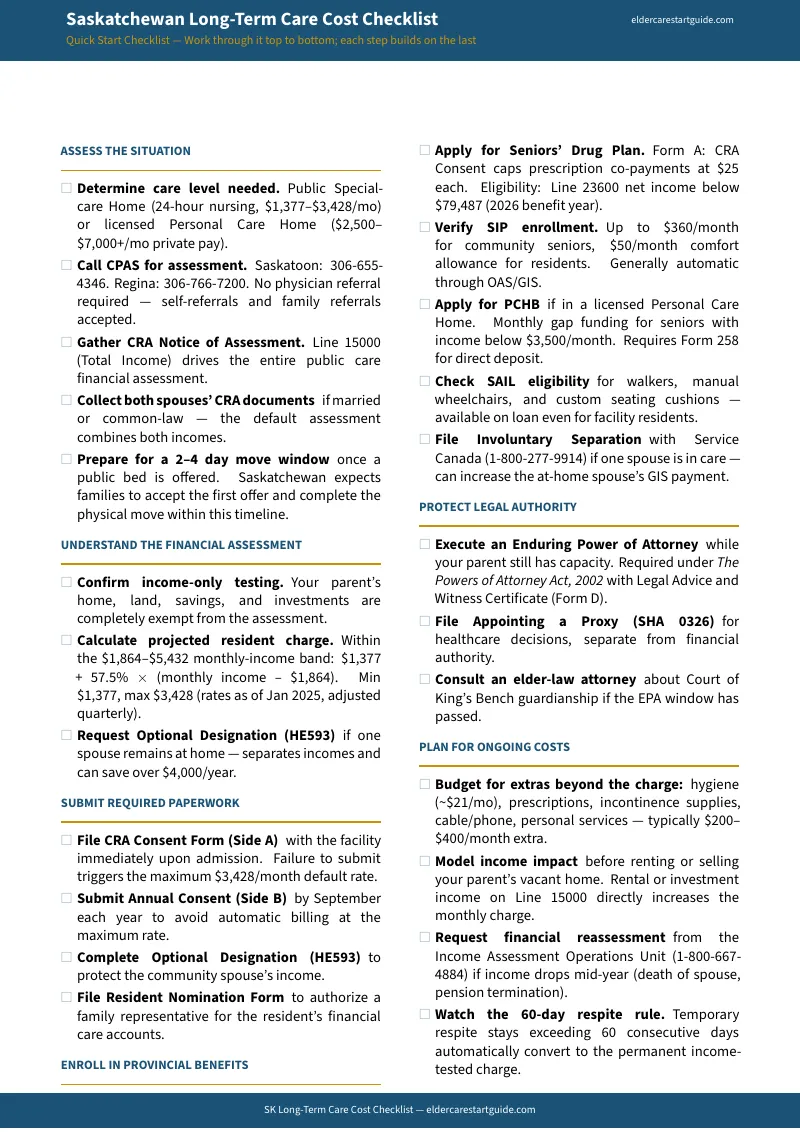
- Saskatchewan Long-Term Care Cost Checklist — A two-page action reference with every critical step from contacting CPAS through CRA consent filing, benefit enrollment, and spousal designation. Every threshold, phone number, and deadline at a glance.
- Monthly Budget Worksheet — Calculate the true all-in monthly cost: resident charge plus out-of-pocket extras, income offsets, and monthly shortfall.
- Resident Charge Calculator — Step-by-step fill-in for both the default and Optional Designation scenarios, with a built-in savings comparison.
- Spousal Protection Worksheet — Side-by-side income comparison showing exactly how much the Optional Designation saves your family.
- Financial Application Checklist — Every form and submission organized chronologically from pre-admission through annual renewal, with checkboxes and date tracking.
- Benefits Enrollment Tracker — Program-by-program tracker for the Seniors' Drug Plan, SIP, PCHB, SAID, SAIL, and tax credits with eligibility thresholds and application status.
- Agency Communication Log — Track every call, email, and meeting with SHA, CPAS, facility staff, and Ministry departments.
- Official Forms Register — One-page reference of all 10 government forms with issuing agencies and checkboxes.
- Key Contacts Reference Card — Every phone number and agency for Saskatchewan long-term care on one printable page.
Who This Is For
- Adult children whose parent is being discharged from the hospital and someone needs to figure out the monthly bill before signing the admission paperwork
- Families whose parent's spouse is about to lose half their income to a combined-income assessment — and who need the Optional Designation filed before the first billing cycle
- Caregivers whose parent is on SAID, GIS, or a fixed CPP pension and needs every available rate reduction and provincial supplement secured correctly
- Families weighing whether to keep a parent at home with SHA Home Care versus transitioning to a Special-care Home — and need the actual cost comparison, not a guess
- Adult children managing a parent in a private Personal Care Home and wondering whether the PCHB can offset some of the $2,500-to-$7,000 monthly bill
- Out-of-province siblings coordinating a Saskatchewan parent's care remotely and needing every form reference, phone number, and deadline in one place
Why Not Free Government Resources?
The Saskatchewan Health Authority publishes clinical program descriptions. eHealth Saskatchewan hosts PDF forms. The Ministry of Social Services lists benefit eligibility thresholds. PLEA provides plain-language legal explainers.
Here is what none of them provide:
- The income-testing formula with worked examples so you can calculate your parent's specific monthly charge before the Ministry does
- A unified walkthrough connecting the CRA consent forms, the Optional Designation, the Involuntary Separation filing, and the benefit enrollment steps into one chronological sequence
- The break-even analysis comparing SHA Home Care, private home care, Personal Care Homes, and Special-care Homes at your parent's income level
- A complete inventory of every provincial benefit — Drug Plan, SIP, PCHB, SAID, SAIL, tax credits — with the specific eligibility thresholds and application steps for each
Government portals administer rules. Elder-law firms explain them at $300 to $500 per hour. This guide bridges the gap — translating hundreds of pages of Saskatchewan policy into a sequence you can execute in an evening.
Satisfaction Guarantee
If the guide doesn't give you a clearer path forward, email [email protected] for a full refund — no time limit.
— Less Than One Hour of an Elder-Law Attorney's Time
An initial consultation with a Saskatchewan elder-law attorney in Regina or Saskatoon runs $300 to $500. A full estate planning or guardianship engagement can cost $5,000 or more.
This guide will not replace an attorney for contested guardianship proceedings or complex estate litigation. But for navigating the income-testing system, protecting the at-home spouse's income, securing every provincial benefit, and managing the SHA placement process — it covers 90% of what most Saskatchewan families need, at a fraction of the cost.
Start with the free checklist to see if the approach fits your situation. The full guide goes deeper — every formula, every form, every phone number, every benefit.