Your parent needs care. Quebec's financial system is designed for people who already understand it.
The CLSC social worker hands you a stack of RAMQ financial disclosure forms and says the assessment is underway. Your parent's Iso-SMAF profile will determine whether they stay home, move to an intermediate resource, or enter a CHSLD. And their monthly contribution — the amount the province expects them to pay for room and board — depends on a formula that evaluates twelve consecutive months of income, assets, bank statements, TFSAs, RRSPs, and RRIFs.
Nobody warns you about the family home trap. The principal residence is exempt up to $389,677 — but only while a spouse or dependent lives there. Sell the house before understanding the formula, and the proceeds become non-exempt liquid assets. The monthly contribution jumps by hundreds of dollars. The decision is irreversible.
Government websites list the rules. They do not tell you which rules to handle first, which forms to file before others, or how one agency's calculation affects another's. RAMQ, Revenu Québec, Service Canada, and the Curateur public each own one piece. This guide connects them into a single sequence.
The Quebec Care Cost Navigation System
The Quebec Long-Term Care Costs & Subsidies Guide organizes every financial rule, subsidy program, tax credit, legal procedure, and appeal mechanism into the order you actually need them — from the first CLSC intake call through the RAMQ rate reduction application and beyond.
Where free government portals scatter information across dozens of disconnected pages, this guide maps the dependencies: what to file before the Iso-SMAF assessment, what to prepare before the RAMQ financial disclosure, how to protect the family home and the surviving spouse's income, and when the home care subsidies make institutional placement unnecessary.
What's inside the guide
The Iso-SMAF Assessment — Understanding What the CLSC Measures
The CLSC evaluates twenty-nine functions to assign your parent a clinical profile from 1 to 14. That number determines everything: whether they qualify for home care hours, intermediate resource placement, or a CHSLD bed. The guide explains what the assessor measures, how to document your parent's true daily challenges before the visit, and what each profile range means for available services and costs.
RAMQ Room and Board Rates — The Real Numbers
When your parent enters public care, they contribute toward room and board based on their financial capacity. The guide details current monthly maximums for private, semi-private, and ward rooms, explains how the income-and-asset formula works, and walks through the rate reduction application (Form 3657 for CHSLDs, Form 3807 for intermediate resources) step by step — including every document RAMQ requires.
The 12-Month Asset Look-Back — How RAMQ Catches Transfers
RAMQ reviews a full year of financial records to identify asset transfers made before admission. Large cash withdrawals, property transfers, and financial gifts during this window are treated as if the assets were never moved. The guide explains what triggers scrutiny, how to prepare the documentation correctly, and the common mistakes that inflate contribution rates.
The Family Home Protection Rules
The principal residence exemption shields up to $389,677 — but only under specific conditions. Selling, gifting, or transferring the home at the wrong time converts an exempt asset into non-exempt liquid cash with a far lower allowance. The guide maps every scenario: when the home is protected, when it is not, and what happens to the exemption if the surviving spouse also enters care.
Spousal Protection and the Involuntary Separation Advantage
When one partner enters care and the other remains at home, the RAMQ formula protects a monthly income allowance for the remaining spouse. But most families miss the federal involuntary separation provision — a Service Canada filing that splits OAS and GIS as though the couple were single, often adding hundreds of dollars per month to the household's total benefits. The guide covers both the provincial and federal sides with the exact forms and filing steps.
Home Care Subsidies — PEFSAD and the CMD Tax Credit
Before placement becomes necessary, two Quebec programs can substantially reduce home care costs. The PEFSAD program provides hourly exemptions for social economy enterprise services. The CMD home care tax credit covers a significant portion of eligible expenses for seniors with reduced autonomy. The guide explains how to calculate and stack both programs, and identifies the financial tipping point where home care exceeds what a subsidized CHSLD bed would cost.
Protection Mandates, Tutorship, and Mesure d'Assistance
Under Quebec civil law, a standard power of attorney dies when your parent becomes incapable. The guide maps the full homologation process for protection mandates — medical and psychosocial evaluations, register searches with the Chambre des notaires and the Barreau, the Superior Court filing — and explains the alternative paths when no mandate exists: tutorship ($3,000–$5,000, six to twelve months) and the newer mesure d'assistance for situations that do not require full legal proceedings.
Disputes and Appeals — Two Tiers, Strict Deadlines
If RAMQ's rate calculation is wrong or a rate reduction is denied, the family has 30 days to submit a Request for Administrative Review. If the review fails, the next step is the Tribunal administratif du Québec within 60 days. The guide outlines both tiers, the evidence that strengthens a case, and the deadlines that cannot be extended.
The Home Care vs. Placement Financial Comparison
The guide runs a realistic side-by-side comparison: gross home care costs for a senior requiring 25–40 hours per week, net costs after PEFSAD and CMD, versus what the same senior would pay in a subsidized CHSLD after the rate reduction. The calculation shows exactly where the tipping point falls — so the decision is based on numbers, not guilt or guesswork.
11 Standalone Printable Tools
Every purchase includes printable worksheets and reference cards designed to be used at the point of action: a RAMQ document preparation worksheet, a rate reduction application walkthrough, a family home financial strategy calculator, a home care vs. placement cost comparison worksheet, a monthly care budget template, a CMD tax credit calculator, a protection mandate homologation roadmap, an involuntary separation filing tracker, an appeal timeline tracker, an agency communication log, and a key contacts reference card with every phone number, form number, and deadline your family will need.
Who this is for
You are managing a hospital discharge crisis — your parent is medically stable but cannot go home, the CLSC has started the MAH placement process, and RAMQ's financial contribution forms just arrived. You need the rate formula, the document checklist, and the rate reduction process before you sign anything.
You are planning ahead for a parent with dementia — cognitive decline is progressing, and you want to get the protection mandate homologated, organize financial records, and estimate future RAMQ contributions while there is still time to prepare.
You are weighing home care against placement — the monthly costs of private PABs and CLSC supplements are climbing, and you need to know the exact financial comparison: net home care costs after PEFSAD and CMD versus what your parent would pay in a CHSLD after the rate reduction.
You are a surviving spouse — your partner has entered care, and you need to understand the spousal protection allowance, the involuntary separation filing for OAS and GIS, and what happens to the family home exemption, before the RAMQ contribution erodes your household income.
Why free government portals are not enough
RAMQ's website explains the rate structure. It does not explain that selling the family home before the assessment converts an exempt asset into taxable liquid cash. Revenu Québec's tax credit pages explain the CMD formula. They do not show how to combine CMD with PEFSAD to push your net home care cost below the CHSLD threshold. The Curateur public explains tutorship. It does not compare tutorship costs against homologation costs so you can make an informed choice before capacity is lost.
Free senior placement agencies cannot help either. Most operate on commissions from private seniors' residences. They can tour you through RPAs, but they cannot guide you through the RAMQ rate reduction, the 12-month asset audit, or the protection mandate process. Their financial incentive points toward private placement — not the public system that most Quebec families need to navigate.
This guide is independent, covers the public system, and has no commercial relationship with any facility or agency.
Satisfaction guarantee
If the guide does not help you navigate Quebec's long-term care financial system, request a full refund — no time limit, no questions. Email [email protected].
Get started now
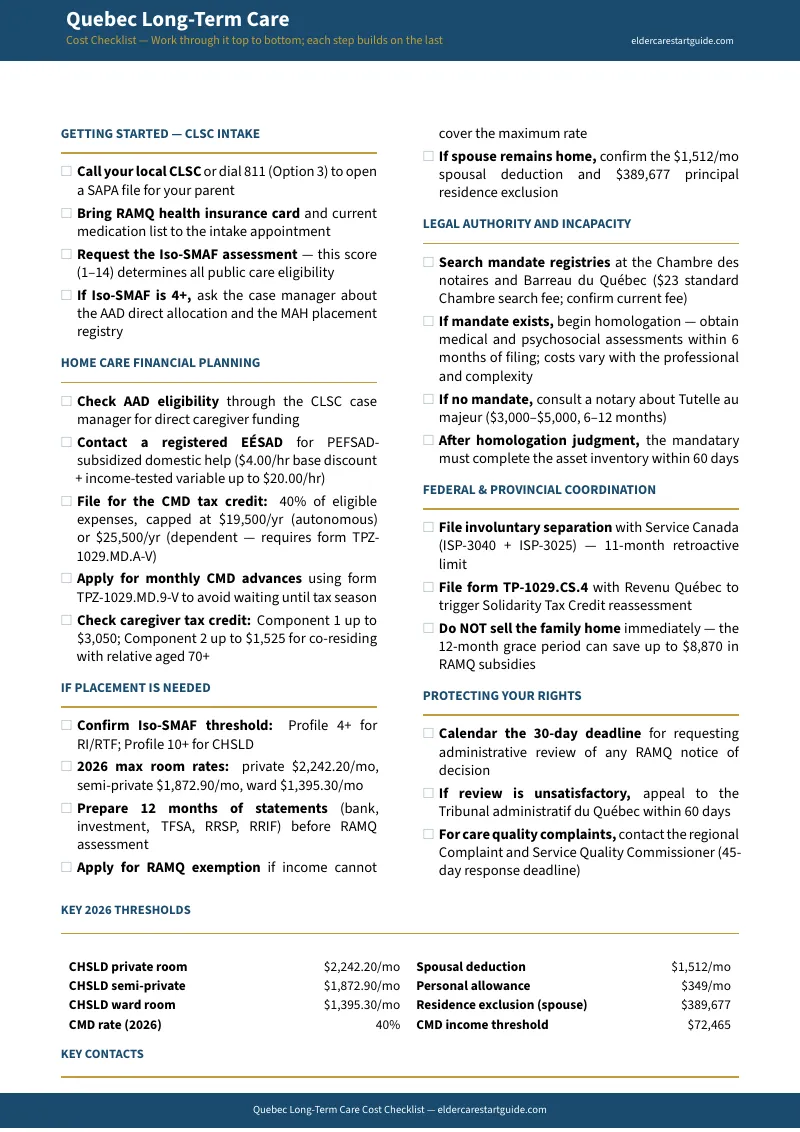
Download the free Quebec Long-Term Care Cost Checklist for the essential action items and key contacts on a single page. When you are ready for the complete system — thirteen chapters covering every financial rule, subsidy program, legal procedure, and appeal mechanism — get the full Quebec Long-Term Care Costs & Subsidies Guide for .