Your Parent Needs Help. Quebec Says You Have No Authority.
Your mother fell. Or your father's memory is fading. Or the hospital discharge planner just told you someone needs to sign a lease for the CHSLD bed that opened up — and you have 24 hours to accept or your parent goes back to the bottom of the waiting list.
You call the bank to pay the care facility deposit. They freeze the account. You try to redirect the pension cheque. Retraite Québec says you need a specific form. You contact Hydro-Québec to set up a payment plan. They ask whether you have a procuration or a consentement — and you don't know the difference.
You're the one doing the caregiving. But Quebec's civil law system doesn't care. Without the right legal instruments — and Quebec uses instruments that exist nowhere else in Canada — you have zero authority over your own parent's finances, healthcare, or housing.
The Quebec Authority Navigation System
This isn't a blank protection mandate form. The Curateur public already provides that for free on quebec.ca.
This is the execution methodology that turns those blank forms into legally binding documents — the step-by-step signing protocols, agency-specific proxy guides, homologation filing walkthroughs, and Bill 18 compliance templates that make institutions actually accept your authority during a care transition.
Quebec operates under civil law, not common law. Every other province uses an "enduring" or "continuing" power of attorney that persists through incapacity. Quebec uses a completely different two-instrument system: a procuration that dies the moment capacity is lost, and a mandat de protection that sleeps until a court wakes it up through homologation. Most free guides online — including national platforms like Willful that don't even offer Quebec POA products — blur these distinctions or skip them entirely.
What's Inside
The Two-Phase Authority System Explained
A plain-language walkthrough of how Quebec's civil law framework splits decision-making authority into two instruments — the Power of Attorney (procuration) for the capable phase and the Protection Mandate (mandat de protection) for incapacity. Covers when each document applies, when each one stops working, and the dangerous gap between them that freezes accounts and blocks care placements.
Protection Mandate Signing Guide
Step-by-step instructions for executing a witnessed (private) protection mandate that holds up during homologation. Covers the strict witness eligibility rules under the Civil Code, joint vs. separate mandatary structures, how to draft personal care clauses that institutions cannot ignore, and the Commissioner for Oaths affidavit that can save you thousands in notary fees later. Includes a printable signing preparation checklist you can bring to the ceremony.
7-Step Homologation Walkthrough
The court process to activate a protection mandate typically costs $2,500–$7,000 when handled by a professional. Our guide maps each step — locating the original document, booking the medical assessment, obtaining the psychosocial evaluation (free through the CLSC system but with 6–18 month waits, or $900–$2,700 privately), filing with the Superior Court, and assembling the tutorship council. The printable step tracker lets you log dates, costs, and contacts for each stage so you know exactly where you stand.
Capacity Assessment Worksheet
A diagnosis of cognitive decline does not automatically strip your parent of legal rights. Capacity is presumed under Quebec civil law, and documents signed during a lucid interval are valid. The printable worksheet helps you document your parent's understanding at the moment of signing — the critical evidence trail that protects the document from challenges by relatives or rejection during homologation.
Agency-Specific Proxy Forms Guide
A generic power of attorney template will not work at Quebec agencies. Revenu Québec requires the MR-69-V. Retraite Québec has pension-specific proxy forms. The SAAQ demands its own vehicle transaction procuration. Hydro-Québec distinguishes between consent (view-only) and procuration (account changes). Épargne Placements Québec uses a limited power of attorney that expires after five years. The guide covers each agency's requirements, and the printable tracker worksheet lets you log which forms you've filed and their confirmation status.
Bill 18 Mandatary Duties Toolkit
After homologation, Quebec law requires you to complete an asset inventory within 60 days and render accounts every three years. Failing these obligations invites judicial oversight and family disputes. The toolkit includes printable worksheets for the 60-day asset inventory and the triennial accounting report, with structured sections for bank accounts, real estate, investments, pensions, debts, income, expenses, and summary totals.
Advance Medical Directives (DMA) Guide
Quebec's DMAs are a separate legal layer registered with RAMQ that cover five specific end-of-life treatments — and they override your mandatary's instructions for those treatments. Most families need both a DMA and a protection mandate, but the two documents are created and registered through completely different channels. The guide walks you through both so nothing falls through the cracks.
CLSC and Care Placement Navigator
When your parent needs home care or long-term care placement, the CLSC system controls access through SMAF/OEMC autonomy assessments and the MAH (Mécanisme d'accès à l'hébergement) housing queue. The navigator covers how to request assessments, how the scoring determines care hours and placement priority, and how to handle the strict 24-hour acceptance deadline when a CHSLD or Maison des aînés bed is offered.
Who This Is For
- Your parent still has capacity — you want to get a procuration and protection mandate in place before a crisis forces you into court-ordered tutorship
- Your parent's capacity is borderline — you need to execute documents during a lucid interval with proper safeguards before the signing window closes
- Your parent has already lost capacity — you need to understand the homologation process or the court-ordered tutorship regime reformed under Bill 18
- A bank or institution is blocking you — you have a procuration but they suspect capacity loss and froze the accounts, and you need to know your options
- You're navigating the CLSC and care placement system — you need legal authority to sign care facility leases, redirect pensions, and manage accounts during a care transition
Why Not Just Use the Free Government Form?
The Curateur public offers a free protection mandate template. Éducaloi publishes plain-language guides. Every notary in Montreal has a blog post about mandates.
None of them give you a sequential execution plan.
They hand you a blank mandate template but don't tell you how to choose between joint and separate mandataries — or why that decision matters when siblings disagree about care placement. They explain what homologation is but don't walk you through obtaining the psychosocial assessment, assembling the tutorship council, or filing the court application. They mention the SAAQ procuration but don't cover the Hydro-Québec consent-vs-procuration distinction or the Épargne Placements Québec five-year expiry trap.
The free form assumes you already know Quebec civil law. This kit assumes you don't — and gives you the execution methodology to get it right the first time.
What About Hiring a Notary?
Quebec notaries charge $300–$1,000+ per document, and a full incapacity planning package can exceed $2,000. The homologation process adds another $2,500–$7,000 in professional fees, court costs, and assessment expenses.
For straightforward situations — one or two parents, standard financial accounts, no active family disputes or complex trust structures — you can prepare and execute a valid witnessed protection mandate yourself. The Civil Code explicitly recognizes witnessed mandates as having equal legal standing to notarized ones.
This kit helps you handle the standard planning. If your situation involves interprovincial assets, contested estates, corporate holdings, or active litigation among family members, we'll tell you that too — and explain when hiring a notary or lawyer is worth the investment.
100% Satisfaction Guarantee
If the kit doesn't give you a clear path to securing legal authority for your parent in Quebec, email us for a full refund. No time limit, no questions.
— Less Than One Hour of Notary Time
Quebec notaries bill $300–$1,000+ per document. A single consultation often costs more than this entire kit. Get the same procedural knowledge in a format you can use at your kitchen table, on your schedule, without a retainer or a formal appointment.
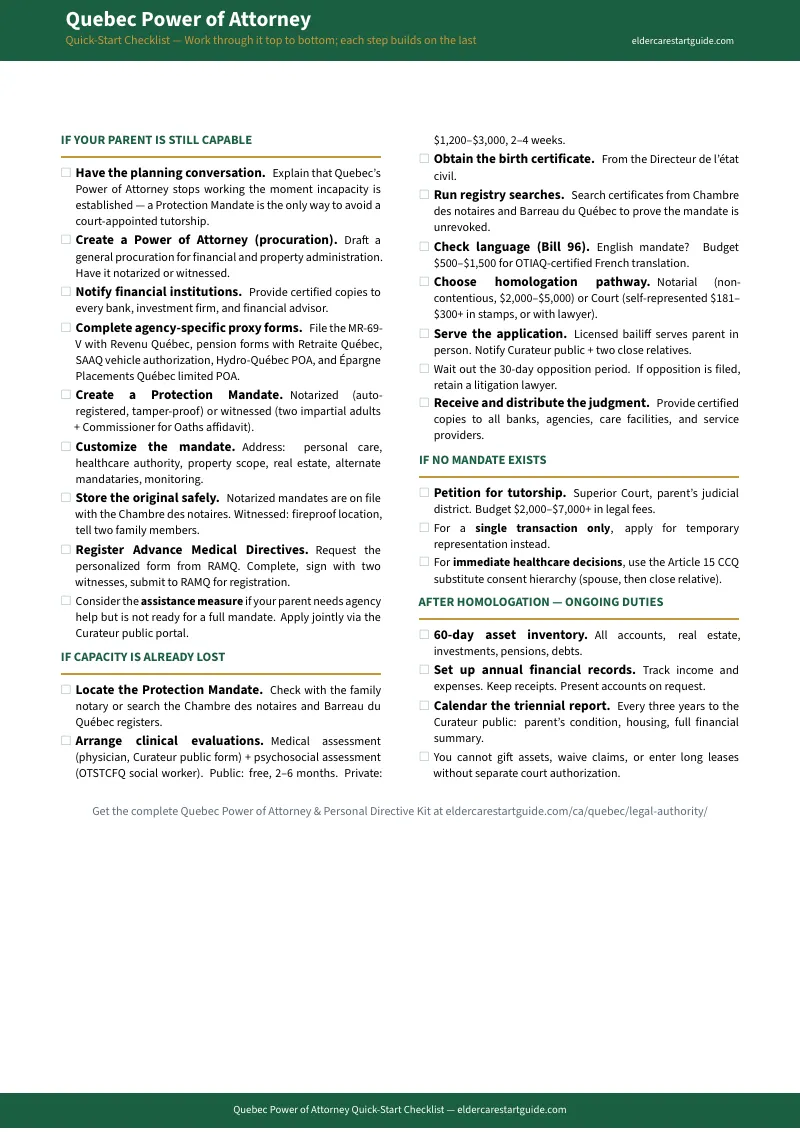
Start with the free checklist to see if your parent's current legal documents cover the Quebec-specific requirements. If they don't — or if no documents exist at all — the full kit gives you everything you need to fix it.