Your Parent's Bank Won't Let You Pay Their Bills — And PEI Just Changed Every Rule About Who Can
Your parent is in hospital after a fall. The Health PEI discharge planner tells you a bed is available at a licensed manor — accept it now or the hospital will discharge your parent home, transferring the full care burden and accommodation costs back to your family. But the admission coordinator needs three things you don't have: a Power of Attorney to access your parent's bank accounts and CRA tax records for the subsidy application, a Personal Directive authorizing someone to consent to the residential placement, and a Health Care Directive naming a proxy for medical decisions. You assumed one document covered all of this. In Prince Edward Island, as of November 2025, it takes three — and the free kits everyone used to rely on have been pulled from circulation.
This is the legal authority gap that catches PEI families mid-crisis. The province does not give adult children any automatic power over an aging parent's finances, medical care, or living arrangements. Every decision — from paying a utility bill to choosing a long-term care facility — requires a signed legal instrument that names you specifically. And on November 1, 2025, the new Powers of Attorney and Personal Directives Act completely overhauled the rules, introduced the Personal Directive as a brand-new legal concept, and imposed strict eligibility requirements and accounting duties that didn't exist before. Community Legal Information of PEI withdrew all of their POA kits because the old templates became legally invalid overnight.
The PEI Three-Document Authority System
What separates this kit from the scattered information on government websites and the generic templates on national document-builder sites: it treats PEI's three-document system as a coordinated sequence, not three isolated forms. The Enduring Power of Attorney handles your parent's financial life — bank accounts, tax filings, pension management, real estate. The Personal Directive handles where your parent lives, who may visit them, and how their daily care is managed. The Health Care Directive handles medical consent — treatment decisions, surgical procedures, palliative care. Each document names a different representative title (attorney, agent, proxy), each activates under different conditions, and each institution — the bank, the care facility, the hospital — will demand proof that you hold authority in the correct lane. The kit walks you through all three instruments using the statutory optional forms from Regulation EC927/25 that PEI banks and institutions are legally trained to recognize on sight, so your documents don't get rejected at the counter when you need them most.
What's Inside
- Complete Guide (guide.pdf) — 13-chapter reference covering the Enduring Power of Attorney (immediate vs. springing activation, criminal-record and bankruptcy eligibility screens, enhanced accounting duties under Regulation EC927/25), the Personal Directive (housing, personal care, and daily life decisions), the Health Care Directive and proxy appointment (including the mandatory proxy consent section), witness requirements under Section 32 of the Act, the Health PEI LTC Subsidization Program (income-based calculation, 30-day deadline, asset exemptions, worked financial examples), and court-ordered guardianship and trusteeship when capacity is already lost — every statute, regulation, and deadline specific to PEI
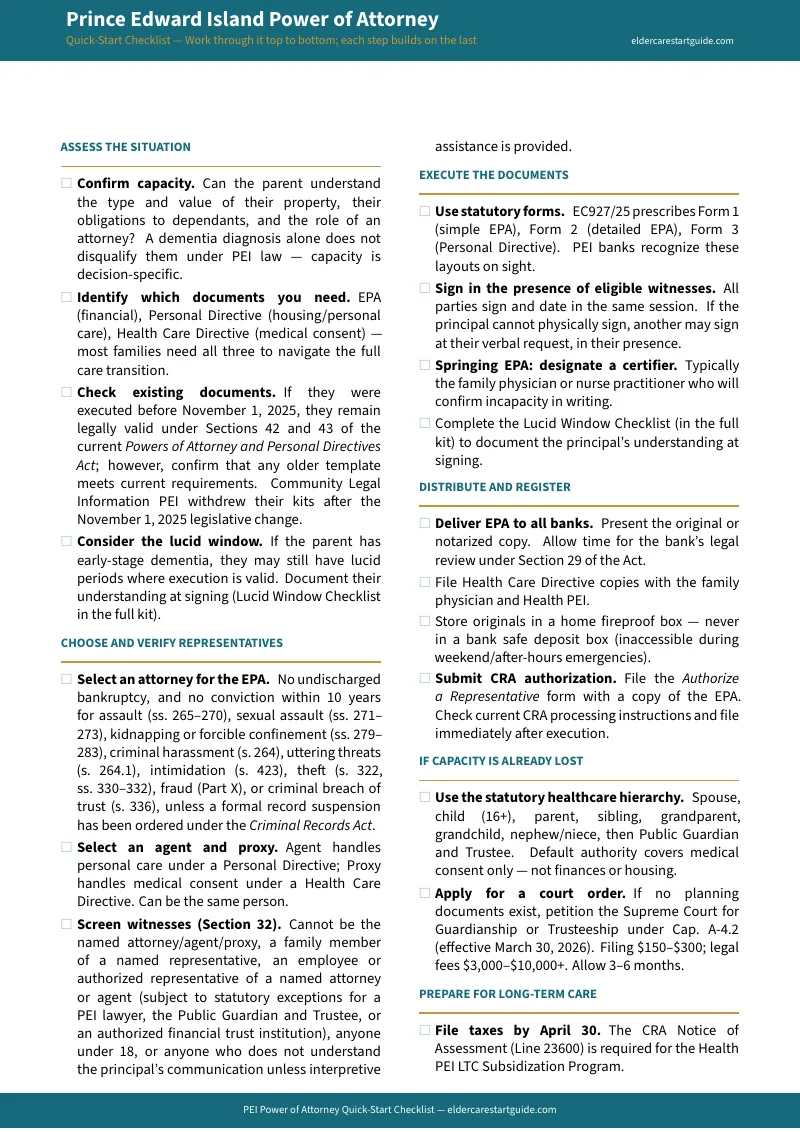
- Quick-Start Checklist (checklist.pdf) — overview of every step, form, and deadline across the voluntary (POA/Directive) and court (guardianship/trusteeship) pathways
- 6 Standalone Worksheets — printable tools designed to be used alongside the guide: Section 32 Witness Screening Sheet (verify every witness meets the eligibility requirements before signing day), Lucid Window Checklist (document the principal's capacity at the moment of signing), Financial Inventory Worksheet (compile assets, liabilities, income, and expenses for statutory accounting duties), LTC Subsidy Application Checklist (track every document Health PEI requires), Agency Communication Log (record every call, email, and meeting with Health PEI, CRA, banks, and legal offices), and Annual Compliance Calendar (month-by-month schedule of tax deadlines, subsidy reassessments, and court reporting obligations)
Who This Is For
- Adult children who need to manage an aging parent's finances, medical care, or living arrangements in Prince Edward Island — and discovered that being next of kin gives them no legal authority
- Families facing a Health PEI placement coordinator who requires three separate legal authorities before a long-term care transition can proceed
- Caregivers who want to execute planning documents while a parent still has capacity — especially during lucid intervals, since a dementia diagnosis does not automatically disqualify a parent from signing under PEI law
- Families who need to pursue court-supervised guardianship or trusteeship after capacity is already lost
- Anyone navigating the Health PEI Long-Term Care Subsidization Program — the income-based calculation, the 30-day application window, and the strategic timing of RRSP/RRIF withdrawals that can eliminate subsidy eligibility
- Siblings who need a neutral reference to decide who should serve as attorney, agent, and proxy without triggering family conflict
Why Free Resources Leave You Stuck
Health PEI provides a helpful advance care planning workbook and a basic Health Care Directive template, but they do not provide financial Power of Attorney forms — leaving you able to direct medical treatment but with no legal power to pay your parent's mortgage, access their bank accounts, or submit a subsidy application on their behalf. Community Legal Information of PEI, the non-profit that social workers and hospital staff used to recommend, withdrew all of their POA packages after November 1, 2025 because the new Act made their templates legally invalid. National online will services like Willful and Epilogue focus on wills and long-term estate planning — their POA options are designed for proactive planning, not for coordinating with Health PEI's LTC placement process during a hospital discharge crisis. Generic template sites like LawDepot deliver raw legal forms without guidance on navigating PEI's specific institutions, the LTC Subsidization Program, or the Section 32 witness eligibility rules that can invalidate your documents.
Elder law attorneys on the Island handle all of this — at $300 to $500 per hour, or $1,000 to $1,500+ for a full document package. A court-ordered guardianship runs $3,000 to $10,000+ in legal fees alone. For families with straightforward authority needs — parent has capacity, no contested siblings, no complex estate restructuring — this kit delivers the same statutory forms and process knowledge at a fraction of the cost, preserving your family's savings for the care itself.
Satisfaction Guarantee
If the guide doesn't help you identify at least one legal pathway, document requirement, or subsidy strategy you weren't already aware of, email us for a full refund. No forms, no waiting period.
Start Securing Legal Authority for Your Parent Today
Download the free checklist to get the quick-start overview — or get the full guide for and have every statutory form reference, execution protocol, witness screening tool, subsidy calculation, and step-by-step procedure you need to secure legal authority over your aging parent's care in Prince Edward Island.