The hospital discharge planner just handed you a form and said "pick five long-term care homes." You have 48 hours.
Your parent is in an Ontario hospital bed, flagged as Alternate Level of Care. The care coordinator is explaining Bill 7. The words are blurring — "non-consensual placement," "$400 per day," "70 kilometres." You did not know this was legal. You did not plan for this. And nobody is explaining what your actual options are.
Maybe it is not a hospital crisis. Maybe your parent is still at home, and you are watching them decline — struggling with meals, forgetting medications, falling in the bathroom. You called Ontario Health atHome and got a clinical assessment, but the care hours they assigned are a fraction of what your parent needs. You are filling the gaps with your own time, your own money, and your own health. The average Ontario caregiver spends $758 per month out of pocket. Sixty-eight percent have reached their breaking point.
The Ontario continuing care system is one of the most complex provincial systems in Canada. Fourteen former regional organizations were merged into a single Crown agency. The long-term care waitlist has crossed 50,000 people. Bill 7 lets hospitals override your consent during placement. The co-payment structure has multiple tiers most families never learn about. And the legal authority rules — Power of Attorney, Substitute Decision Makers, the Consent and Capacity Board — are a maze of overlapping statutes that even hospital social workers do not fully explain.
The Ontario Continuing Care Navigator — a system-by-system roadmap built for the family doing this alone
The Arranging Elder Care in Ontario Guide is not a summary of government policy. It is a sequential action plan that walks you through every decision point in the Ontario continuing care system — from the first Ontario Health atHome referral to long-term care placement, Bill 7 hospital discharge, cost planning, and legal authority — in the order you will actually face them.
This is what makes it structurally different from the free government pages, the commission-funded placement agencies, and the $250-per-hour elder law consultations. Government portals explain rules. Placement agencies promote private retirement homes. Lawyers handle the legal slice. This guide covers the entire system in one document, translates the regulations into concrete steps, and tells you what to do at each stage — not just what the rules say.
What's inside the guide
- Ontario Health atHome Referral Playbook — the exact intake process, the 310-2222 number that works without an area code, how to frame your parent's situation during the call so the referral triggers a full clinical assessment instead of a minimal intake
- InterRAI Assessment Preparation Worksheet — the clinical tool measures cognitive performance (CPS2), physical function (ADLH), and caregiver risk (CaRE algorithm), and the scores directly determine home care hours and waitlist priority. The worksheet helps you document your parent's true daily challenges before the assessor arrives, because the 45-minute visit captures a snapshot — not the 3 a.m. falls and the missed medications
- Long-Term Care Waitlist Strategy — how the five priority categories work (Category 1 crisis through Category 5 standard), how to select your five preferred homes strategically, the 24-hour bed offer window, and the geographic and cultural factors that compress or extend wait times in your region
- Bill 7 Hospital Discharge Response Guide — the ALC designation, the consent override rules, the 70 km Southern / 150 km Northern radius, the $400/day fee, and word-for-word communication frameworks for discharge planners that protect your parent's preferences without triggering the fine
- Co-Payment Calculator and Rate Reduction Program Walkthrough — the basic, semi-private, and private room rate structure, the income-tested Rate Reduction Program for basic accommodation, the net-income formula including dependent deductions, and the application steps that could reduce your parent's long-term care bill by thousands of dollars
- Legal Authority Roadmap — Power of Attorney for Personal Care, the statutory SDM hierarchy under the Health Care Consent Act, capacity assessment rules (decision-specific under Ontario law), the Consent and Capacity Board appeal process, and the guardianship pathway when capacity has already been lost
- Facility Evaluation Framework — structured criteria for comparing long-term care homes beyond the brochure: staffing ratios, inspection history, resident and family council activity, cultural programming, and geographic accessibility for visiting family
- Complaint and Appeal Process — how to escalate when home care hours are reduced, when a facility violates care standards, or when a placement decision feels wrong — from the service provider organization to Ontario Health atHome supervision to the Health Services Appeal and Review Board (HSARB)
- 6 Standalone Printable Tools — caregiver risk assessment checklist, family alignment and decision worksheet, Ontario Health atHome intake call script, facility tour and quality check script, long-term care rate reduction worksheet, and agency communication log — designed to be printed and used at the point of action
Who this is for
- The adult child facing a hospital discharge crisis — your parent is flagged ALC and the discharge planner is pushing placement. You need to understand Bill 7 before Friday, not next month
- The primary caregiver running on empty — you are covering the gaps between what Ontario Health atHome provides and what your parent actually needs, and the math is not working anymore
- The family without a Power of Attorney — your parent's capacity is declining and banks, hospitals, and care facilities are refusing to speak with you. You need the legal authority roadmap now
- The out-of-province coordinator — your parent is in Ontario and you are managing everything from another province by phone and email. You need the system map, the right phone numbers, and the steps that work remotely
- The family weighing home care against facility placement — you are trying to understand what publicly funded home care actually covers, what private care costs to supplement it, and when long-term care placement becomes the safer choice
Why free tools and government websites are not enough
Ontario.ca explains that the Rate Reduction Program exists. It does not walk you through the net-income formula, the dependent deductions, or the application process. Ontario Health atHome's website lists intake phone numbers. It does not explain how to prepare for the interRAI assessment so your parent's actual functional needs are captured — rather than the sanitized version most seniors present when a stranger is evaluating them.
Free placement agencies like A Place for Mom operate on referral commissions from private retirement homes. They can arrange tours of $4,000-per-month private residences. They cannot help you navigate the publicly funded long-term care waitlist, apply for rate reductions, or respond to a Bill 7 discharge demand.
An elder law lawyer can draft a Power of Attorney — for $250 to $500 per hour. They handle the legal piece. They do not explain how the home care assessment works, how the waitlist priority categories function, or how to communicate with a hospital discharge planner.
This guide covers all of it in one place, for a fraction of one hour with any of those professionals.
Satisfaction guarantee
If the guide does not give you a clearer understanding of the Ontario continuing care system and a concrete plan of action for your family, email us and we will make it right. No forms, no conditions.
Get started now
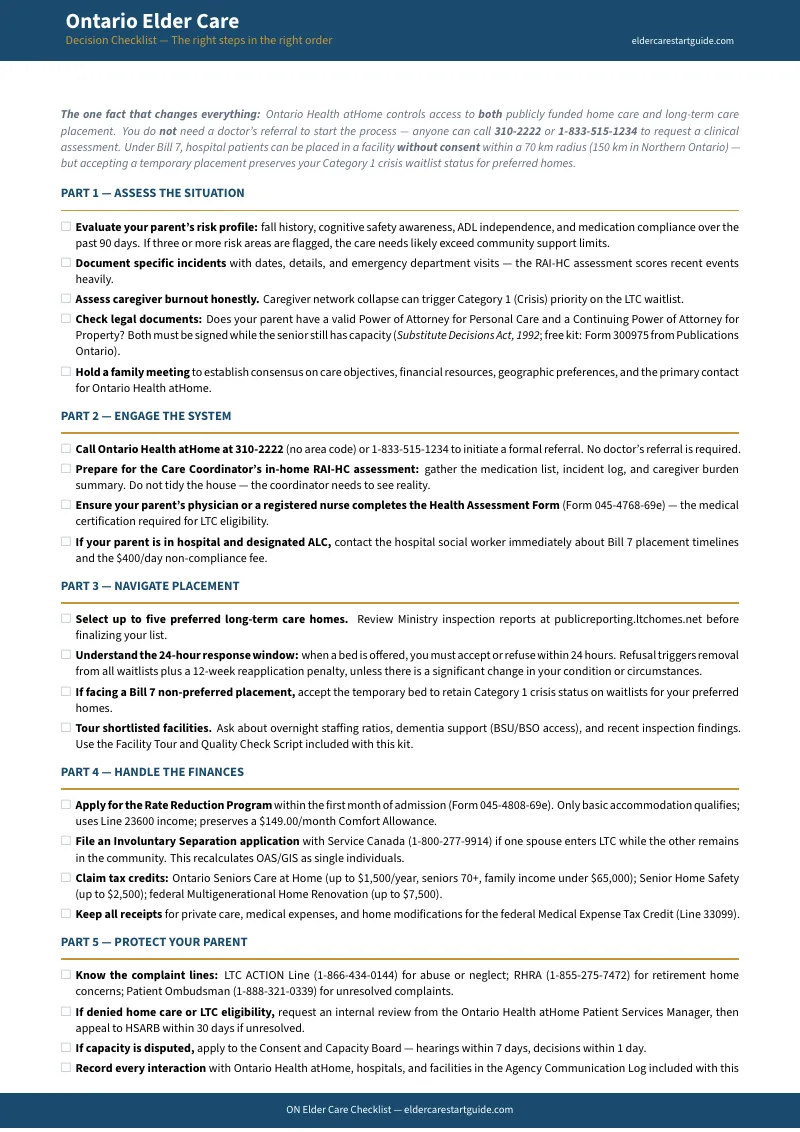
Download the free Ontario Elder Care Decision Checklist — a one-page action plan covering the most critical steps in priority order. If your family needs the full system — every assessment, every cost calculation, every legal step — the complete Arranging Elder Care in Ontario Guide is available for .
Your parent's care decisions should not be made under pressure, in a hospital hallway, with a discharge planner holding a stopwatch. They should be made with a plan.