Your Parent Needs Medical Care That Doesn't Exist in Nunavut. You Have No Legal Authority to Act When They Get There.
Your parent's dementia is progressing past what the community health centre can manage. Or the Home and Community Care coordinator just told you that your parent has exceeded the two-hour daily personal care cap — the territory's hard limit — and residential placement is the next step. The nearest appropriate bed is in Winnipeg, Ottawa, or Edmonton. Not Iqaluit.
The hospital down south has no digital access to your parent's Nunavut medical records. The charting systems are completely disconnected. The bank wants an Enduring Power of Attorney before they release pension funds for boarding-home costs. The social worker needs someone with legal authority to consent to treatment. But Nunavut has no statutory framework for healthcare proxies — you cannot simply sign a consent form on your parent's behalf.
And the Guardianship and Trusteeship Act requires you to be a Nunavut resident to serve as guardian. Which gets complicated when you have been living in Winnipeg for the past year because that is where your parent's care is.
The Cross-Border Legal Authority System
This kit is not a stack of blank forms. It is the process around the forms — the part that out-of-territory lawyers explain in a consultation that costs more than the kit itself, and that free government websites scatter across four different departments without connecting any of it.
It covers two paths: proactive planning (when your parent can still sign) and court-ordered guardianship and trusteeship (when capacity is already gone). And it connects both paths to the cross-border medical travel system, the Home and Community Care transition process, and the Inuit-specific supports that most national legal templates ignore entirely.
What's Inside
The kit includes a 14-chapter guide, a printable quick-start checklist, and 8 standalone worksheets you can print separately and bring to the signing appointment, the hospital, the bank, or the court — 10 PDFs total, covering every legal instrument, every institutional process, and every cross-border complication a Nunavut family faces:
- Enduring Power of Attorney Walkthrough (Form B) — Not just the form. Execution requirements, witnessing rules (the attorney and their spouse are barred from witnessing), the difference between Form A (springing) and Form B (enduring), and why Form B is almost always the right choice for aging-parent situations where you cannot afford a delay in a crisis. Includes a standalone POA Execution Checklist to bring to the signing appointment.
- The Personal Directive Gap — Nunavut is the only Canadian jurisdiction without statutory legislation for healthcare directives. A signed personal directive has no legal enforcement mechanism — but it is far from useless. The Guardianship and Trusteeship Act requires the court to consider your parent's prior written wishes when appointing a guardian. The kit explains how to draft a directive that carries maximum weight in court despite the statutory void.
- Cross-Border Medical Travel Authority Dossier — When your parent is medevaced south, the receiving hospital's clinical team has zero access to their Nunavut medical history. The kit provides a structured authority dossier framework that packages your legal documents, medical history summary, medication list, and decision-making authority into a format that out-of-territory institutions can process immediately — instead of making phone calls to a community health centre two time zones away. Includes a standalone printable dossier to pack in the medevac travel bag.
- Guardianship and Trusteeship Process — When capacity is gone and no Enduring POA exists, the Nunavut Court of Justice is the only path. The kit separates the two court orders (guardian for personal care, trustee for finances), covers eligibility rules including the "friendly personal contact within the past 12 months" requirement, and explains the landmark Eaton v. Eaton (2021 NUCJ 21) decision that protects families forced south for medical travel from losing their residency status. Includes a standalone Guardianship Filing Checklist.
- Home and Community Care Transition Map — The territory caps homemaking at five hours per week and personal care at two hours per day. Palliative care is the only exemption. When your parent exceeds those limits, the program formally recommends residential placement. The kit maps every step of the transition — from the initial assessment to out-of-territory facility admission — and identifies every point where you need legal authority to sign, consent, or authorize. Includes a standalone Home Care Transition Worksheet.
- Inuit-Specific Supports and Federal Jurisdiction — For families of First Nations or Inuit elders, the intersection of territorial and federal law creates additional complexity. The kit covers the Indian Act estate administration process, the role of Indigenous Services Canada for on-reserve dependents, the tikkuaqtaujuq (community advocacy) framework, and how Nunavut's Mental Health Act interacts with traditional support networks.
- Capacity Assessment Worksheet — A dementia diagnosis does not automatically strip legal capacity. The legal standard requires understanding at the moment of signing. The kit provides a practical worksheet for determining whether your parent can still sign — including guidance on obtaining a physician's capacity letter that protects against future challenges. Print and bring to the physician appointment.
- Financial Management Worksheet — Track every bank account, pension, government benefit, and monthly obligation under the POA. Includes the attorney's record-keeping obligations and a fillable table for your parent's complete financial picture.
- Emergency Action Card — A one-page card for the fridge or your wallet covering what happens in a medical emergency when no guardian exists, how to get temporary guardianship, and exactly who to call for every escalation scenario.
- Forms and Contacts Quick Reference — Every Nunavut legal form, government contact, regional Inuit association, and cost estimate on two pages. Print and keep with your parent's documents.
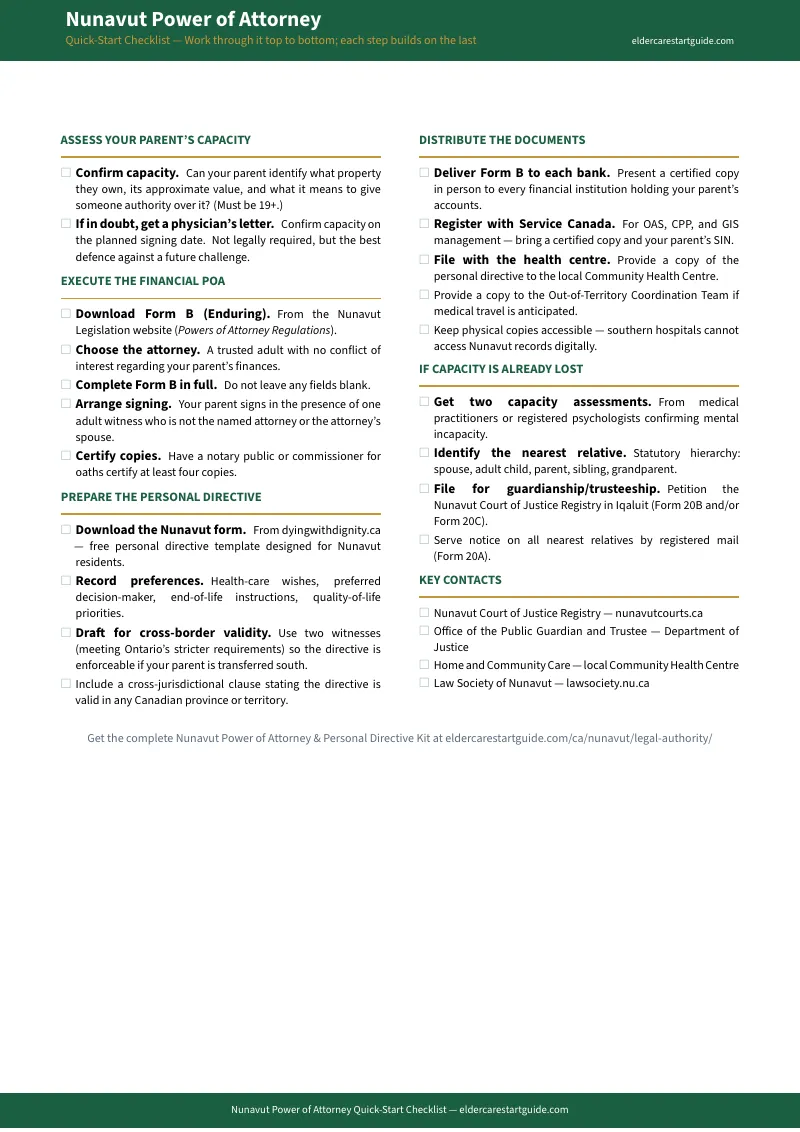
- Quick-Start Checklist — A printable, single-page action list organized into five sections. Start here when you need to know what to do today, this week, and this month.
Who This Kit Is For
- Adult children whose aging parent lives in one of Nunavut's 25 communities and needs care that exceeds what the local health centre can provide
- Families navigating medical travel to Winnipeg, Ottawa, or Edmonton who need legal authority that southern hospitals and banks will actually accept
- Caregivers whose parent can still sign and who want to set up an Enduring POA before the only option left is a court-ordered guardianship
- Families whose parent has already lost capacity and need to understand the guardianship and trusteeship application process
- Inuit families working with elders councils and Home and Community Care coordinators who need legal authority documented alongside cultural care preferences
Why Not Just Use Free Government Forms?
The Government of Nunavut publishes Form A (Springing POA) and Form B (Enduring POA) as free downloads. You can get them right now from the Nunavut Legislation website.
Here is what those forms do not tell you:
- That a personal directive signed in Nunavut has no statutory enforcement mechanism — and what to do about it
- That if your parent is medevaced to a Winnipeg hospital, the charting systems are completely disconnected and the clinical team has no access to Nunavut medical records
- That the witnessing rules bar the named attorney and their spouse — and that a document witnessed by either one is invalid, potentially forcing your family into the court guardianship process
- How to determine whether your parent still has the mental capacity to sign, or whether you have already crossed the line into guardianship territory
- How the Home and Community Care program's two-hour daily personal care cap triggers a residential placement recommendation — and what legal authority you need at each step of the transition
The forms are the first step. This kit covers every step that comes after.
Satisfaction Guarantee
If this kit does not give you a clearer path forward for your parent's care, email [email protected] and we will make it right.
— Less Than One Hour of an Out-of-Territory Lawyer's Time
Nunavut does not allow law professional corporations — the only Canadian jurisdiction with this restriction. That means fewer lawyers physically located in the territory, higher fees, and most families hiring counsel from southern provinces who may not understand local rules around notary requirements, medical travel authority, or the personal directive gap. This kit puts the exact process, templates, and strategy into your hands for a fraction of a single consultation.
Includes the full 14-chapter guide, the quick-start checklist, and 8 standalone printable worksheets — 10 PDFs total. Download instantly. Print the checklist and start working through it this afternoon — while your parent's capacity window is still open.