
The Bank Will Not Let You Pay Your Parent's Bills. The Hospital Wants to Know Who Has Authority to Consent. Continuing Care Is Asking for a Legal Representative — and You Are Holding a Blank Form You Downloaded at 2 AM.
Your parent's decline was gradual until it was not. Maybe the bank teller told you they cannot share account information without a valid Power of Attorney. Maybe the hospital discharge planner informed you that your parent is medically stable and must leave — and nobody can sign the placement agreement. Or maybe you just realized that "next of kin" does not mean what you thought it meant in Nova Scotia.
Nova Scotia splits decision-making authority into two separate legal instruments: an Enduring Power of Attorney (EPOA) for finances and a Personal Directive for healthcare and personal care. After the July 2022 amendments to the Powers of Attorney Act, documents drafted under the old rules are invalid for new signings. And if your parent has already lost capacity, neither document can be created — the only remaining path is a representation order through the Supreme Court of Nova Scotia under the Adult Capacity and Decision-making Act, a process that typically costs $5,000 or more.
The Nova Scotia Power of Attorney & Personal Directive Kit is a Legal Authority Navigation System — a step-by-step roadmap that walks you from capacity assessment through document execution, bank acceptance, Continuing Care coordination, Caregiver Benefit qualification, and long-term care placement. Not a blank template with no instructions. Not a national overview that mentions Nova Scotia in a footnote. A province-specific manual built on the Powers of Attorney Act (2022 amendments), the Personal Directives Act, and the Adult Capacity and Decision-making Act — covering every requirement, every institutional barrier, and every financial trap in the order Nova Scotia families actually encounter them.
What's Inside the Legal Authority Navigation System
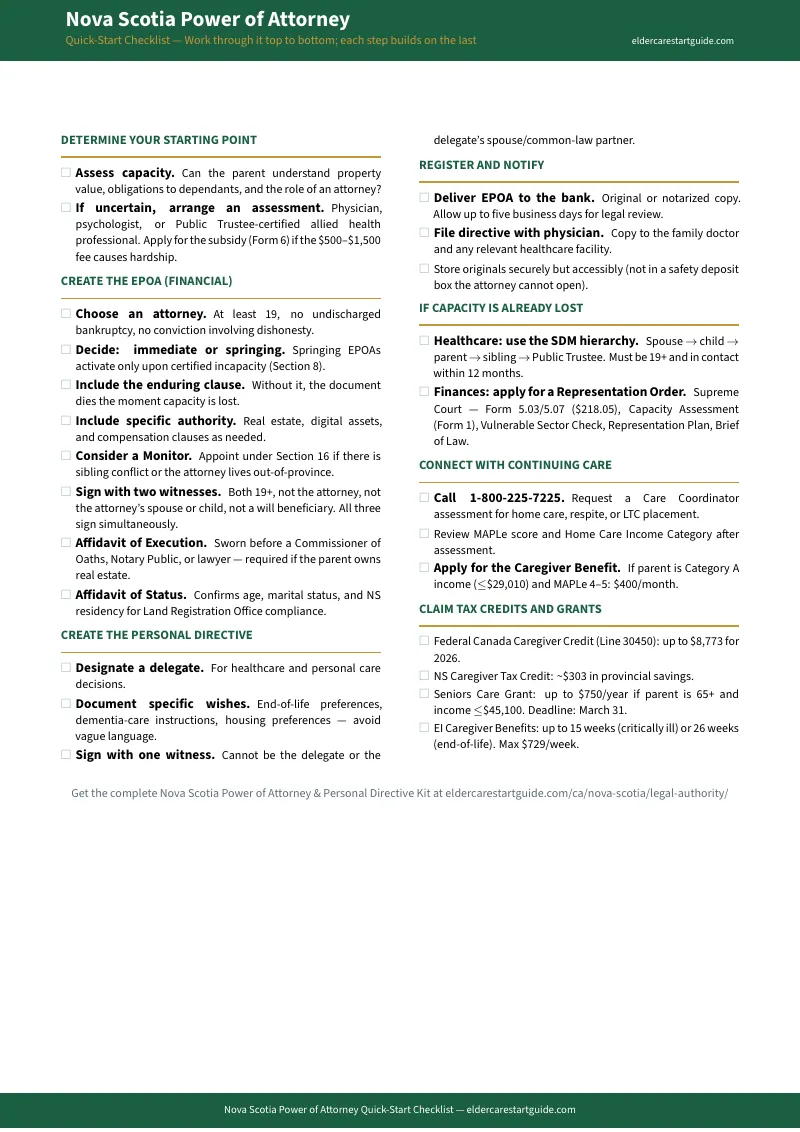
A 15-chapter guide, 10 standalone printable worksheets, a decision flowchart, and a 20-item quick-start checklist — covering every legal pathway for acting on behalf of an aging parent in Nova Scotia:
The Two-Document System and the July 2022 Watershed
Most Nova Scotia families assume a single document covers everything. It does not. The EPOA handles finances. The Personal Directive handles healthcare and personal care. The guide starts by explaining exactly where each document's authority begins and ends — because using the wrong one at the bank or the hospital means getting turned away. It also explains why any EPOA template created before July 7, 2022 is now invalid for new signings, and what the amended statute requires.
Creating the Enduring Power of Attorney — 2022-Compliant
The 2022 amendments introduced strict new requirements: two independent witnesses (not one), suitability restrictions on the appointed attorney (no undischarged bankruptcy, no criminal conviction involving dishonesty), codified capacity standards for the donor, and rules around "springing" powers that activate only upon certified incapacity. The guide walks through every requirement so the finished document survives bank compliance review — because a rejected EPOA means your parent's bills go unpaid while you start over.
Real Estate Transactions Under an EPOA
If the parent owns property in Nova Scotia, the EPOA must include a notarized Affidavit of Execution before the Land Registration Office will accept it. This single requirement trips up more families than any other step. The guide explains the affidavit process, registration requirements, and what happens when a property sale needs to proceed while the parent is in a care facility.
Creating a Personal Directive
The Personal Directive covers healthcare consent, nutrition preferences, housing placement decisions, and end-of-life care instructions. It requires one independent witness and a named delegate who is at least 19 years old and willing to serve. The guide explains how to write directives that are specific enough to actually guide medical teams — because vague instructions like "do what's best" leave care providers guessing and families arguing.
Getting Banks to Accept Your EPOA
Canadian banks have internal compliance protocols that routinely delay or reject valid EPOAs. The guide covers why banks refuse documents, the standard five-business-day compliance review window, the risk of signing a bank-specific POA form that accidentally revokes your comprehensive estate document, and a step-by-step escalation protocol — from branch manager to client care ombudsperson — when front-line staff refuse to honour a valid instrument.
When Capacity Is Already Lost — Court Representation Orders
If the parent can no longer sign legal documents, the guide maps the two remaining pathways: the Adult Capacity and Decision-making Act (for a representation order through the Supreme Court) and the statutory decision-maker hierarchy under the Personal Directives Act (which may provide temporary healthcare decision authority without court involvement). It explains the costs, timelines, and documentation required for each — so you know which path applies before you spend money on the wrong one.
Navigating Continuing Care, the Caregiver Benefit, and Long-Term Care Placement
The guide walks through Nova Scotia Health's Continuing Care intake process (the 1-800-225-7225 call), the clinical assessment that determines placement priority and subsidy eligibility, the Caregiver Benefit qualification criteria ($400/month — income thresholds and MAPLe scoring), hospital discharge rules including the "First Available Bed" policy and ALC fees, and the long-term care financial assessment that determines accommodation charges based on net income over the past two years.
Who This Guide Is For
- The adult child whose parent can still sign — who needs to execute a 2022-compliant EPOA and Personal Directive correctly before capacity declines further, and who wants the documents to survive bank compliance review on the first try
- The family facing a hospital discharge crisis — whose parent must leave the hospital bed and needs to understand placement authority, the First Available Bed policy, and how to avoid accepting an unwanted facility 100 kilometres away
- The caregiver trying to access the Caregiver Benefit — who needs to understand the income thresholds and MAPLe clinical scoring to qualify for $400 per month in provincial support
- The family whose parent has already lost capacity — who needs to know whether the statutory decision-maker hierarchy or a court representation order is the right path, and what each one costs
- The sibling dealing with family conflict over care decisions — who has discovered that disagreements among next-of-kin can freeze medical decisions entirely until the Public Trustee is contacted
Why Free Templates Will Not Get You Through This
Nova Scotia legal authority information exists. It is scattered across novascotia.ca, the Legal Information Society of Nova Scotia (LISNS), hospital social worker handouts, and elder law firm blogs. Here is what happens when you try to navigate this system using free sources alone:
- LISNS publishes accurate blank templates without process guidance. You can download an EPOA form or a Personal Directive form. Nobody explains how to handle bank compliance review, what to do when front-line staff refuse the document, how the forms interact with Continuing Care intake, or which authority grants you need before you can apply for the Caregiver Benefit on your parent's behalf.
- Nova Scotia Health publishes clinical pathway information without legal context. The Continuing Care website explains how to call the intake line and what services are available. It does not explain which legal documents you need before the coordinator will speak to you about your parent's care, or how the financial assessment interacts with your authority under the EPOA.
- Elder law firm blogs are accurate and designed to sell retainers at $260+ per hour. Every article about capacity assessment or representation orders ends with "contact our office." The content explains how complex these processes are — and they are — but it rarely tells you that arriving at the consultation with your capacity documentation, financial inventory, and authority requirements already organized saves hours of billable time.
- National platforms generate legal documents but leave you on your own. Willful and LegalWills produce valid templates for $99–$199. They do not explain how to navigate bank acceptance, optimize a MAPLe score during clinical assessment, handle hospital discharge pressure, or qualify for the Caregiver Benefit.
Free resources give you blank forms from one source and general information from another. The Legal Authority Navigation System puts every Nova Scotia-specific statute, execution requirement, institutional process, and financial protection strategy into one document, in the order you actually encounter them.
— Less Than One Hour With an Elder Law Attorney
An initial consultation with a Nova Scotia elder law attorney runs $260 or more. A full court representation order under the ACDMA costs $5,000+. This guide costs less than one hour of professional time and gives you the complete Nova Scotia legal authority roadmap — every 2022-compliant execution requirement, every bank acceptance protocol, every Continuing Care navigation step, and the financial protection strategies that connect them.
Your download includes the 15-chapter guide, the 20-item quick-start checklist, and 10 standalone printable worksheets — EPOA Execution Checklist, Personal Directive Checklist, Bank Acceptance Protocol, Capacity-Lost Pathways comparison, Home Care Fee Schedule, Caregiver Benefit Worksheet, Long-Term Care Cost Worksheet, Tax Credits & EI Benefits Reference, Official Forms & Resources Directory, and Decision Flowchart.
30-day money-back guarantee. If the guide does not give you clarity on which legal authority path applies to your family, how to execute the documents correctly, and how to navigate the institutions that stand between you and your parent's care — email us for a full refund. No questions asked.
Not ready for the full guide? Download the free Nova Scotia — Power of Attorney Quick-Start Checklist — a step-by-step overview covering capacity assessment, the two-document system, execution requirements, and what to do if capacity is already lost. Enough to understand which path you are on and what comes next.
You did not ask for this responsibility. But your parent needs someone who understands Nova Scotia law — and the system is not going to explain itself. This guide does.